
To address bitcoin's "quantum crisis," conservatives and radicals are already at odds

Arguing over upgrade issues has become a tradition in the Bitcoin community, and this time the debate is about "whether we should worry about quantum computing."
Written by: Eric, Foresight News
Readers who follow cutting-edge technology are likely somewhat aware of this year’s progress in quantum computing. Like AI, this so-called "technological revolution" that has been hyped for years finally saw a breakthrough this year. Simply put, quantum computing has now moved from being a physics problem to an engineering problem, marking a turning point from laboratory research to commercialization. This year has also been designated by the United Nations as the International Year of Quantum Science and Technology.
Technological breakthroughs are good news, but the bad news is that quantum computing is closely tied to Bitcoin’s survival. Once computing power reaches a certain threshold, public keys exposed on the network could have their private keys brute-forced by quantum computers, which could deal a devastating blow to Bitcoin.
If previous discussions about quantum computing were still stuck on "Will it affect Bitcoin?", this year’s debate has already evolved to "What should we do about it?" Major issues in the Bitcoin community have always sparked heated debates—from block size expansion to the Lightning Network, and then to the Taproot upgrade—each time the arguments have been fierce, and this time is no exception.
Interestingly, the core of this debate is not about which solution is better, but rather about the level of concern. Given that past debates were all about making Bitcoin better, and this time it’s about survival, the radicals believe Bitcoin’s leaders are too optimistic. If they don’t take this seriously and come up with a solution quickly, irreversible damage could occur due to lack of preparation. The conservatives, on the other hand, think the radicals are making a mountain out of a molehill—Bitcoin has always found a way forward, and this time will be no different.
What’s even more different from previous discussions is that this time, some prominent figures have elevated the debate to the level of community culture, sharply pointing out: the Bitcoin community can no longer handle criticism.
Radicals: "The emperor is not anxious, but the eunuch is"
The representative of the radical camp is Nic Carter, founding partner of Castle Island Ventures. As Fidelity’s first crypto asset analyst and a VC founder who has invested heavily in Bitcoin ecosystem projects, Nic’s opinions carry some weight in the Bitcoin space.
Nic’s concern is not that Bitcoin developers can’t come up with a solution, but rather, based on past experience: if action isn’t taken soon, Bitcoin may not complete a quantum-resistant upgrade before quantum computing matures.
Nic points out that many quantum computing companies predict that by the mid-2030s, fully functional and scalable quantum computers could be built. The U.S. government’s official standards body, NIST, has already recommended that government agencies worldwide gradually phase out quantum-vulnerable cryptographic schemes, such as ECC256, by 2030, and completely stop relying on them by 2035.
It’s worth noting that these are just predictions; private companies are unlikely to fully disclose their progress, and one day may suddenly announce a major breakthrough, just like with AI. Nic believes that in the face of such unpredictable threats, Bitcoin developers should act immediately.
The uncertainty of when technological breakthroughs will occur is just one reason for Nic’s sense of urgency. The second reason is that reaching consensus in the Bitcoin community on a quantum-resistant solution and how to migrate at-risk bitcoins will obviously be a massive challenge that will take years of discussion.
Nic notes that the SegWit and Taproot upgrades took two and three years respectively from proposal to activation, and the complexity of a "post-quantum" upgrade is clearly much higher. Replacing the core cryptographic technology of the protocol would change almost every aspect of the system, including how users interact with it. In addition, if an upgrade does happen, how should addresses that have been dormant for years be handled? Should those bitcoins be frozen, or should we simply let the more than 1.7 million bitcoins that are confirmed "lost" be handed over to whoever can claim them?
These are obviously time-consuming issues, not to mention the need to allow enough time for as many people as possible to learn that they need to transfer their bitcoins to new addresses. Nic estimates that completing all these tasks would take about 10 years. If quantum computing really does achieve a breakthrough within 10 years, then Bitcoin’s quantum-resistant upgrade needs to start now.
What truly worries Nic is not the inaction of Bitcoin developers, but rather that this indifference stems from a pathological caution in the development culture. Nic believes that, in order to avoid unpredictable risks to Bitcoin, upgrade choices are ideologically driven—relying as little as possible on third-party libraries and restricting features like scripting languages. Since 2017, Bitcoin has only had two major upgrades, both accompanied by significant controversy and infighting, which perfectly illustrates this paranoid reluctance to change Bitcoin.
Conservatives: I know you’re anxious, but don’t be in a hurry
In response to Nic’s criticism, Adam Back, co-founder of Bitcoin development company Blockstream and inventor of the PoW mechanism, seemed unfazed. Under Nic’s post on X, Adam bluntly stated that Nic was either ignorant or malicious: either you don’t understand the work we’re doing, or you’re deliberately spreading panic.
Adam said that Blockstream has been actively involved in PQ (post-quantum) application research, but it’s not as simple as writing a BIP and pushing a "PQ signature scheme." Blockstream is focused on analyzing its applicability and first optimizing hash-based schemes for specific domains. In addition, Blockstream team members have contributed to the security proof of SLH-DSA (Stateless Hash-Based Digital Signature Algorithm, one of the post-quantum cryptography standards released by NIST in August 2024), so they are fully capable of solving this problem.
Adam said that what they need to do now is determine a safe and conservative quantum-resistant scheme. If they hastily choose a scheme that is later proven unsafe, the damage would be even greater. Adam believes that Nic is acting this way partly because Bitcoin developers are very low-key and don’t share their research on social media, leading Nic to be unaware of the latest progress. Adam also hinted that Nic is trying to spread panic.

Nic’s post on X was actually a summary of his research report of over 20,000 words. Adam’s way of rebutting without reading the report directly angered Nic, who lashed out at this elitist arrogance in his reply, making it clear: read it before you comment.

Objectively speaking, Adam’s answer seems to be somewhat evasive. He didn’t directly answer whether Bitcoin could solve the problem in time if quantum computing made a qualitative breakthrough within 10 years, but kept emphasizing that they have made progress and cannot act rashly. Some people expressed similar views in the comments. A user named BagOfWords on X said: "The problem is, if they’re wrong, Bitcoin will get quantum resistance faster; but if you’re wrong, we’ll have to act in a hurry, and real panic will break out, which is worse than panic-mongering. Honestly, the migration speed is indeed very slow."
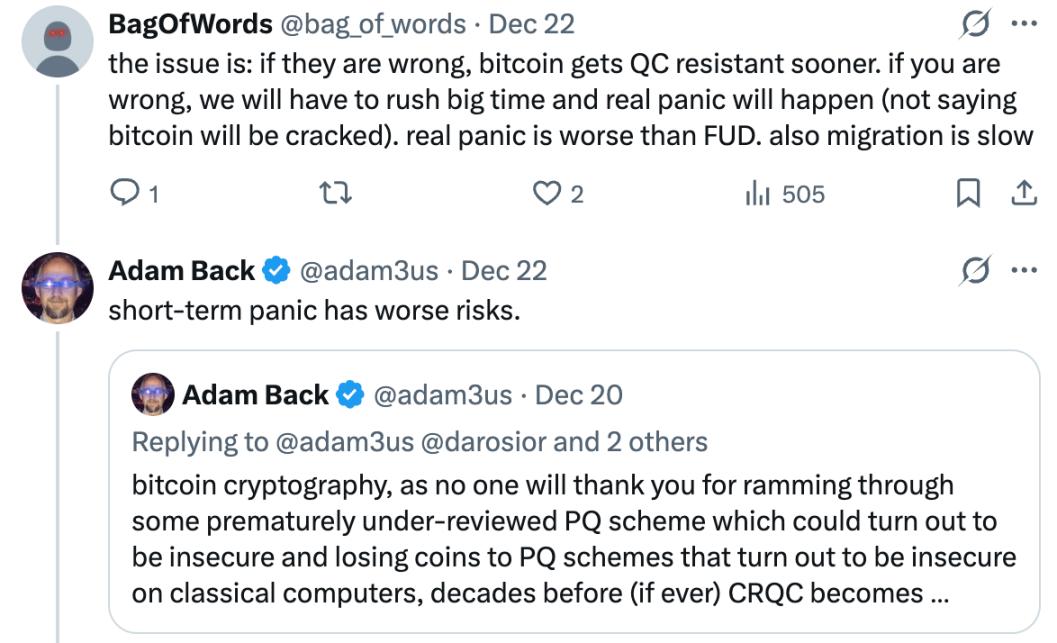
Adam’s response was, "Short-term panic brings more serious risks." It’s unclear whether the so-called risks refer to price risks or concerns that short-term panic would force developers to hastily choose a quantum-resistant scheme that may not be fully proven effective. However, this answer does convey the "arrogance" Nic mentioned.
However, Adam’s concerns are not entirely unfounded. Although quantum computing has entered the engineering stage, it’s still unclear what it will ultimately become. If a quantum-resistant scheme is hastily adopted now and later proves ineffective against quantum computing or is overkill, it could indeed create more problems. We don’t know whether Bitcoin developers’ lack of urgency comes from technical confidence or something else, but Nic’s "early action" attitude clearly resonates more with the general public’s instincts.
Industry OG: There really is a problem with Bitcoin community culture
The two figures mentioned above are just representatives of their respective camps. The two sides have been debating this topic on various platforms for nearly a year. Meanwhile, Hasu, advisor to Flashbots, Lido, and Stakehouse, and a crypto OG researcher, used the debate to point out the root problem currently facing the Bitcoin community.
In an article posted on X, Hasu described the issue as follows: Bitcoin culture has long ensured that its core rules are not easily changed, but over time, this culture has evolved into a "refusal to change."
Bitcoin faces two long-term risks: one is the "quantum crisis," and the other is the economic model shifting to fee-driven incentives as block rewards continue to decrease. Hasu admits that he is not sure whether these two risks can be properly resolved. The reason, Hasu believes, is that the culture that has formed in Bitcoin over the long term has made it politically incorrect to say "Bitcoin has problems" or even just "Bitcoin could be improved in some ways."
Although he didn’t state the reason explicitly, the author speculates that this culture stems from Bitcoin’s long-term marginalization by the mainstream in its early days. After gaining recognition, many so-called "believers" who have supported Bitcoin for a long time fostered a quasi-religious culture within the community. This culture has led to the mythologizing of Bitcoin to the point where it cannot tolerate even a grain of sand—a pathological release after years of repression, to some extent.
Hasu further explains that this extreme culture makes it easier for gradualists to gain recognition and influence in the community, while relatively radical and bold suggestions or proposals become increasingly rare. Even in discussions about the quantum crisis, many relatively professional individuals describe it as "alarmist," while very few actually simulate possible consequences and explore solutions. This description matches Adam’s attitude very well.
Regarding this issue, Hasu’s solution is also very reasonable. He believes that Bitcoin’s "rigidity" should be a strategy, not a belief. This strategy can remain highly neutral, but there also needs to be a "contingency plan"—that is, when a truly threatening risk arises, there should be a clear allowance for criticism and questioning without being condemned, and the ability to mobilize resources to immediately start defensive work.
Finally, Hasu states that pretending tail risks don’t exist does not make Bitcoin stronger; it only weakens its ability to respond when tail risks move beyond the theoretical level. What the Bitcoin community should focus on now is cultural adjustment: how to remain cautious while also being able to respond to fragility at any time.
Disclaimer: The content of this article solely reflects the author's opinion and does not represent the platform in any capacity. This article is not intended to serve as a reference for making investment decisions.
You may also like
Bitcoin Price Prediction: Critical $67K Warning Looms as Weekly Dead Cross Pattern Threatens BTC
XRP and ADA Survival Warning: Galaxy Digital CEO Reveals Critical Utility Test for 2025 Crypto Market
Bitcoin Options Expiry Unleashes Crucial Price Normalization After $23.6 Billion Market Shift
Trending news
MoreCrypto prices
More





