
Base’s 2025 report card: Revenue grows 30 times, consolidating its leading position among L2s

Original Title: Are you Based? Base's Outlook for 2026
Original Author: AJC, Messari
Original Translation: Tim, PANews
In 2025, Base further solidified its leading position as the top Ethereum L2 across multiple data metrics. Among these, revenue is the most telling indicator of its dominance within the entire L2 ecosystem.
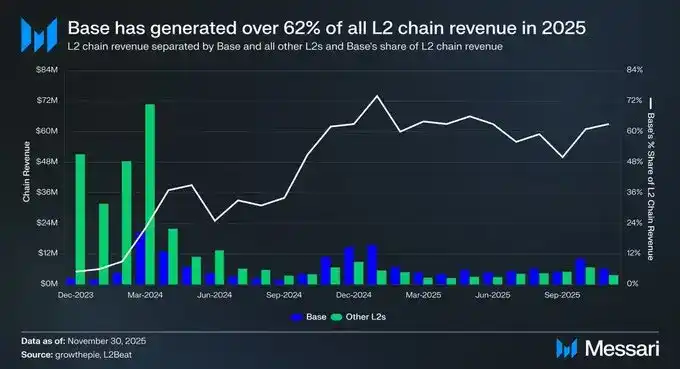
Although total L2 revenue has dropped significantly from its 2024 peak, Base continues to dominate the L2 market. In December 2023, Base's on-chain revenue was $2.5 million, accounting for only 5% of the total L2 revenue of $53.7 million. A year later, Base's on-chain revenue grew to $14.7 million, making up 63% of the total L2 revenue of $23.5 million in December 2024. This trend has continued into 2025, with Base achieving $75.4 million in revenue year-to-date, accounting for 62% of the total L2 revenue of $120.7 million.
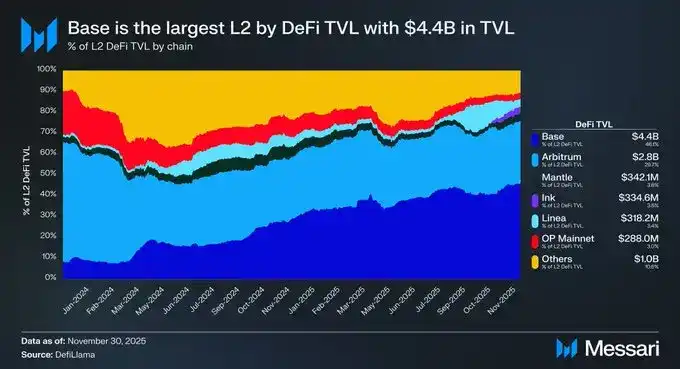
Base's leading advantage is not only reflected in revenue; its DeFi TVL has also become the frontrunner in the L2 sector. After surpassing Arbitrum One in January 2025, Base now holds $4.63 billion in DeFi TVL, accounting for 46% of the entire L2 market. Notably, Base's share of DeFi TVL has continued to rise throughout 2025, steadily increasing from 33% at the beginning of the year to its current level.
Base's greatest advantage over other L2 solutions lies in its distribution channel, the importance of which cannot be overstated. According to Coinbase's latest 10-Q filing, it had 9.3 million monthly active trading users in the third quarter, enabling Base to directly reach a large and already onboarded user base—something other L2 networks can hardly match. While most L2s must acquire users through incentives or third-party integrations, Base enjoys a natural distribution advantage thanks to its direct connection with the largest centralized exchange in the US.
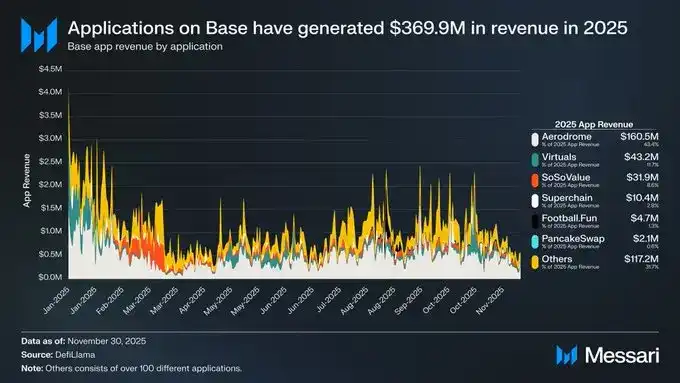
Base also stands out for the large-scale development of applications within its ecosystem that create real value. So far this year, applications in the Base ecosystem have generated $369.9 million in revenue. Notably, application revenue is mainly concentrated in Aerodrome, which contributed $160.5 million, accounting for 43% of total application revenue. However, the leading DEX on Base is not the only successful application in 2025.
The AI agent launch platform Virtuals has achieved $43.2 million in revenue, accounting for 12% of Base ecosystem application revenue; meanwhile, the recently launched sports prediction app Football.Fun has already generated $4.7 million in revenue. These figures indicate that Base has formed a portfolio of revenue-generating products across multiple fields, and ecosystem activity does not rely on a single application or use case.
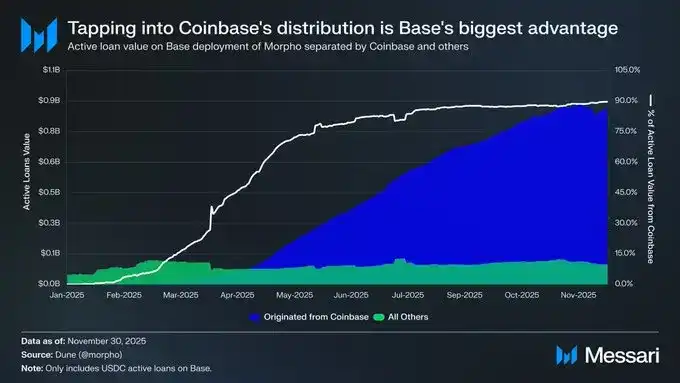
This distribution advantage is best exemplified in the collaboration between Coinbase and Morpho. This partnership allows Coinbase users to borrow USDC directly on the platform using crypto assets as collateral. While the user experience is embedded within the Coinbase website, collateral management and loan execution are all completed on-chain via Morpho's deployment on Base. This lending product has been live for less than a year, but adoption is already quite high.
Coinbase users have applied for $866.3 million in loans through Morpho, currently accounting for 90% of Morpho's active loans on the Base network. During the same period, Morpho's TVL on Base grew by 1,906% within the year, rising from $48.2 million to $966.4 million. Base's distribution advantage means that on-chain activity can become a byproduct of Coinbase product usage. This user acquisition channel is not available to other L2 networks, which means they mainly rely on incentive programs to attract liquidity and users to their DeFi ecosystems.

Although Base's DeFi TVL has continued to grow since 2025 and on-chain revenue remains stable, user on-chain behavior has begun to change. According to the number of daily filtered users (referring to unique addresses that conduct at least two transactions on a specific contract and consume more than 0.0001 units of gas in a single day), USDC has now become the most widely used application on Base, with an average of 83,400 daily users in November, a 233% year-on-year increase from 25,100 a year ago.
Meanwhile, retail interactions with DEXs have dropped significantly. The daily filtered user count for Uniswap and Aerodrome fell by 74% and 49%, respectively. More notably, DEX trading volume on Base hit a record high in 2025, indicating that activity on Uniswap and Aerodrome is increasingly concentrated among traders with larger capital and higher trading volumes.
Base's Key Layout for 2026: Base App
Base's natural advantage from Coinbase is a luxury that other chains can hardly match. It has already established a solid moat in terms of user base, liquidity, and application ecosystem. Base leads in revenue among L2 networks, boasts the deepest DeFi TVL in the sector, and continues to receive on-chain user traffic from Coinbase. In other words, unlike most L2 networks that are still struggling to gain a foothold or attract users, Base has already moved beyond this development stage.
With this moat, Base is now looking beyond core L2 network metrics and targeting the creator economy. If this market opportunity is seized, the potential total market size is expected to approach $500 billion. To capture this direction, Base's core strategy focuses on the Base App. This "super app" aims to integrate asset custody, trading, social, and wallet core functions into one. Unlike most crypto wallets, Base App is equipped with several innovative features that go beyond basic asset management:
· Social information feed based on Farcaster and Zora;
· Direct messaging and group chat functions via XMTP (supporting interactions with other users and AI agents like Bankr);
· Built-in mini-app discovery feature, allowing users to access and use various mini-apps directly within Base App.

Base App launched its internal beta in July, initially limited to users invited via whitelist. Nevertheless, Base App has achieved significant growth. A total of 148,400 users have created accounts, with registrations accelerating in November, up 93% month-on-month. User retention is also strong, with 6,300 weekly active users (up 74% month-on-month) and 10,500 monthly active users (up 7% month-on-month). Although not officially confirmed, Base App is likely to end its internal testing phase this month, paving the way for a full public launch before the New Year.
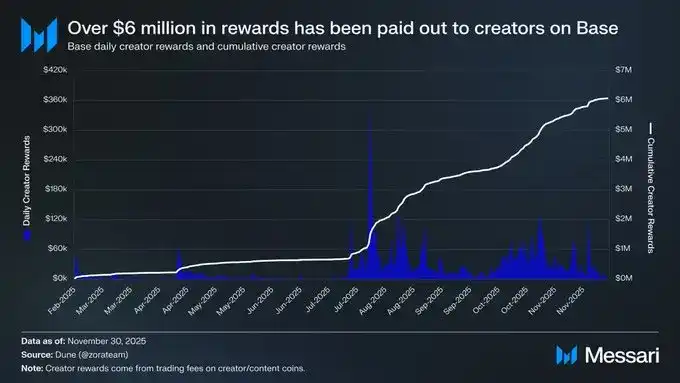
The most important goal of the on-chain economy that Base is trying to build is to enable creators to profit directly from the content they create. Content created in Base App is tokenized by default (although users can opt out), turning each post into a tradable market. Creators can earn a share of the transaction fees generated by their content, specifically 1% of each transaction.
Looking ahead, users will also be able to issue creator tokens for their accounts directly within Base App, opening up another monetization avenue (this feature is currently in early testing). At the technical level, both creator tokens and content tokens are tokenized based on the Zora protocol. To date, creators have earned a total of $6.1 million through Zora's tokenization model, with an average monthly payout of $1.1 million since July.
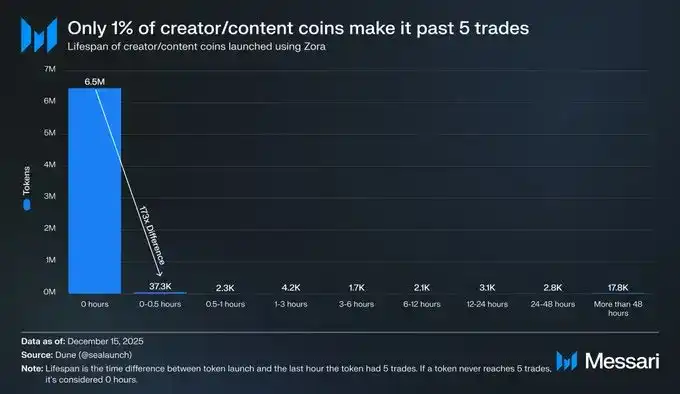
So far, the total number of creator and content tokens tokenized via Zora has exceeded 6.52 million. Of these, 6.45 million (about 99% of the total) failed to achieve five trades. Only 17,800 tokens (0.3% of the total) remained actively traded 48 hours after issuance.
Before interpreting these figures, it's important to understand a basic fact: the vast majority of content published on the internet is essentially worthless. From this perspective, the fact that 99% of tokens failed to attract market attention may simply reflect the natural distribution of online content, rather than a structural flaw in the Base model. What truly matters are those tokens that survive beyond 48 hours. We believe that if a creator or content token continues to trade after 48 hours, it signals that the creator or content itself has real value.
In other words, Base has so far made little splash in the creator economy. Only 17,800 creator and content tokens have shown sustained activity, which is a drop in the ocean compared to the massive amount of content produced online every day. Pessimists may think this model simply doesn't work, but optimists believe that while Base's penetration into the creator economy is currently close to zero, there is huge room for growth if improvements are made in content distribution, discovery, and functional tools. In any case, increasing the number of tokens that survive more than 48 hours should be Base's main focus in 2026.
Finally, Base may also have the most effective incentive mechanism in the crypto market: tokens. In September this year, Base confirmed it is exploring token issuance, but has not yet announced specific details regarding distribution, utility, or a possible launch date. The most notable aspect of the Base token is not the token itself, but its application scenarios. Unlike most L2s, Base does not need to rely on tokens to attract liquidity. Instead, it can use tokens to incentivize on-chain creator participation, rewarding behaviors that drive user engagement, content creation, and social activity, rather than short-term trading.
In summary, with its established L2 core ecosystem, Base is leveraging its distribution channels, product coverage, and potential token incentives to move forward and explore consumer- and creator-oriented application cases. If this strategy succeeds, Base will build a moat around social and creator ecosystems. This moat will be stickier for users than DeFi TVL or stablecoin balances—something other L2s have yet to achieve.
Disclaimer: The content of this article solely reflects the author's opinion and does not represent the platform in any capacity. This article is not intended to serve as a reference for making investment decisions.
You may also like
SEI Network Holds $0.10 Support as Traders Eyes $0.115 Breakout
Watch Cryptocurrency Titans Clash in 2025: TRON Vs. Zcash Showdown
BTC Price Holds Firm as Altcoins Bleed—Is the Capital Rotating Back to Bitcoin?
Grayscale Sees Chainlink as Key Infrastructure for RWA Tokenization
Trending news
MoreCrypto prices
More





