
TRM Labs Underscores Venezuela's Positive Crypto Adoption in a Risky Ecosystem

In a recent report, TRM Labs sustained that organic adoption dominates trading volumes, as stablecoins have become a key driver for Venezuelans navigating economic instability and exclusion from traditional global settlements and payments platforms, even in an ecosystem with structural risks.
TRM Labs: Venezuela’s Organic Crypto Adoption Surpasses Illicit Activity
TRM Labs, a global blockchain forensics and analytics firm, has discussed the current state of the cryptocurrency ecosystem in Venezuela against a backdrop of increased sanctions.
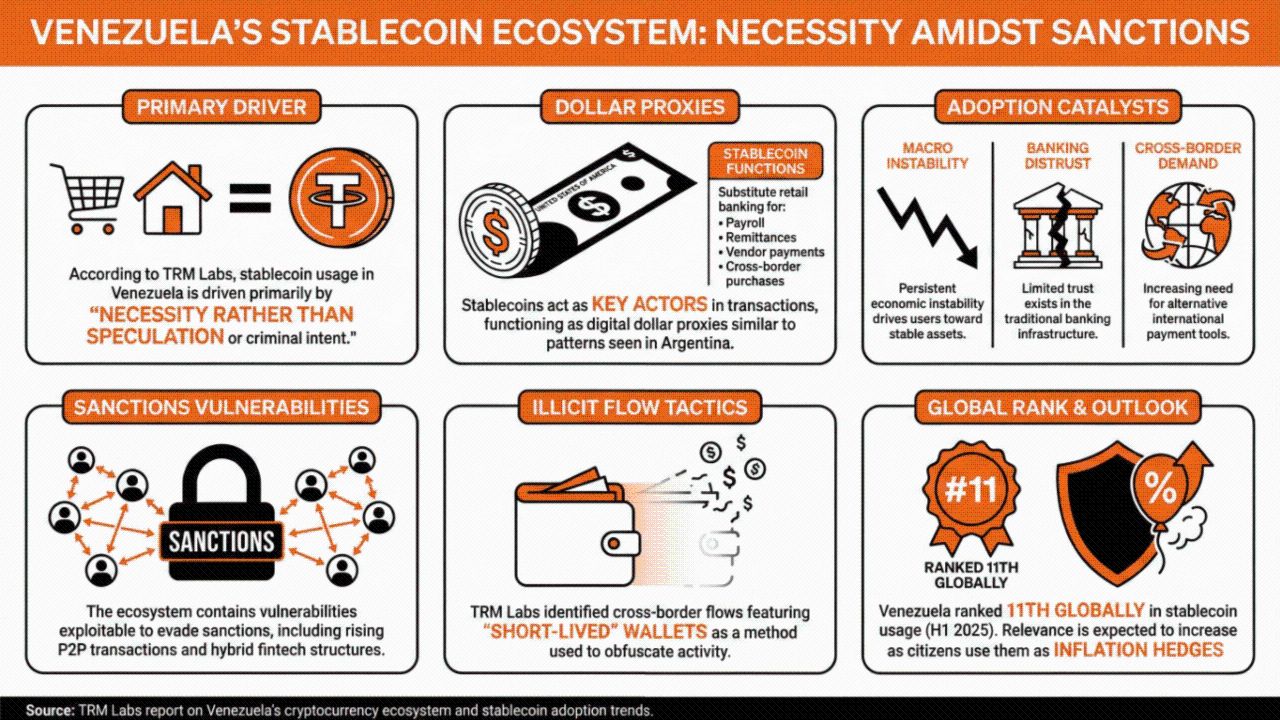
In a recent article, the firm acknowledged that, even with renewed global compliance concerns, the usage of stablecoins remains primarily driven by “necessity rather than speculation or criminal intent.”
TRM Labs found that stablecoin adoption in Venezuela follows a similar pattern observed in countries like Argentina, becoming key actors in both household and commercial transactions as dollar proxies.
For the firm, three elements act as drivers of stablecoin adoption in the current Venezuelan economic context: persistent macroeconomic instability, a limited trust in traditional banking infrastructure, and an increasing demand for alternative cross-border payment tools.
TRM Labs stated:
Stablecoins now operate as a substitute for retail banking — facilitating payroll, family remittances, vendor payments, and cross-border purchases in the absence of consistent domestic financial services.
Nonetheless, TRM Labs also identified several vulnerabilities within the Venezuelan ecosystem that might be exploited to avoid unilateral sanctions. These include the rising popularity of P2P (peer-to-peer) transactions, the use of hybrid fintech structures that combine banking services with blockchain wallets, and the existence of cross-border flows featuring “short-lived” wallets.
The TRM Labs’ report comes as the U.S. government recently confiscated a tanker containing Venezuelan oil, an action that was labeled as “piracy” by Venezuelan authorities.
Previous reports have linked the sale of Venezuelan oil to third parties to stablecoin transactions, though no official statements have been made, neither confirming nor denying these allegations.
Finally, TRM Labs concludes that, if nothing changes, the relevance of stablecoins in Venezuela is expected to keep increasing, as everyday citizens continue to rely on these tools as inflation and devaluation hedges.
The firm’s own stablecoin crypto adoption report ranked Venezuela as the 11th country with the most stablecoin usage during the first half of 2025.
Read More: Economist: USDT Leveraged to Settle Crude Oil Sales in Venezuela
FAQ
-
What recent insights did TRM Labs provide about cryptocurrency usage in Venezuela?
TRM Labs highlighted that stablecoin usage in Venezuela is primarily driven by necessity due to increased sanctions and economic instability. -
What patterns of stablecoin adoption were observed?
Stablecoin adoption in Venezuela mirrors trends in Argentina, serving as a dollar proxy in both household and commercial transactions. -
What factors are driving stablecoin usage in Venezuela?
Three key drivers include macroeconomic instability, a lack of trust in traditional banking, and growing demand for alternative cross-border payment methods. -
What future trends are expected for stablecoins in Venezuela?
TRM Labs anticipates that stablecoins will become increasingly relevant as Venezuelans continue to rely on these digital assets to hedge against inflation and devaluation.
Disclaimer: The content of this article solely reflects the author's opinion and does not represent the platform in any capacity. This article is not intended to serve as a reference for making investment decisions.
You may also like
Zcash Halving Scheduled for November 2025: Igniting a Bull Run for Privacy Coins
- Zcash's 2025 halving reduced block rewards by 50% to 1.5625 ZEC, implementing ZIP 1015 to lock 12% of rewards in a community-controlled wallet. - Total ZEC supply remains capped at 21 million, with 16.3 million in circulation, tightening liquidity and mirroring Bitcoin's scarcity-driven model. - Historical Bitcoin halving patterns suggest Zcash's deflationary design could trigger a bull cycle, supported by 700% price growth since September 2025. - Privacy coins like Zcash now attract institutional invest
The Rise of Financial Wellness: Exploring a New Era in Impact Investing
- Financial wellness movement integrates emotional, mental, and systemic solutions to address rising financial stress affecting 53% of Americans. - Employers adopt earned wage access (EWA) and SECURE Act 2.0-driven retirement programs to reduce workplace financial strain and boost productivity. - Fintech/edtech leverages AI for personalized financial tools, while impact investors allocate $1.164T to projects combining social good and returns. - Corporate wellness programs now include budgeting apps and AI

XRP Price Prediction: Why the $3 December Target Is More Hope Than Reality
“Bitcoin Rodney” Faces Decades in Prison as Feds Expand HyperFund Charges
Trending news
MoreCrypto prices
More





