
Solana Struggles With Adoption Slowdown

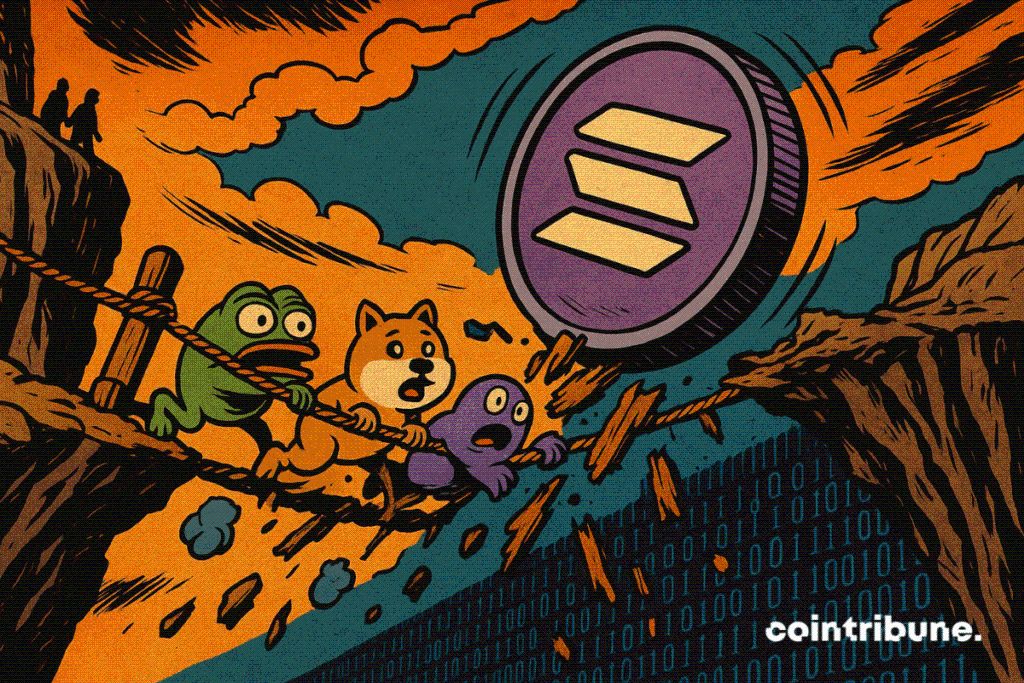
Solana falters. Long presented as one of Ethereum’s most serious competitors, the blockchain today faces a significant decline in its fundamentals : liquidity drop, user disengagement, innovation slowdown. After months of euphoria, the ecosystem shows clear signs of slowdown.
In Brief
- Solana is going through a marked slowdown period despite its status as Ethereum’s rival.
- Its TVL (Total Value Locked) dropped by more than 10 billion dollars in less than three months.
- The revenues generated by DApps on Solana are sharply decreasing, signaling user disengagement.
- Memecoins, once activity drivers on the blockchain, are attracting less and less interest.
The Onchain Activity Slowdown on Solana
The Solana blockchain, once renowned for its ability to attract capital and talent quickly, today sees its Total Value Locked (TVL), the main indicator of ecosystem vitality, plunge sharply, while JPMorgan has just launched a $50M issuance there .
Indeed, Solana’s TVL dropped from $15 billion in September to less than $5 billion, a loss of over $10 billion in less than three months. Meanwhile, weekly revenues generated by DApps on the platform fell from $37 million to $26 million, illustrating a marked decline in economic activity on the blockchain.
This trend is directly related to a reduction in smart contract deposits, which mechanically increases the amount of SOL available for sale.
This disengagement is also reflected in traders’ attitude towards the native SOL token. On-chain data show that the annualized funding rate for SOL perpetual futures contracts was only 6 % last Friday, signaling weak demand for long positions.
An anomaly was also observed on Thursday, with a negative funding rate of −11 %, interpreted not as a massive bearish signal but as a temporary imbalance corrected by liquidity providers. In summary, several key indicators show growing disinterest in financial products linked to Solana:
- A 46 % drop in the SOL price over three months, with no recovery above $145 ;
- Decreased funding rate : only 6 % annual versus 10–12 % during bullish phases ;
- The temporary negative rate of −11 %, revealing unmanaged volatility ;
- Reduced market depth on DEX, a consequence of declining confidence post-liquidation.
Technical Innovations Struggling to Revive Market Confidence
Despite this deterioration in market indicators, Solana’s technical development is not fading. The blockchain officially launched on mainnet Firedancer this Friday, a new validation client developed for more than three years under the leadership of Jump Trading.
Presented as a major advancement in performance and scalability, this client managed to resynchronize a node in under two minutes. This performance aims to improve network resilience and its capacity to absorb increasing volumes, a central argument in Solana’s long-term strategy.
Meanwhile, some projects continue innovating on the application layer. This is the case for Kamino, the second largest DeFi protocol in the Solana ecosystem in terms of TVL, which announced the launch of new products Friday : fixed-rate loans, off-chain collateral, on-chain credit lines backed by bitcoin, and private credit solutions.
Kamino records $69 million in annualized revenues and offers an average 10 % annual yield on deposits, notable figures in a market cooling context. However, it is unlikely that software improvements or DeFi offering expansion alone will restore the confidence necessary for a sustainable upward trend.
While the ecosystem slows fundamentally, another indicator draws attention : Solana ETFs are exploding . This renewed institutional interest contrasts with the on-chain decline and could redefine, in the long term, the network’s trajectory if this enthusiasm lasts beyond the announcement effect.
Disclaimer: The content of this article solely reflects the author's opinion and does not represent the platform in any capacity. This article is not intended to serve as a reference for making investment decisions.
You may also like
Glassnode: Bitcoin Weakly Fluctuates, Is Major Volatility Coming?
If signs of seller exhaustion begin to appear, a short-term move towards $95,000 and the short-term holder cost basis is still possible.
Should You Still Believe in Crypto
No industry has always been right from the beginning, until it truly changes the world.

Zeus unveils institutional-grade MPC infrastructure blueprint at Solana Breakpoint 2025, enabling Bitcoin to enter Solana’s on-chain capital markets
The focus will now shift to building MPC tools and providing support for developers, driving the creation of more native UTXO applications on Solana.
When Belief Becomes a Cage: The Sunk Cost Trap in the Crypto Era
As cryptocurrencies transition from idealism to mainstream finance, participants need to be wary of the sunk cost effect and soberly assess whether they are still striving for a worthwhile future.
Trending news
MoreCrypto prices
More





