
JPMorgan Denies Political Motive Behind Crypto Account Closure Tied to Trump

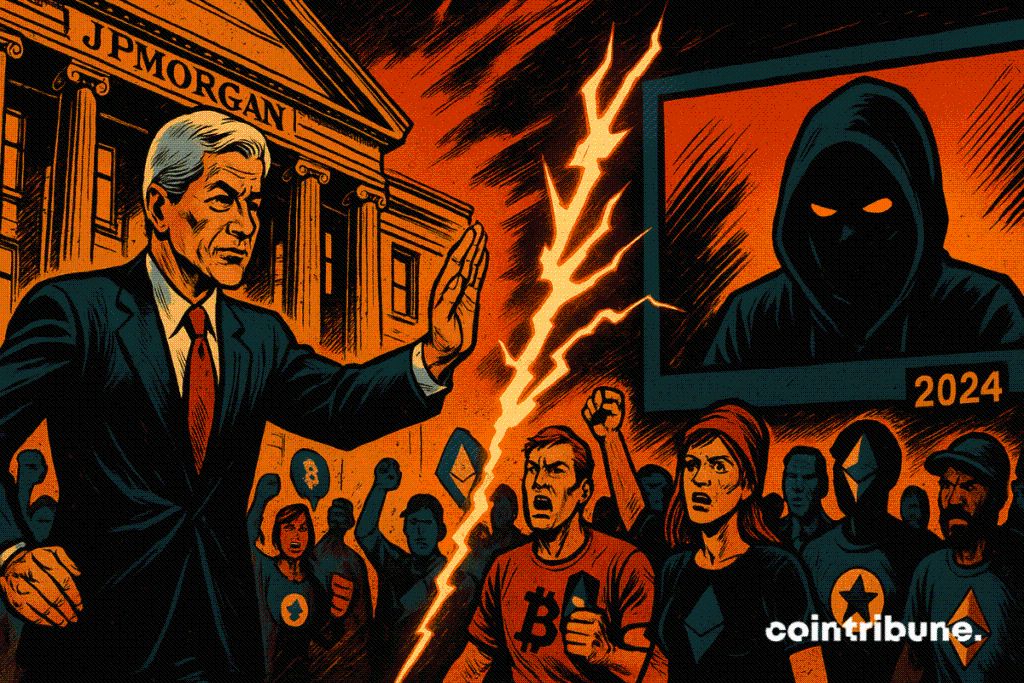
Crypto account closures reignite controversy between financial institutions and conservative figures. JPMorgan is indeed accused of targeting pro-Trump users. Its CEO, Jamie Dimon, firmly rejects this version.
In brief
- JPMorgan denies targeting crypto actors for political or ideological reasons.
- Jamie Dimon calls for reform of debanking rules deemed unclear and unfair.
Crypto and account closure: accusations rain down on JPMorgan
Several personalities in the crypto sector denounce the closure of their bank accounts by JPMorgan, without clear justification.
- The CEO of Strike Jack Mallers claims, for example, to have lost access to his personal funds.
- Trump Media, headed by Devin Nunes, mentions a similar blockage.
- The same scenario on the crypto platform ShapeShift.
These incidents revive fears of a new “Operation Chokepoint”. Some administrations use this controversial method to restrict access to crypto banking services.
Jamie Dimon, JPMorgan CEO, categorically rejects these allegations during an interview with Fox News.
The debate actually touches a sensitive point: the neutrality of banks in the face of the rise of digital assets. More precisely referring to the massive debanking that raises the question of possible financial censorship hidden behind vague compliance rules.
Crypto, Trump and regulation: Jamie Dimon’s strong defense
Jamie Dimon affirms he has been advocating for 15 years to reform the rules that push banks to close accounts on mere suspicion or media reporting. He thus calls for a clarification of the financial regulation standards imposed on banks.
Dimon reminds that JPMorgan never delivers information to authorities without a subpoena. However, he accuses the political climate of turning banks into easy targets. For him, the problem comes from the law (and not the intentions of the institution).
The crypto community therefore fears an abusive use of these procedures, seen as a barrier to decentralized finance. In a context where digital wallets are gaining popularity, each incident fuels distrust toward traditional actors.
In any case, the war between crypto supporters and traditional banks seems far from settled. Regulation will have to decide between control and innovation, before a real gap grows between two visions of finance.
Disclaimer: The content of this article solely reflects the author's opinion and does not represent the platform in any capacity. This article is not intended to serve as a reference for making investment decisions.
You may also like
Ethereum network sees 62% drop in fees: Is ETH price at risk?

SOL Price Forecast: Solana Enters a New Phase with Network Enhancements and Market Fluctuations
- Solana's 2025 upgrades (Firedancer, Alpenglow) enable 1M TPS and 5,200x cheaper transactions, boosting institutional adoption. - TVL rebounded to $8.8B with 32.7% QoQ growth, supported by Bitwise ETF and 7% staking yields attracting institutional capital. - Fed's December 2025 rate cut and QT cessation create favorable macro conditions, historically correlating with crypto gains. - Technical indicators (RSI 42.5, bullish MACD) suggest strategic entry above 200-day EMA ahead of December FOMC meeting. - In

Solana's Abrupt Price Swings and Institutional Reactions: Analyzing Core and Market Factors Behind the Decline and Reviewing Long-Term Value
- Solana (SOL) plummeted 14% in late 2025 due to weak on-chain metrics, 7.5% inflation, and waning memecoin demand. - Institutional investors maintained 1% SOL treasury holdings and $101.7M ETF inflows despite macro risks and $19B crypto liquidations. - Alpenglow/Firedancer upgrades (1M+ TPS, 150ms finality) and 50-80% lower validator costs aim to strengthen Solana's infrastructure resilience. - Regulatory uncertainties (SEC ETF reviews, MiCA) and delayed $2.9B inflation reduction plan (2029) persist as sy

The Impact of Institutional Funding on Education and Workforce Training in Renewable Energy
- Institutional investors are boosting renewable energy education and workforce programs to drive long-term economic resilience and sustainability. - Global investments hit $386B in H1 2025, with education initiatives bridging skill gaps and enabling equitable clean energy transitions. - Case studies like Morocco’s 38% renewable electricity and Portugal’s green skills programs highlight education’s role in job creation and sector growth. - Education and green finance synergies in RCEP and U.S. $265B 2024 i

Trending news
MoreCrypto prices
More





