
Cardano News Today: Cardano Faces a Defining Point in 2026: Advancements Versus Liquidity Hurdles
- Cardano's community approved a $71M upgrade budget for Hydra scaling and Acropolis node redesign, but large stakeholders are withdrawing amid governance criticism. - Market turbulence saw ADA drop over 10% as crypto sell-offs erased $140B in value, exposing liquidity challenges despite $248M DeFi TVL growth targets. - A November 2025 chain split and delayed DeFi adoption highlight operational risks, with founder Charles Hoskinson emphasizing Bitcoin interoperability for long-term growth. - Institutional
Cardano Faces Mixed Reactions Amid Governance Changes and Technical Upgrades
Recent decisions within the Cardano ecosystem, including major governance approvals and technical enhancements, have led to a divided response from investors. While the network enters a pivotal stage in its evolution, some large holders are quietly reducing their positions.
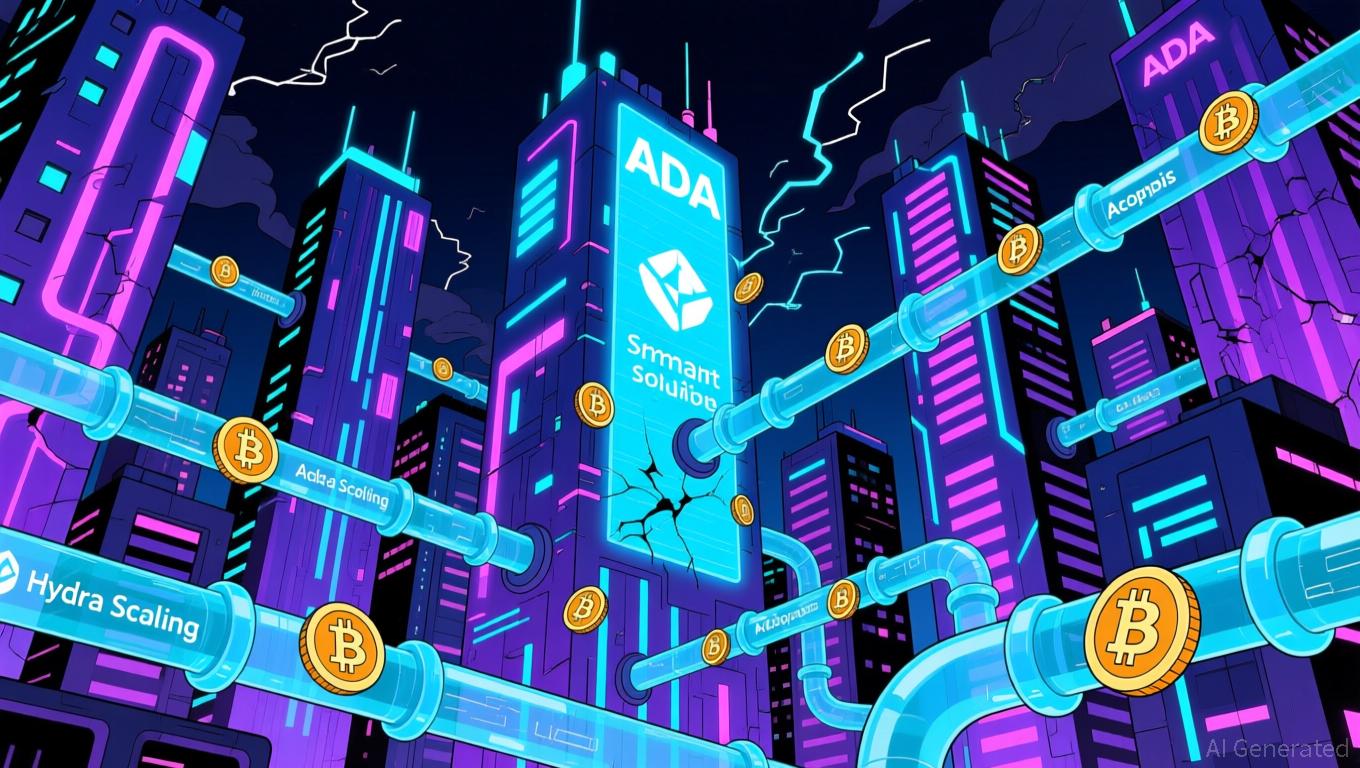
The Cardano community has endorsed a $71 million treasury budget to fund a year’s worth of upgrades. These improvements include the implementation of Hydra for layer-2 scaling and a comprehensive node overhaul through Project Acropolis. Despite receiving 74% approval, the initiative has faced criticism regarding its transparency and the level of detail provided. Meanwhile, the broader cryptocurrency market remains under pressure: a global sell-off recently drove Bitcoin below $86,000 and resulted in double-digit losses for altcoins such as ADA, intensifying concerns about liquidity and investor confidence.
The newly approved funding is designed to address Cardano’s current DeFi limitations. Of the treasury, 96 million ADA—about 13%—will be distributed to Input Output Global (IOG) based on progress milestones, with oversight from the governance group Intersect. Key objectives include deploying Hydra to accelerate transaction speeds and launching Acropolis to simplify the onboarding process for developers, both of which could increase demand for ADA in the future. In addition, a separate $30 million project aims to bolster Cardano’s economic infrastructure by integrating stablecoins, custody solutions, and cross-chain bridges, with backing from IOG, EMURGO, and the Cardano Foundation. However, some analysts argue that these steps may not fully resolve the network’s persistent liquidity issues, as slow DeFi adoption and fragmented vendor participation continue to impede growth.
Further complicating matters, Cardano suffered a brief chain split in November 2025 after a malformed AI-generated transaction exploited a validation flaw. Although node operators quickly restored network consensus, the incident highlighted vulnerabilities in edge-case scenarios and raised questions about the platform’s operational resilience. Founder Charles Hoskinson has emphasized the importance of achieving interoperability with Bitcoin and developing the Midnight privacy network as part of a longer-term strategy to attract greater activity to Cardano’s ecosystem, rather than relying on immediate fixes.
Market conditions have added to the uncertainty. The recent downturn wiped out $140 billion from the overall crypto market, with ADA and other altcoins experiencing steeper declines than Bitcoin. Over $300 million in leveraged long positions were liquidated, underscoring the market’s sensitivity to macroeconomic shifts and leverage-induced volatility. Despite these challenges, on-chain data reveals that institutional investors are still accumulating ADA at key support levels, suggesting continued faith in Cardano’s long-term prospects even amid short-term instability.
Looking forward, the year 2026 will be crucial in determining whether Cardano’s governance reforms and new integrations can drive tangible economic growth. Should stablecoin adoption and infrastructure partnerships gain momentum, the network’s DeFi total value locked (TVL), currently at $248 million, could potentially double—mirroring early growth seen on other layer-1 blockchains. Nonetheless, without robust bridges, reliable oracles, and advanced institutional tools, Cardano may struggle to retain liquidity and will face stiff competition in the expanding DeFi sector.
Disclaimer: The content of this article solely reflects the author's opinion and does not represent the platform in any capacity. This article is not intended to serve as a reference for making investment decisions.
You may also like
Internet Computer's Rapid Rise: Key Drivers and What It Means for Long-Term Investors
- Internet Computer (ICP) surged 385% in November 2025, driven by Caffeine AI, Chain Fusion, and institutional partnerships. - Caffeine AI's no-code dApp platform and Chain Fusion's cross-chain interoperability expanded ICP's utility and developer adoption. - Institutional adoption via Microsoft/Azure and $237B TVL growth positioned ICP as a decentralized infrastructure leader in AI and DeFi. - Price forecasts range $4.4-$30 by 2025-2030, but risks include volatility, regulatory uncertainty, and unproven u

How Will the 2026 Federal Reserve Affect the Crypto Space?
To transition from the Powell era's technocratic caution to a more explicit policy framework aimed at reducing borrowing costs and advancing the President's economic agenda.

Bitcoin’s Sharp Decline: What Sparks Anxiety During a Bullish Market?
- Bitcoin's 2025 bull market collapsed 30% to $83,824 amid Fed policy shifts and liquidity contractions, defying typical risk-on dynamics. - A 0.72 correlation to Nasdaq 100 and $19B leveraged liquidation event exposed Bitcoin's vulnerability to macro risks and institutional sentiment shifts. - AI-driven algorithms and algorithmic feedback loops amplified volatility, with Treasury yields and dollar strength triggering cascading sales. - Market psychology metrics (Fear & Greed Index, stablecoin outflows) an

Infrastructure Initiatives Fuel Real Estate Growth in Upstate New York: The Impact of Local Government Projects on Industrial Market Transformation
- Webster , NY leveraged a $9.8M FAST NY grant to transform a 300-acre Xerox brownfield into a high-tech industrial hub, slashing vacancy rates to 2%. - Infrastructure upgrades attracted food processing and semiconductor firms , with a $650M fairlife® dairy plant expected to create 250 jobs by 2025. - Strategic site readiness and pre-leased industrial space at the NEAT site reduced investor risk, driving 10.1% residential property value growth since 2023. - The model highlights underpenetrated markets' pot
Trending news
MoreCrypto prices
More






