
XRPL Foundation Board Director Explains Why XRP Price Is Down Despite ETF Launch

The XRP community continues to discuss why XRP’s price failed to rally following the launch of the highly anticipated Canary Capital XRP ETF (XRPC).
While the fund posted one of the strongest ETF debuts of 2025, pulling in $245 million on day one, XRP’s price continued drifting lower.
Now, Fabio Marzella, Founding and Board Director of the XRPL Foundation, has stepped in to explain what’s really happening beneath the surface.
“ETF Trading Happens on the Stock Market, Not Crypto Exchanges”
In a post on X, Marzella noted that many people expected the price to shoot up as soon as XRPC began trading. But the structure of ETF settlement explains why that didn’t happen.
According to him, ETF trades occur on the stock market, not on crypto exchanges, where spot XRP is bought and sold.
Due to the T+1 settlement system, when someone buys an XRP ETF share, the issuer does not receive the cash immediately. The money settles the next business day, and only then can the provider begin purchasing the actual XRP needed to back the fund.
This delay means early inflows don’t immediately translate into spot market demand. Essentially, Marzella stressed that an ETF does not pump the price on day one. The real impact comes later, sometimes quietly at first, then all at once.
Strong ETF Debut, Weak Price Reaction
After XRPC’s debut , the ETF recorded $26 million in trading volume in its first 30 minutes and $58.5 million by market close. Additionally, it logged $245 million in net inflows on the first day.
These numbers made XRPC the top ETF debut of the year, surpassing even the Bitwise Solana ETF. It also placed the XRP fund among the best-performing ETF launches out of more than 900 issued in 2025.
Yet despite this momentum, XRP fell from $2.52 to around $2.28. Since the ETF launch, XRP’s price has dropped to $2.16 before slightly recovering to $2.25 at press time. At this price, the coin is down 8.63% over the past week.
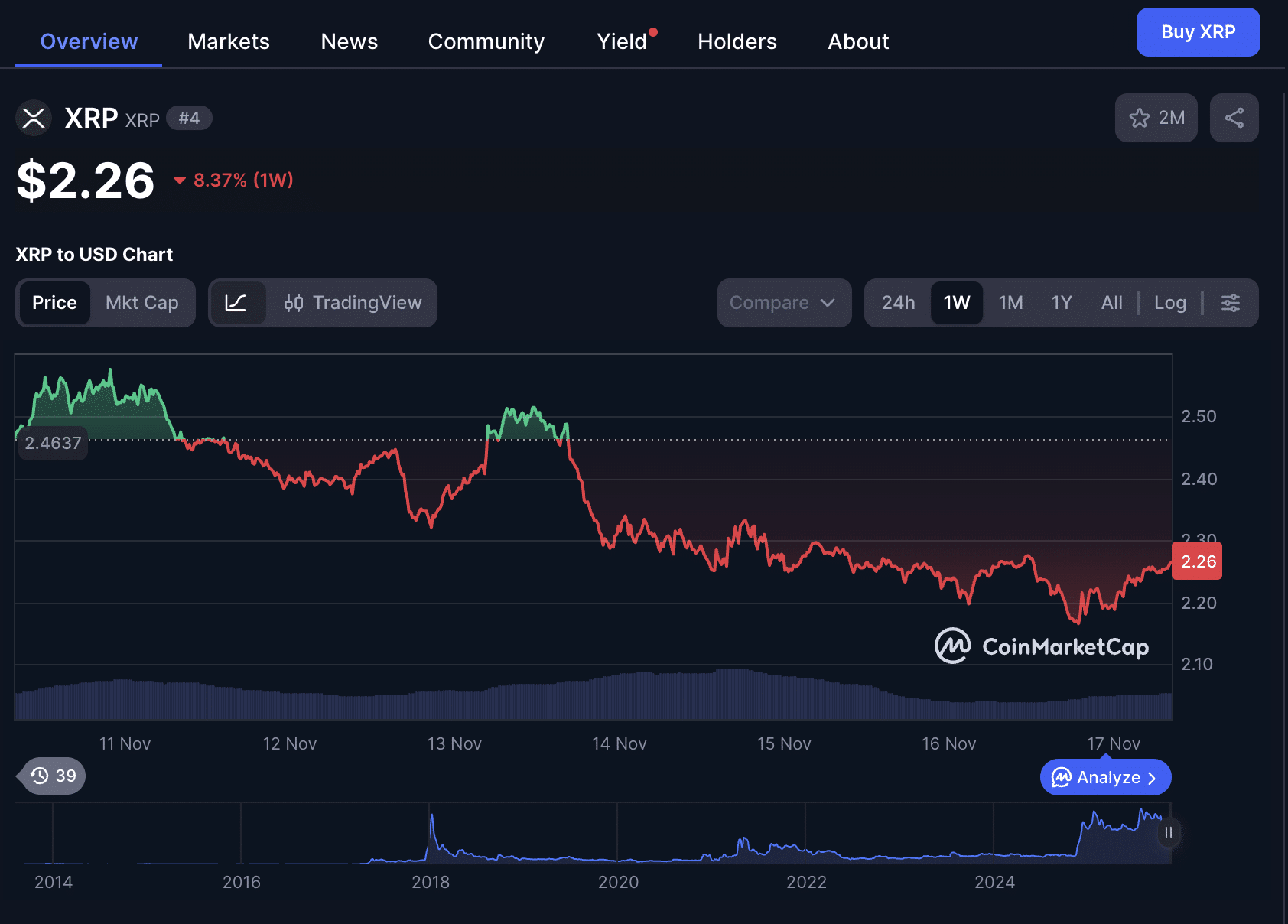 XRP chart CoinMarketCap
Bearish Market Dampened the Effect
Marzella also highlighted a second factor behind XRP’s decline: the entire crypto market is bearish.
Bitcoin lost the $100,000 support last Friday and has since fallen to $92,900. This bearish Bitcoin performance dragged the rest of the market down with it. In other words, as major altcoins corrected, XRP followed the trend.
Nick from The Web Alert pointed out that inflows worth tens or even hundreds of millions are still too small to overpower market selling pressure—especially considering XRP’s large supply. Any selling by major holders can offset upward pressure.
OTC Purchases May Hide the Real Buying Activity
Another reason the price impact hasn’t appeared yet is the way ETFs acquire their underlying assets. Even after settlement, issuers rarely buy directly from public exchanges. Large funds like Canary Capital often source assets from over-the-counter liquidity providers, meaning the purchases are not visible on spot price charts.
Marzella ended his explanation with a message of patience. ETF-driven price effects typically lag behind launch-day hype, as seen with Bitcoin’s own ETF debut in January 2024, which initially showed little price reaction before kicking off a major rally weeks later.
Disclaimer: The content of this article solely reflects the author's opinion and does not represent the platform in any capacity. This article is not intended to serve as a reference for making investment decisions.
You may also like
LUNA Rises 1.13% Amid Progress on U.S. Lawmaker’s Stock Trading Ban
- LUNA rose 1.13% in 24 hours amid U.S. political pressure to ban congressional stock trading, despite an 82.66% annual decline. - Rep. Anna Paulina Luna advanced the bipartisan Restore Trust in Congress Act, which would prohibit lawmakers and families from trading individual stocks. - The bill faces bipartisan opposition over financial flexibility concerns but has 100+ supporters, including conservatives and progressives, seeking to close ethics loopholes. - Critics argue the 2012 STOCK Act lacks sufficie

BCH Rises 9.13% Over 24 Hours as Overall Market Trends Upward
- Bitcoin Cash (BCH) surged 9.13% in 24 hours, with 10.08% monthly and 37.01% annual gains, signaling sustained bullish momentum. - Analysts attribute the rise to BCH's utility in cross-border payments, low fees, and institutional interest as a Bitcoin layer-2 solution. - No immediate catalysts (regulatory shifts, partnerships) were identified, suggesting market sentiment and macro trends drive the rally. - Experts highlight BCH's structural strengths and active development, positioning it to outperform br

YFI Rises 7.78% in a Day as DeFi Market Swings and Fresh Yield Strategies Emerge
- YFI surged 7.78% in 24 hours amid DeFi sector turbulence, despite a 50.04% annual decline. - BI DeFi launched new yield plans to stabilize returns amid regulatory uncertainty and investor wariness. - DeFi Technologies faces a class-action lawsuit after a 20% revenue drop and a 27.59% stock plunge. - Balancer DAO’s $8M recovery plan highlights systemic DeFi risks, including 83–95% inactive liquidity. - Analysts stress the need for regulatory clarity and tech improvements to stabilize the volatile DeFi mar
ZEC Rises 5.45% in the Past 24 Hours Following Grayscale's ZEC ETF Filing
- ZEC rose 5.45% in 24 hours but fell 26.99% weekly amid Grayscale's ZEC ETF filing with the SEC. - Whale activity shows $25M ZEC short exposure with $3. 3M unrealized gains, signaling growing bearish pressure. - Grayscale's ZEC ETF aligns with institutional altcoin adoption trends, following recent approvals for XRP , SOL, and DOGE . - Analysts anticipate ETF approval within months, potentially boosting ZEC's institutional adoption despite short-term volatility.
Trending news
MoreCrypto prices
More






