
Wall Street and the White House are closely watching! What waves will tonight’s US employment data revision stir up?

Wall Street has basically assumed that employment data will be significantly revised downward; it’s just a question of by how much! The Trump administration is already preparing to "shift the blame"...
A revised set of data on the past year’s U.S. employment situation will be released at 10 p.m. Beijing time on Tuesday, and it is widely expected that this number will shake both the economic and political circles.
It is generally expected that this figure will be revised downward compared to the data currently shown by the government—the only question is by how much. The market expects the data to show that from March 2024 to March 2025, the number of jobs created will be 598,000 fewer than previously thought.
Economists from Goldman Sachs, Bank of America, RSM US, and Mizuho Securities have predicted a downward revision of between 650,000 and 750,000 jobs, while Oxford Economics even suggests the revision could reach as high as 900,000.
Economists will be looking for any clues about the recent deterioration in the U.S. labor market. Specifically, the question is to what extent the obvious downward trend in the labor market this summer actually began earlier than previously known.
The Trump administration will also be closely watching this data, and officials may use any revision as further ammunition to criticize government economic data, and may also use the results to try to shift the blame for the current economic slowdown onto former President Biden and Federal Reserve Chairman Powell.
Despite the recent political heat, these revisions are a routine annual operation by the Bureau of Labor Statistics, which updates its employment level estimates as more data becomes available. Tuesday’s release will cover the year ending March 2025, roughly the last 10 months of Biden’s term and the first two full months of Trump’s term.
After last Friday’s release of the August non-farm payroll data, which flashed a glaring red light for the slowing job market, the employment market has received extra attention. The report showed that only 22,000 jobs were added in the U.S. in August.
Last year, when the Bureau of Labor Statistics released the same preliminary annual revision during the heated final stage of the U.S. presidential campaign, and it showed that the U.S. economy had created 818,000 fewer jobs than previously thought, it immediately became a flashpoint—so this year’s political focus is also expected to be intense.
Recently, after Trump baselessly accused the Bureau of Labor Statistics of “falsifying” data and then fired the agency’s director citing the revision as a key reason, political attention on employment has become even more prominent.
Trump’s allies have seized on the unusually large revisions in recent years to argue for the need for new data processing methods.
Trump’s pick for the new director, E.J. Antoni from the Heritage Foundation, has been one of the agency’s fiercest critics. He will face a confirmation hearing before the Senate Labor Committee in the coming months and will express his views.
A “war of words” is bound to break out?
During this period of political transition, any degree of downward revision in employment data is certain to trigger a political war of words over the economic legacies of Trump and Biden.
In short, the Trump administration can use any downward revision to argue that the economy was already weakening before he took office.
One sign that the numbers are under close political scrutiny is that last Sunday, two of Trump’s senior economic advisers—Treasury Secretary Bessent and National Economic Council Director Hassett—both proactively mentioned this revision.
“We’ll get last year’s revised data next week, and there could be as many as 800,000 jobs revised downward,” Bessent said on his show. “I don’t know what these data collectors have been doing,” he added.
Bessent’s focus on the revision came when he was asked to explain why, despite Trump’s promise to revitalize manufacturing, and growth achieved under Biden, U.S. manufacturing has been losing jobs since April.
Hassett added on his own show that the large revisions are “why we need new and better data.”
Meanwhile, Powell is also unlikely to be spared, as any significant revision will certainly reinforce expectations for a rate cut later this month, and may even raise hopes for a so-called “large” 50 basis point cut.
In addition, this could reignite criticism from Trump’s circle over Powell’s entire tenure.
Last week’s weak non-farm report was met with responses from Trump and his newly appointed Labor Secretary, both stating that the weak numbers should not be blamed on Trump’s economic management, but rather on Powell’s delay in cutting rates.
In Trump’s words, “Powell should have cut rates a long time ago. As usual, he’s ‘too late!’”
Disclaimer: The content of this article solely reflects the author's opinion and does not represent the platform in any capacity. This article is not intended to serve as a reference for making investment decisions.
You may also like
Mars Morning News | Ethereum Fusaka upgrade officially activated; ETH surpasses $3,200
The Ethereum Fusaka upgrade has been activated, enhancing L2 transaction capabilities and reducing fees; BlackRock predicts accelerated institutional adoption of cryptocurrencies; cryptocurrency ETF inflows have reached a 7-week high; Trump nominates crypto-friendly regulatory officials; Malaysia cracks down on illegal Bitcoin mining. Summary generated by Mars AI. The accuracy and completeness of this summary are still undergoing iterative updates.

Do you think stop-losses can save you? Taleb exposes the biggest misconception: all risks are packed into a single blow-up point.
Nassim Nicholas Taleb's latest paper, "Trading With a Stop," challenges traditional views on stop-loss orders, arguing that stop-losses do not reduce risk but instead compress and concentrate risk into fragile breaking points, altering market behavior patterns. Summary generated by Mars AI. The accuracy and completeness of this summary are still being iteratively improved by the Mars AI model.

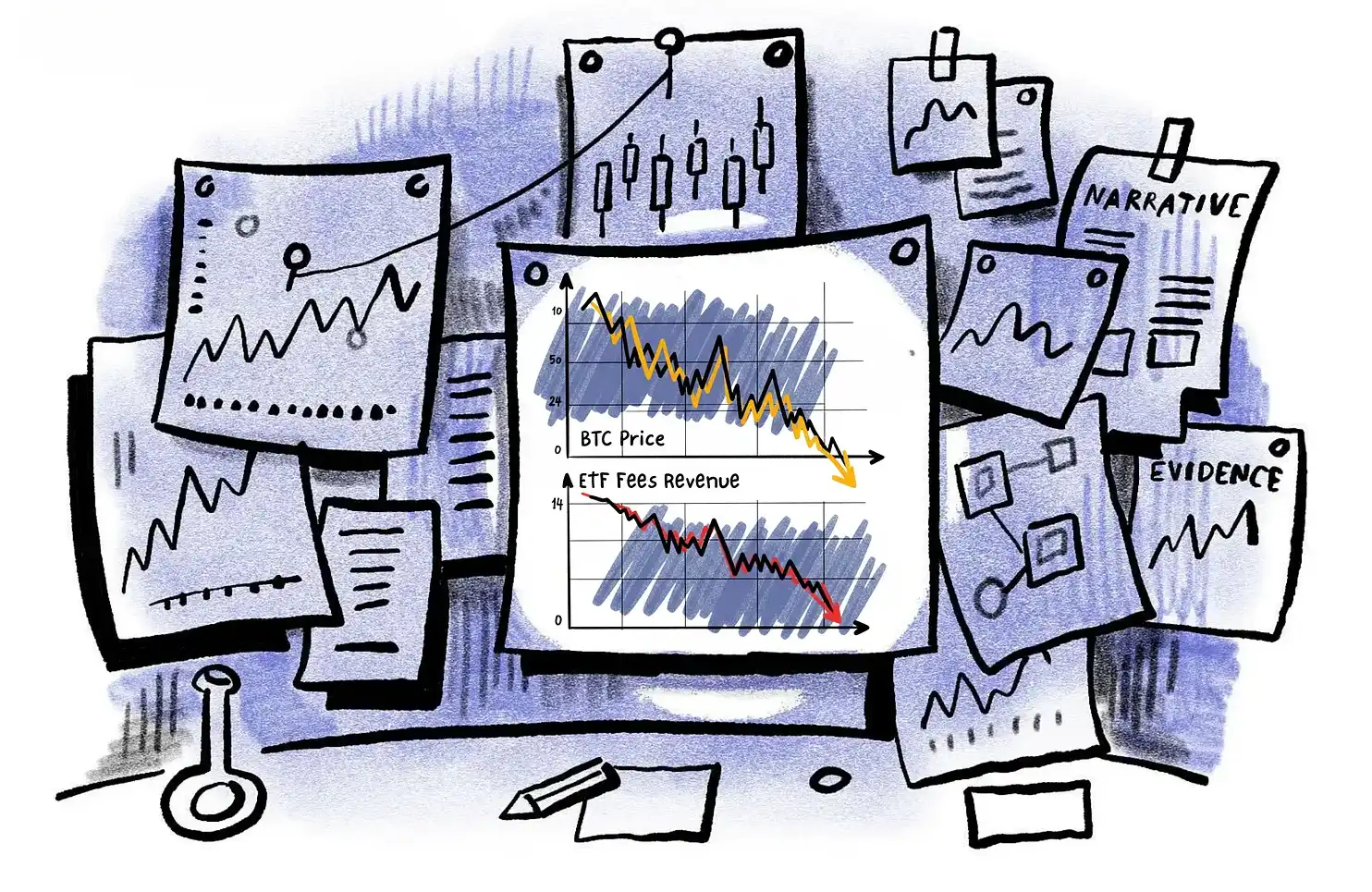
With capital outflows from crypto ETFs, can issuers like BlackRock still make good profits?
BlackRock's crypto ETF fee revenue has dropped by 38%, and its ETF business is struggling to escape the cyclical curse of the market.
Incubator MEETLabs today launched the large-scale 3D fishing blockchain game "DeFishing". As the first blockchain game on the GamingFi platform, it implements a dual-token P2E system with the IDOL token and the platform token GFT.
MEETLabs is an innovative lab focused on blockchain technology and the cryptocurrency sector, and also serves as the incubator for MEET48.

Trending news
MoreCrypto prices
More






