
Ethereum's Two-Year Technical Roadmap Revealed: Which Upgrades Will Provide the Strongest Price Support?

Several <i>technical breakthroughs</i> depicted in the technical chart may provide support for the Ethereum price (E Guard Special).
Original Author: Haotian, Crypto Researcher
Based on the Ethereum's Future Two-Year Technology Roadmap, sharing several "Technological Breakthroughs" that could potentially provide support for the price direction (E Guard Exclusive):
1) zkEVM Layer1 Integration
Implementation Timeline: Mainnet deployment to be completed from Q4 2025 to Q2 2026;
Technical Goals:
· 99% of blocks validated within 10 seconds;
· 80% reduction in zk-SNARK verification cost;
Significance of Implementation:
· Increased market share of stablecoins such as USDC, USDT on the Ethereum main chain, leading to a corresponding increase in daily Gas consumption, directly driving ETH deflation;
· zkEVM's zero-knowledge proof technology provides compliance and privacy protection for traditional financial institutions, activating potential large-scale institutional DeFi application scenarios;
2) RISC-V New Architecture Execution
Implementation Timeline: Research and development to start in the second half of 2025, phased slow progress from 2026 to 2030;
Technical Goals:
· 3-5x improvement in smart contract execution efficiency;
· 50-70% reduction in Gas cost;
· Open-source instruction set architecture to replace the current EVM, better compatible with modern hardware acceleration technologies;
Significance of Implementation:
· The magnitude improvement in execution performance will spur new application scenarios, such as high-frequency trading, real-time gaming, AI inference, micropayments, and microtransactions;
· Lower Gas costs will reinvigorate microtransaction scenarios, significantly expand user base and usage frequency, creating a positive cycle of ETH demand;
3) Layer1-Layer2 Ecosystem Collaboration
Implementation Timeline: Starting in Q4 2025, continuous optimization from 2026 to 2027;
Technical Goals:
· Achieve seamless interoperability between L1 and major L2 solutions (Arbitrum, Optimism, Base, etc.);
· The current decentralized liquidity is around $1.2 trillion TVL, with the total unified liquidity pool TVL surpassing $2 trillion;
· Cross-layer transaction costs have been reduced by 90%, achieving cross-layer confirmation within 10 seconds;
Significance of Achievement:
· DeFi protocols can more efficiently aggregate liquidity across the entire ecosystem (L1+L2), generating a network effect where 1+1>2, significantly improving the capital efficiency and user experience of the entire Ethereum ecosystem;
4) Validator Economic Optimization
Implementation Timeline: Starting in the second half of 2025, in coordination with various technical upgrades, continuous optimization over 2 years;
Technical Goals:
· Gradually reduce the validator's minimum staking threshold from 32 ETH to 16 ETH, and eventually to 1 ETH;
· Increase staking annual rewards from the current 4-6% to 6-8%;
· Simplify validator operation requirements, support light node validation, and increase network decentralization;
Significance of Achievement:
· The reduction in the validator threshold and optimization of the reward model are expected to increase the ETH staking rate from the current approximately 25% to over 40% (locking up around 48 million ETH), further reducing ETH's circulating supply and strengthening deflation expectations;
· The increased staking rewards will enhance the attractiveness of ETH as a "digital bond," providing fundamental support for its valuation;
5) Sharding Technology Revival (ETH 3.0)
Implementation Timeline: Design and development to begin in 2026, with implementation in 2027-2028 or later;
Technical Goals:
· Achieve processing capacity of millions of transactions per second through zkEVM+ and sharding;
· Reduce data availability costs by 99%;
· Distribute blockchain data across multiple shards, with validators only needing to process a portion of the data;
Significance of Achievement:
· The reintroduction of sharding indicates that Ethereum is preparing for the widespread adoption of Web3 in the next decade, and the long-standing vision of the "world computer" will be brought back to the agenda;
Disclaimer: The content of this article solely reflects the author's opinion and does not represent the platform in any capacity. This article is not intended to serve as a reference for making investment decisions.
You may also like
Mars Morning News | After the Ethereum Fusaka upgrade, the blob base fee surged by 15 million times
Multiple blockchain industry updates: a Bitcoin OG wallet transferred 2,000 BTC; Cloudflare outage was not caused by a cyberattack; the DAT bubble has burst; Ethereum Fusaka upgrade fees have surged; LUNC has risen over 80% intraday. Summary generated by Mars AI. This summary was generated by the Mars AI model, and the accuracy and completeness of its content are still under iterative improvement.
Drones, Fake Birdsong, and Broken Glass Traps: Malaysia is Undergoing an Unprecedented "Bitcoin Crackdown"
The Malaysian government is intensifying its crackdown on illegal bitcoin mining, utilizing technologies such as drones and sensors to uncover numerous operations, with electricity theft causing significant losses. Summary generated by Mars AI. The accuracy and completeness of the content generated by the Mars AI model are still in the process of iterative improvement.

Bitwise CIO: Stop Worrying, MicroStrategy Won't Sell Bitcoin
There are indeed many concerns in the crypto industry, but MicroStrategy selling bitcoin is definitely not one of them.

A 6200-fold profit: Who is the biggest winner of Moore Threads?
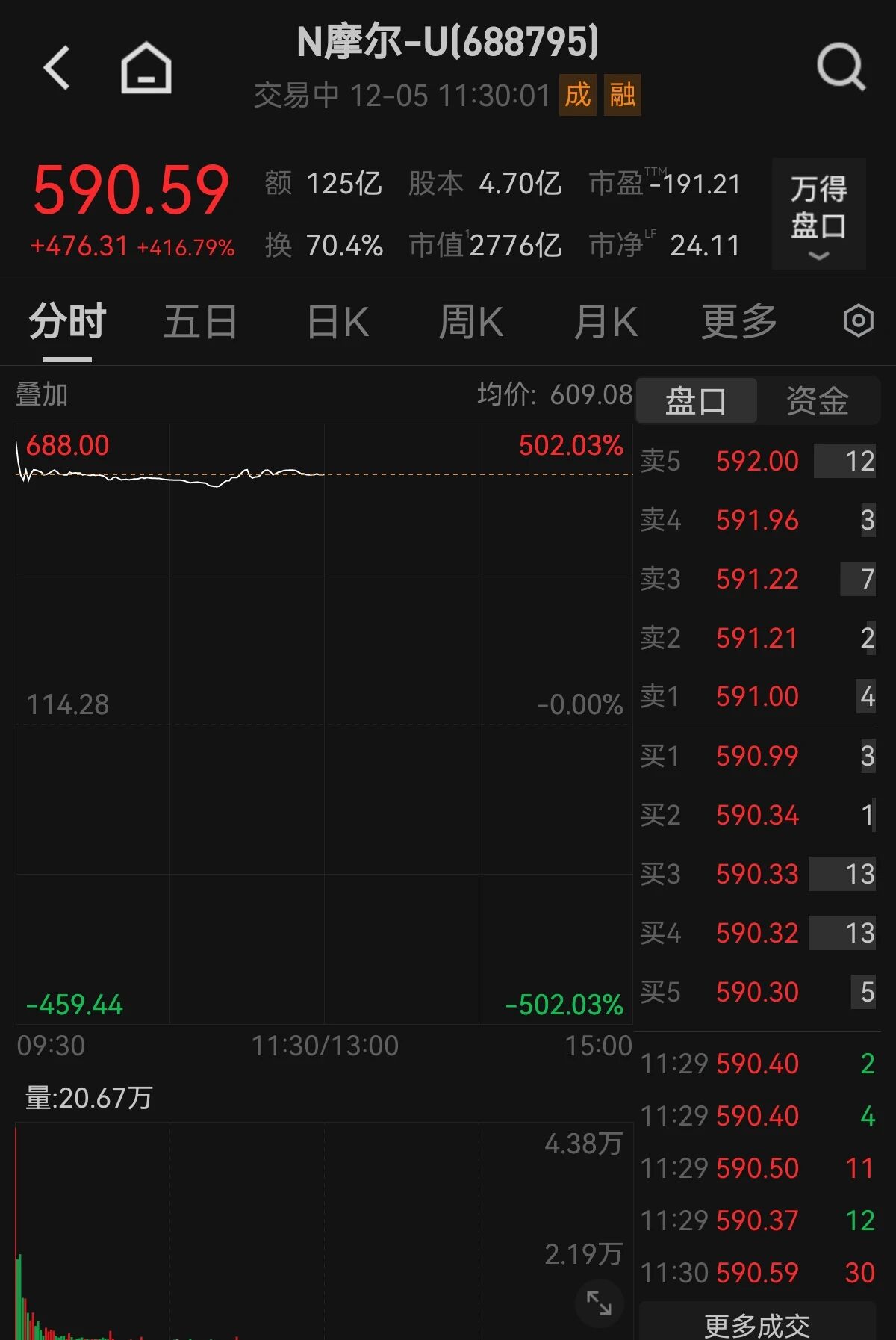
On December 5, Moore Threads officially debuted on the STAR Market, opening at 650 yuan, a surge of 468.78% compared to its issue price of 114.28 yuan.
Trending news
MoreCrypto prices
More





