
Vitalik proposes gas cap to enhance Ethereum security
 2025/07/07 08:40
Ethereum co-founder Vitalik Buterin and researcher Toni Wahrstätter have introduced EIP-7983, a new proposal to cap gas usage per transaction at 16.77 million units.
The cap is designed to improve Ethereum’s network security, performance consistency, and compatibility with zero-knowledge virtual machines (zkVMs).
The proposed limit equals 2²⁴ gas units, or 16.77 million, and would apply to individual transactions—not the overall block gas limit.
Under current rules, a single transaction can consume an entire block’s gas, creating a vector for denial-of-service (DoS) attacks and network instability.
EIP-7983 aims to prevent such attacks by forcing large transactions to be split into smaller, manageable segments.
This change is expected to make gas distribution across the network more predictable and reduce the chance of network congestion.
Transactions attempting to exceed the 16.77 million gas limit would be rejected during block validation.
The change is purely protocol-level and doesn’t impact the adjustable block gas limit that miners and validators control.
Buterin and Wahrstätter argue that the proposed limit balances performance and complexity.
According to the proposal, it allows for sophisticated DeFi interactions and contract deployments without introducing excessive risk.
While not backward-compatible for transactions above the cap, the authors noted that most current transactions are already well below this threshold.
Therefore, the proposal is expected to have minimal impact on user experience and developer operations.
EIP-7983 builds upon previous work like EIP-7825, which also sought to enhance execution predictability on Ethereum.
The proposal aligns with Buterin’s broader vision of simplifying Ethereum’s base protocol.
In May, he advocated for reducing Ethereum’s complexity across consensus, execution, and shared layers.
He argued that Ethereum’s increasing intricacy has resulted in slower development, higher maintenance costs, and elevated security risks.
Buterin has also recently proposed a novel “pluralistic identity” system designed to enable privacy-preserving, equitable participation in digital environments.
The proposed gas cap reflects ongoing efforts to streamline Ethereum’s infrastructure while maintaining the flexibility needed to support evolving use cases.
If adopted, EIP-7983 could enhance Ethereum’s resilience and scalability in the long term.
At the time of reporting, Ethereum price was $2,594.66
Disclaimer: The content of this article solely reflects the author's opinion and does not represent the platform in any capacity. This article is not intended to serve as a reference for making investment decisions.
You may also like
Mars Morning News | The crypto market rebounds across the board, Bitcoin rises above $94,500; The "CLARITY Act" draft is expected to be released this week
The crypto market has fully rebounded, with bitcoin surpassing $94,500 and US crypto-related stocks rising across the board. The US Congress is advancing the CLARITY Act to regulate cryptocurrencies. The SEC chairman stated that many ICOs are not securities transactions. Whales are holding a large number of profitable ETH long positions. Summary generated by Mars AI. The accuracy and completeness of the content generated by the Mars AI model is still being iteratively updated.
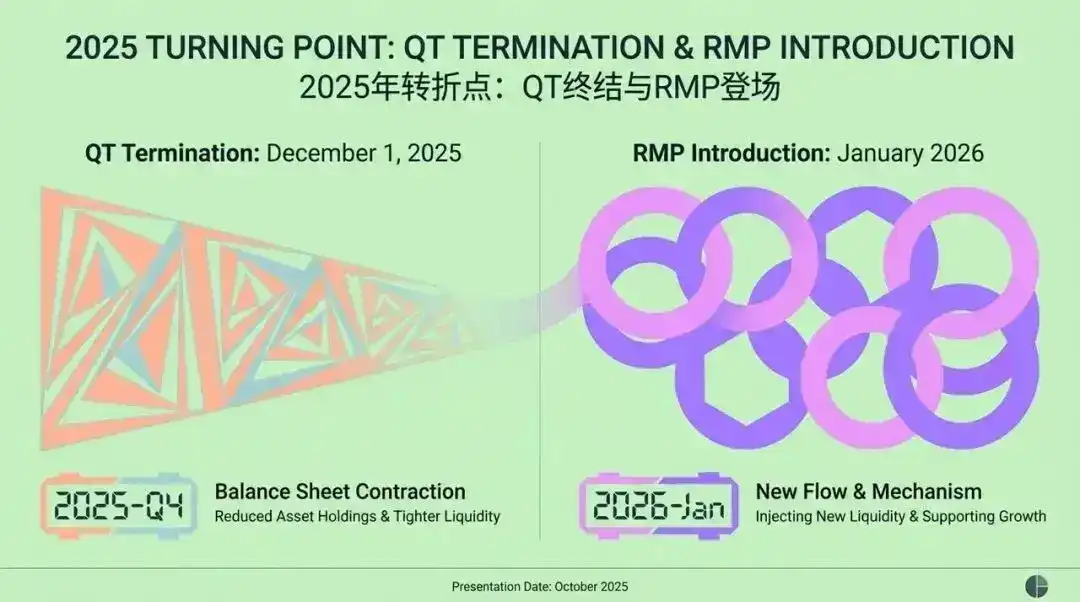
Federal Reserve’s Major Shift: From QT to RMP, How Will the Market Transform by 2026?
The article discusses the background, mechanism, and impact on financial markets of the Federal Reserve's introduction of the Reserve Management Purchases (RMP) strategy after ending Quantitative Tightening (QT) in 2025. RMP is regarded as a technical operation aimed at maintaining liquidity in the financial system, but the market interprets it as a covert easing policy. The article analyzes RMP's potential effects on risk assets, the regulatory framework, and fiscal policy, and provides strategic recommendations for institutional investors. Summary generated by Mars AI This summary was generated by the Mars AI model, and the accuracy and completeness of its content are still in the process of iterative improvement.
Rate Hike in Japan: Will Bitcoin Resist Better Than Expected?
Crucial Decision: Trump’s Final Interviews for Federal Reserve Chair Could Reshape Markets
Trending news
MoreCrypto prices
More





