
Crypto-native bank Custodia partners with Vantage on 'first bank-issued stablecoin' backed by tokenized customer deposits

Quick Take Custodia and Vantage Bank have partnered on a new tokenization project that uses customer deposits to issue Avit stablecoins. The move represents the first-ever “bank-issued stablecoin” issued on a permissionless blockchain, namely Ethereum.

Wyoming-based crypto-native bank Custodia is working with Vantage Bank on a new tokenization program. The two firms noted this test represents the “first bank-issued stablecoin” issued on a permissionless blockchain.
"A new U.S. dollar payment rail has now been activated inside the U.S. banking system, at a time when the global community is increasingly demanding U.S. dollar stablecoins for transactional use," the firms wrote in a Tuesday press release.
In the test, Custodia and Vantage converted a customer's U.S. dollar deposits into digital tokens called Avit stablecoins, which were then issued, transferred and redeemed on the Ethereum mainnet using the ERC-20 standard.
The Avit stablecoin, a Custodia-patented and trademarked product, is pegged to the U.S. dollar and backed by real dollar reserves held by the banks. This is different from some existing stablecoins, like Tether’s USDT and Circle’s USDC, which are not issued by regulated banks and are largely backed by cash equivalents — primarily government debt.
The process involved eight steps: the banks minted Avit tokens, allowed a customer to move them into self-custody, deployed them in business-to-business transactions and then returned them to Custodia Bank to be redeemed for cash.
Vantage Bank managed the fiat dollar reserves and standard banking services like Fedwire/ACH systems while Custodia handled the blockchain tokenization and analytics side. Notably, the transactions were "BSA/AML/OFAC" compliant, "which necessitated designing documentation, policies and procedures that differ from those of current stablecoin issuers."
"All parties to the series of test transactions observed several efficiencies, including low transaction costs, fast transaction settlement, programmability and auditability within a safe, compliant and regulated banking environment," Custodia and Vantage wrote.
"We broke ground on the legal/regulatory front, proving that U.S. banks can collaborate to tokenize demand deposits on a permissionless blockchain in a regulatorily-compliant manner," Caitlin Long, CEO of Custodia Bank, said. "Custodia looks forward to the reversal of U.S. regulatory obstacles that have stymied stablecoin innovation in recent years, so that American consumers can benefit from the substantial network effects and global reach of permissionless blockchain technologies."
Custodia operates as a Special Purpose Depository Institution (SPDI) — a new type of state-chartered bank pioneered by Wyoming in 2019 — that offers digital asset custody services alongside U.S. dollar accounts. Unlike traditional banks, it keeps 100% reserves for deposits.
In 2023, amid the "Operation Choke Point 2.0" crackdown on crypto banking, Custodia sued the Federal Reserve after it was denied a Fed master account, claiming regulatory bias against its crypto focus. It has since appealed the decision to gain direct access to the Fed's payment systems.
Disclaimer: The content of this article solely reflects the author's opinion and does not represent the platform in any capacity. This article is not intended to serve as a reference for making investment decisions.
You may also like
A decade-long tug-of-war ends: "Crypto Market Structure Bill" sprints to the Senate
At the Blockchain Association Policy Summit, U.S. Senators Gillibrand and Lummis stated that the "Crypto Market Structure Bill" is expected to have its draft released by the end of this week, with revisions and hearings scheduled for next week. The bill aims to establish clear boundaries for digital assets by adopting a classification-based regulatory framework, clearly distinguishing between digital commodities and digital securities, and providing a pathway for exemptions for mature blockchains to ensure that regulation does not stifle technological progress. The bill also requires digital commodity trading platforms to register with the CFTC and establishes a joint advisory committee to prevent regulatory gaps or overlapping oversight. Summary generated by Mars AI. The accuracy and completeness of this summary, generated by the Mars AI model, is still being iteratively updated.
Gold surpasses the $4,310 mark—Is the "bull frenzy" returning?
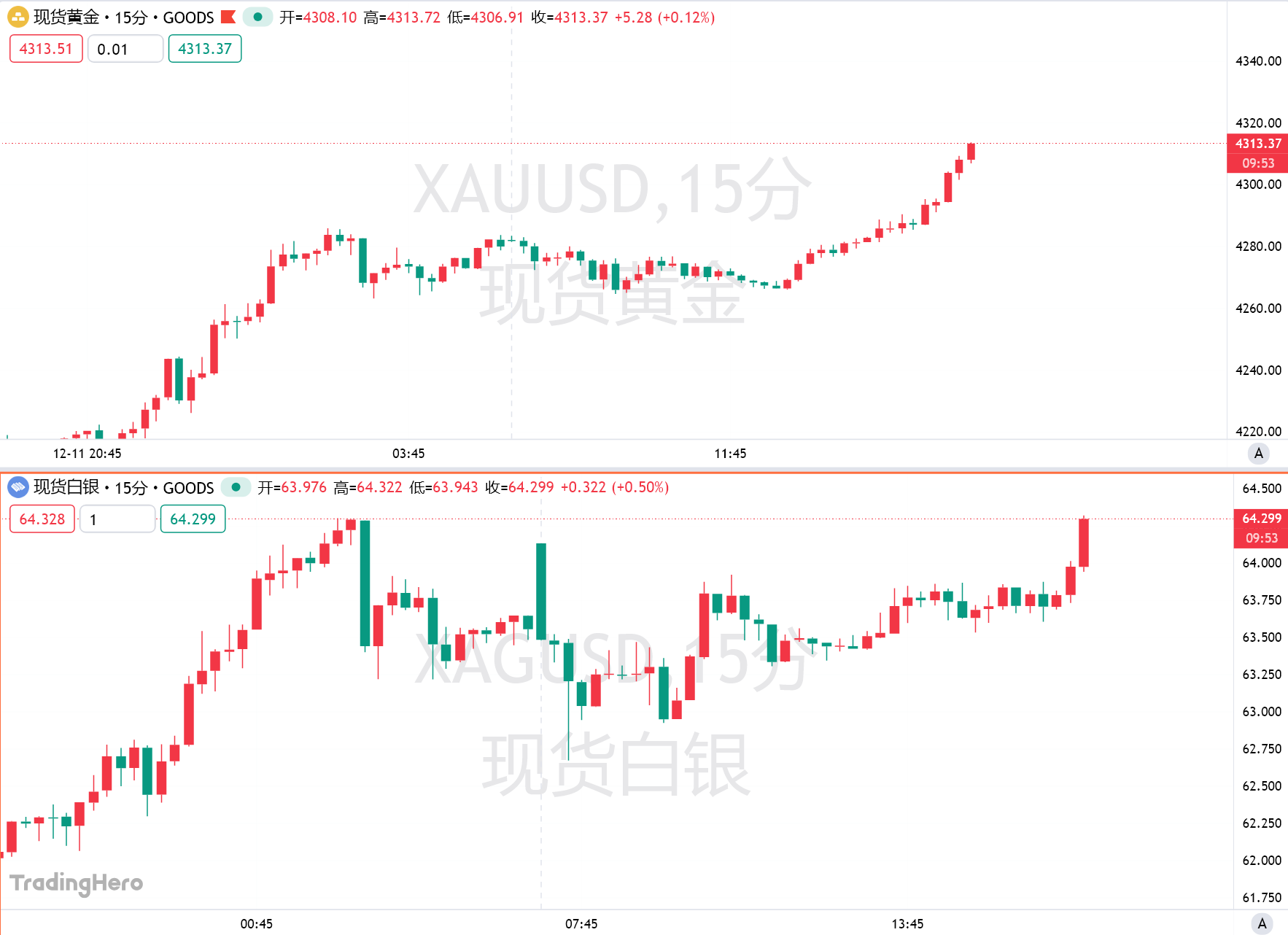
Boosted by expectations of further easing from the Federal Reserve, gold has risen for four consecutive days. Technical indicators show strong bullish signals, but there remains one more hurdle before reaching a new all-time high.
Trend Research: Why Are We Still Bullish on ETH?
Against the backdrop of relatively accommodative expectations in both China and the US, which suppress asset downside volatility, and with extreme fear and capital sentiment not yet fully recovered, ETH remains in a favorable "buy zone."

Trending news
MoreCrypto prices
More





