
Bitcoin ETFs Break Losing Streak With $274 Million Inflows – Is Demand Returning?

Bitcoin ETFs experienced a significant inflow of $274 million, hinting at a potential return of demand after weeks of outflows. However, experts remain cautious, noting that one strong day doesn’t guarantee a lasting trend.
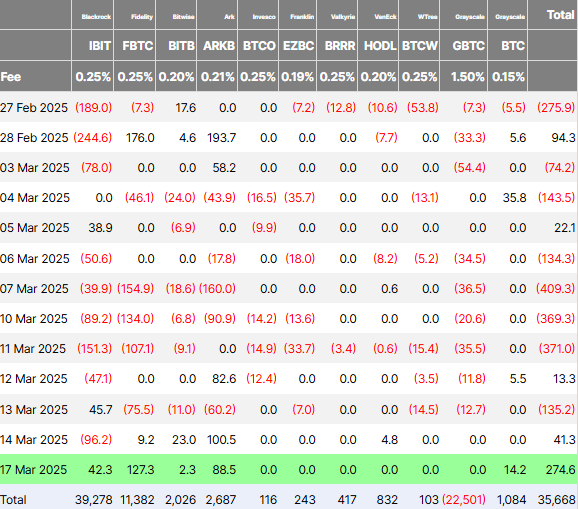
After weeks of outflows, Bitcoin exchange-traded funds (ETFs) have finally reversed course, recording $274.6 million in inflows on March 17.
This marks the largest single-day net inflow in 41 days, hinting at renewed investor interest. While one positive day does not confirm a trend, it raises an important question: Is demand returning to Bitcoin ETFs, or is this just a temporary reprieve?
Bitcoin ETFs See First Major Inflows in Weeks
According to the latest data on Farside Investors, BlackRock’s iShares Bitcoin Trust (IBIT) recorded $42.3 million in inflows on Monday. Despite the positive flows, IBIT failed to lead the way amid ongoing headwinds due to stock market correlation.
Fidelity’s Bitcoin ETF (FBTC) attracted $127.28 million, making it the day’s biggest gainer. The ARK Bitcoin ETF (ARKB), managed by ARK Invest and 21Shares, also saw significant interest, pulling in $88.5 million.
On the other hand, the Grayscale Bitcoin Trust (GBTC), which has been at the center of major outflows, remained flat at $0 million. This is notable because GBTC has lost billions in assets since transitioning to a spot ETF.
Meanwhile, Grayscale’s other Bitcoin product saw a modest inflow of $14.22 million. Other Bitcoin ETFs, including those from Valkyrie, Invesco, Franklin, and WisdomTree, recorded no daily inflows.
 Bitcoin ETF Inflows. Source:
Farside Investors
Bitcoin ETF Inflows. Source:
Farside Investors
However, while Bitcoin ETFs had a strong showing, Ethereum-based spot ETFs continued their downward trajectory. Data on Farside investors showed they logged their ninth consecutive day of net outflows at $7.3 million.
“Bitcoin spot ETFs attract $275 million in inflows, while Ethereum ETFs experience outflows, reflecting shifting investor preferences,” one user on X suggested.
Notably, while this could suggest the returning demand for Bitcoin ETFs after weeks of outflows, analysts say one green day does not make a trend. Nevertheless, it is a shift worth watching.
Bitcoin ETFs Have Lost Billions in Recent Weeks
Just a week ago, Bitcoin ETFs had recorded four straight weeks of net outflows totaling more than $4.5 billion. Profit-taking, regulatory concerns, and broader economic uncertainty fueled the shift in investor sentiment.
The crypto market as a whole has also seen capital flight. As BeInCrypto reported, total crypto outflows exceeded $800 million last week, signaling strong negative sentiment among institutional investors.
With this context, while Monday’s inflow of $274 million could be seen as a sign of stabilization, it is too early to determine whether this marks the beginning of a broader recovery.
Nevertheless, the sudden surge in ETF inflows raises the question of whether this is a resurgence of the so-called “Trump crypto boom” or a case of fear of missing out (FOMO). Some analysts believe hedge funds and institutional players drive the action more than retail investors.
Crypto entrepreneur Kyle Chassé has previously argued that hedge funds play a major role in Bitcoin’s ETF flows. He claims that large investors strategically withdraw and reinvest capital to manipulate price movements, making it difficult to determine organic demand.
“The ETF “demand” was real, but some of it was purely for arbitrage. There was a genuine demand for owning BTC, just not as much as we were led to believe. Until real buyers step in, this chop volatility will continue,” the analyst explained.
If true, the latest ETF inflows might not represent new buyers. Rather, it could mean recycling institutional capital to capitalize on short-term price swings.
Adding to the uncertainty, many investors are considering the Federal Reserve’s upcoming policy decisions. Some have speculated that the Fed will pivot toward monetary easing (QE) soon, but industry experts warn that such expectations are misguided.
Nic Puckrin, a financial analyst and founder of The Coin Bureau, believes those anticipating imminent QE are “deluded.” He notes that the Fed’s fund rate remains at 4.25-4.5%, and historically, QE does not begin until rates approach zero.
“…why is anyone suddenly expecting a massive injection of liquidity into the system? Realistically, if large-scale monetary stimulus is going to come from anywhere, it will be China or Europe, both of which have already implemented monetary easing measures. The most we can expect from Powell tomorrow is a hint at the timing of the next interest rate cut, but we may not even get that. And so, investors should prepare for the markets to throw another tantrum this week,” Puckrin told BeInCrypto.
.
Disclaimer: The content of this article solely reflects the author's opinion and does not represent the platform in any capacity. This article is not intended to serve as a reference for making investment decisions.
You may also like
Bitcoin’s back above $94K: Is the BTC bull run back on?

With retail investors leaving, what will drive the next bull market?
Bitcoin has recently plummeted by 28.57%, leading to market panic and a liquidity crunch. However, long-term structural positives are converging, including expectations of Federal Reserve rate cuts and SEC regulatory reforms. The market currently faces a contradiction between short-term pressures and long-term benefits. Summary generated by Mars AI. The accuracy and completeness of this summary are still being iteratively improved.

Tether's "son" STABLE crashes? Plunges 60% on first day, whale front-running and no CEX listing spark trust panic
The Stable public blockchain has launched its mainnet. As a project associated with Tether, it has attracted significant attention but performed poorly in the market, with its price plummeting by 60% and facing a crisis of confidence. It is also confronted with fierce competition and challenges related to its tokenomics. Summary generated by Mars AI. The accuracy and completeness of the content are still being iteratively updated.
Hassett: The Fed has ample room to cut interest rates significantly.
Trending news
MoreCrypto prices
More





