

Last updated: March 2, 2025 06:04 EST
Ethereum Researcher Proposes Shared Random Algorithm to Decentralize Block Building
By:Ruholamin Haqshanas
The proposal suggests implementing a shared random algorithm to eliminate Maximal Extractable Value (MEV) at the block level and distribute block construction more equitably across the network.

An Ethereum researcher has introduced a novel block proposal mechanism aimed at decentralizing Ethereum’s block-building process.
The proposal, dubbed the “Decentralized Random Block Proposal,” suggests implementing a shared random algorithm to eliminate Maximal Extractable Value (MEV) at the block level and distribute block construction more equitably across the network.
Pseudonymous researcher Malik672 detailed the concept in a March 1 post , explaining that while Ethereum’s proof-of-stake (PoS) model and the proposer-builder separation (PBS) system have mitigated MEV concentration to some extent, block-building remains highly centralized.
Ethereum’s Block Building Dominated by Few as Centralization Concerns Grow
The dominance of builders and relays has resulted in a system where only a few entities control a large portion of Ethereum’s blocks.
Ethereum Foundation researcher Toni Wahrstätter previously highlighted that two block builders, Beaverbuild and Titan Builder, were responsible for constructing 88.7% of Ethereum blocks in the first half of October 2024.
Though this concentration has since dropped to around 80%, Malik672 argues that this level of centralization remains a significant concern.
“This system flips that: block-building spreads to thousands of clients globally, fully democratizing the process,” Malik672 wrote.
“No single entity dominates—unlike PBS’s builder pool or a centralized mixer—and Byzantine Fault Tolerance (BFT) mitigates mempool variance, ensuring robustness.”
MEV—where block proposers extract value by reordering or censoring transactions—has led to manipulation strategies like arbitrage and front-running, often at the expense of regular Ethereum users.
Malik672 criticized this practice, saying it undermines Ethereum’s decentralization principles.
Under the new proposal, block construction would no longer be controlled by a handful of builders.
Instead, all Ethereum clients would participate using a cryptographically random selection process.
This approach, Malik672 claims, would prevent manipulation and create a more trustless and decentralized Ethereum network.
Additionally, the proposal aligns with Ethereum’s Danksharding roadmap, ensuring compatibility with layer-2 scaling solutions.
Malik672 also suggested that the mechanism could reduce slot times from the current 12 seconds to 6–8 seconds, improving transaction finality.
Ethereum Community Debates Faster Upgrade Rollout Amid Proposed Reforms
The proposal comes amid broader discussions within the Ethereum community on expediting Ethereum upgrades.
On Feb. 13, Ethereum developers agreed to accelerate the rollout of technical improvements, signaling a commitment to refining the blockchain’s infrastructure at a faster pace.
The Pectra upgrade, a significant enhancement to the Ethereum network, was activated on the Holesky testnet on February 25.
Activated at epoch 115,968, the upgrade aims to stress-test new features in a controlled environment.
Holesky, one of Ethereum’s primary test networks, is designed to simulate real-world conditions, enabling developers to identify and resolve potential issues before full deployment.
As reported, a significant on-chain metric supporting ETH’s long-term bullish case is its rapidly declining exchange supply .
As of now, only 6.38% of Ethereum’s total supply remains on centralized exchanges, marking the lowest level since its inception.
Meanwhile, Ethereum’s transaction fees have also plummeted to their lowest level since late August, averaging just $0.41 per transfer.
1
0
Disclaimer: The content of this article solely reflects the author's opinion and does not represent the platform in any capacity. This article is not intended to serve as a reference for making investment decisions.
PoolX: Earn new token airdrops
Lock your assets and earn 10%+ APR
Lock now!
You may also like
"Validator's Pendle" Pye raises $5 million, enabling SOL staking yields to be tokenized
There are truly no creative bottlenecks in the financialization of Web3.
ForesightNews 速递•2025/12/10 22:32
DiDi has become a digital banking giant in Latin America
DiDi has successfully transformed into a digital banking giant in Latin America by addressing the lack of local financial infrastructure, building an independent payment and credit system, and achieving a leap from a ride-hailing platform to a financial powerhouse. Summary generated by Mars AI. This summary was produced by the Mars AI model, and its accuracy and completeness are still being iteratively improved.
MarsBit•2025/12/10 21:24

Fed rate cuts in conflict, but Bitcoin's "fragile zone" keeps BTC below $100,000
The Federal Reserve cut interest rates by 25 basis points, but the market interpreted the move as hawkish. Bitcoin is constrained by a structurally fragile range, making it difficult for the price to break through $100,000. Summary generated by Mars AI This summary was generated by the Mars AI model, and the accuracy and completeness of its content are still being iteratively updated.
MarsBit•2025/12/10 21:22

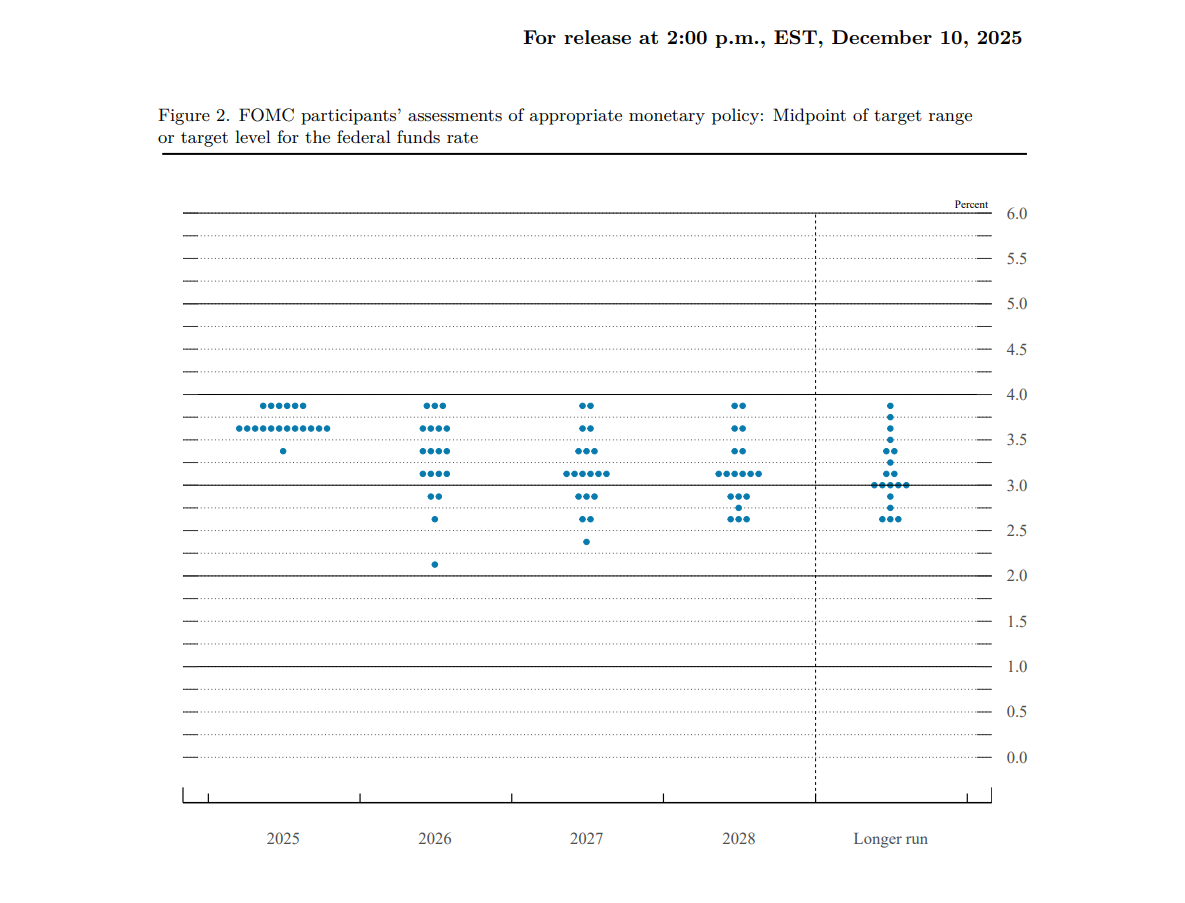
Full text of the Federal Reserve decision: 25 basis point rate cut, purchase of $4 billion in Treasury bills within 30 days
The Federal Reserve cut interest rates by 25 basis points with a 9-3 vote. Two members supported keeping rates unchanged, while one supported a 50 basis point cut. In addition, the Federal Reserve has restarted bond purchases and will buy $40 billion in Treasury bills within 30 days to maintain adequate reserve supply.
Jin10•2025/12/10 21:17
Trending news
MoreCrypto prices
More
Bitcoin
BTC
$92,614.13
-0.37%

Ethereum
ETH
$3,351.71
+0.52%

Tether USDt
USDT
$1
+0.03%

XRP
XRP
$2.06
-2.66%

BNB
BNB
$898.11
-0.50%

USDC
USDC
$0.9998
-0.01%

Solana
SOL
$137.44
-1.07%

TRON
TRX
$0.2799
-1.08%

Dogecoin
DOGE
$0.1445
-2.92%

Cardano
ADA
$0.4585
-2.64%
How to buy BTC
Bitget lists BTC – Buy or sell BTC quickly on Bitget!
Trade now
Become a trader now?A welcome pack worth 6200 USDT for new users!
Sign up now