
Bitcoin spot ETF options could potentially impact demand for the underlying asset, analysts say

Analysts say the SEC’s approval of options for the spot bitcoin ETF marks a significant shift in how institutional investors may engage with bitcoin, with potential implications for demand for the underlying asset.The U.S. Securities and Exchange Commission approved BlackRock’s proposal to list and trade options for its spot bitcoin ETF last Friday.
They noted that the introduction of options on the IBIT ETF might increase the "paper" supply of Bitcoin, as institutional investors can gain exposure to Bitcoin without having to purchase it directly. "Options on spot bitcoin ETFs could also mean that the 'paper' supply of bitcoin will increase, as institutional investors can get exposure to bitcoin buying or selling without having to invest through the spot market, and being long without actually buying bitcoin or being short selling without having to buy bitcoin in the first place," CryptoQuant analysts added.
They pointed to a significant trend in the futures market, where the "paper Bitcoin" supply surged from 279,000 to 549,000 BTC during the 2022 bear market. This increase in open interest indicates a growing preference for Bitcoin derivatives over the physical asset, as investors sought to short Bitcoin without directly participating in the spot market.
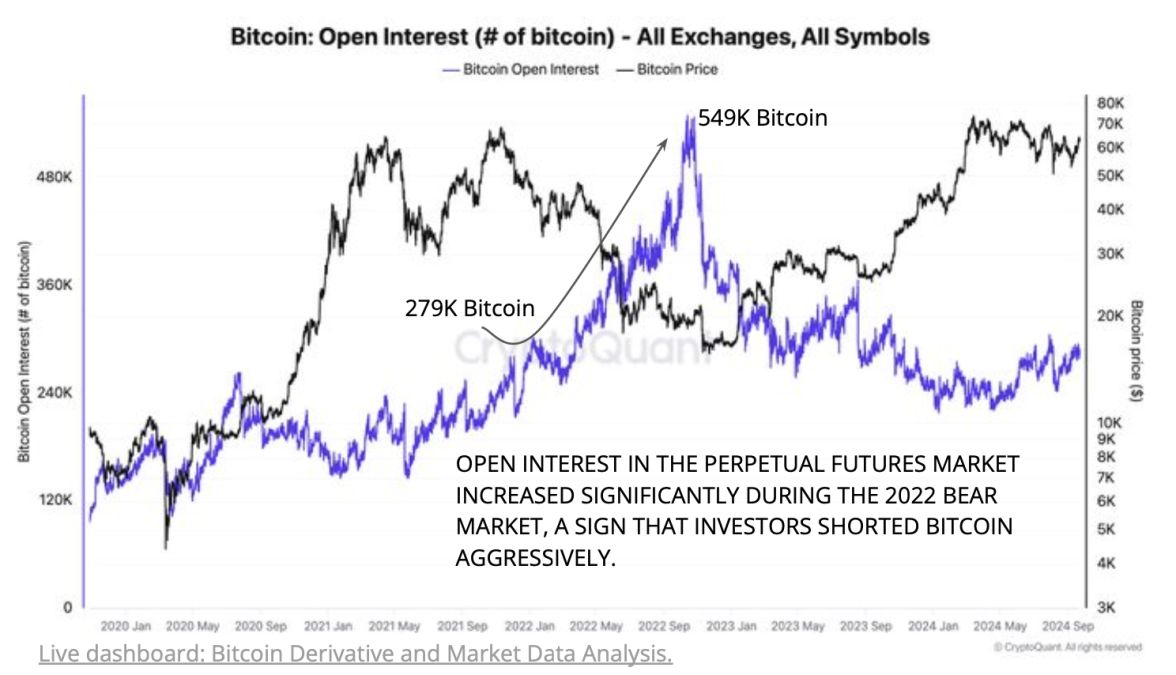
Bitcoin perpetual futures open interest increased significantly during the 2022 bear market. Image: CryptoQuant.
Derivatives insights from the gold market
Derivatives trader Gordon Grant discussed the implications of this trend, drawing parallels with the gold market. He highlighted that while "paper" trading constitutes a substantial portion of total trading volumes, there remains a necessity for physical demand that underpins this supply. "We see that while paper gold trading makes up a significant chunk of the total average daily volumes, so does spot, and while it is true that open interest can burgeon in the paper space, somewhere along the line, paper supply would necessitate paper demand which implicates a physical underpinning," he added.
Grant emphasized that as bitcoin integrates into traditional finance, its use as collateral becomes more complex. Unlike traditional assets, bitcoin isn't as readily accepted as collateral for derivatives contracts. "What is relatively new to bitcoin as we move to traditional financial products is that the digital asset is not easily used as collateral to gain leverage, which is the effective creation of paper contracts backed by bitcoin," he explained.
Grant then said that, as a result, participants will use U.S. dollars rather than Bitcoin for paper contracts. This indicates a preference or necessity for dollar-denominated transactions, likely due to the liquidity and acceptance of dollars in traditional markets. "As such, the necessity for participation in IBIT options will be dollars, not bitcoin itself," he said.
He further explained that the overall market for bitcoin products is expanding. The share of bitcoin derivatives is increasing within that market. "we could see a 'growing pie and growing pie share' phenomenon whereby the overall size of the bitcoin products pie, in terms of average daily volumes, encompassing spot, futures/linear derivatives, and options/nonlinear derivatives, continues to grow in either dollar or bitcoin equivalent units, and the pie-share of bitcoin derivatives also continues to grow," he said.
Grant also mentioned that the price of options could be affected by the new IBIT options product and how it will influence implied volatility . He expressed concerns about a potential volatility squeeze, citing past heightened retail demand for options. "The real question for me is how bitcoin options markets, in terms of the price of optionality as measured by implied volatility, will digest a new source of activity and participatory interest. I wonder about a risk of a potential volatility squeeze in bitcoin options if there is, at some point, frenzied retail-driven demand for bitcoin options, as we saw in the past with GameStop and Ethereum during the EIP 1559 upgrade," Grant added.
Disclaimer: The content of this article solely reflects the author's opinion and does not represent the platform in any capacity. This article is not intended to serve as a reference for making investment decisions.
You may also like
How do 8 top investment banks view 2026? Gemini has summarized the key points for you
2026 will not be a year suitable for passive investing; instead, it will belong to investors who are skilled at interpreting market signals.
Valuation Soars to 11 Billions: How Is Kalshi Defying Regulatory Pressure to Surge Ahead?
While Kalshi faces lawsuits and regulatory classification as gambling in multiple states, its trading volume is surging and its valuation has soared to 11 billion dollars, revealing the structural contradictions of prediction markets rapidly growing in the legal gray areas of the United States.
How will the Federal Reserve in 2026 impact the crypto industry?
Shifting from the technocratic caution of the Powell era, the policy framework is moving towards a more explicit goal of reducing borrowing costs and serving the president's economic agenda.

Babylon partners with Aave Labs to launch native Bitcoin-backed lending services on Aave V4
Babylon Labs, the team behind the leading Bitcoin infrastructure protocol Babylon, today announced the establishment of a strategic partnership with Aave Labs. Both parties will collaborate to build a native Bitcoin-backed Spoke on Aave V4 (the next-generation lending architecture developed by Aave Labs). This architecture adopts a Hub and Spoke model, aiming to support markets built for specific scenarios.
Trending news
MoreCrypto prices
More






