Bitcoin Price Prediction for 2026: What History Tells Us About the Next Cycle
$Bitcoin has never moved in a straight line. Every major rally has been followed by a painful correction, and every deep bear market has eventually set the stage for a new expansion phase. As 2026 approaches, investors are once again asking the same question: is Bitcoin preparing for another major leg higher, or is a prolonged cooling period ahead?
To answer that, we need to step back and look at how Bitcoin has behaved over the years, especially across bullish and bearish cycles.
Bitcoin’s Long-Term Price Behavior: A Cycle-Driven Market
Looking at the weekly Bitcoin chart, one thing becomes clear: Bitcoin moves in cycles, not trends that last forever.
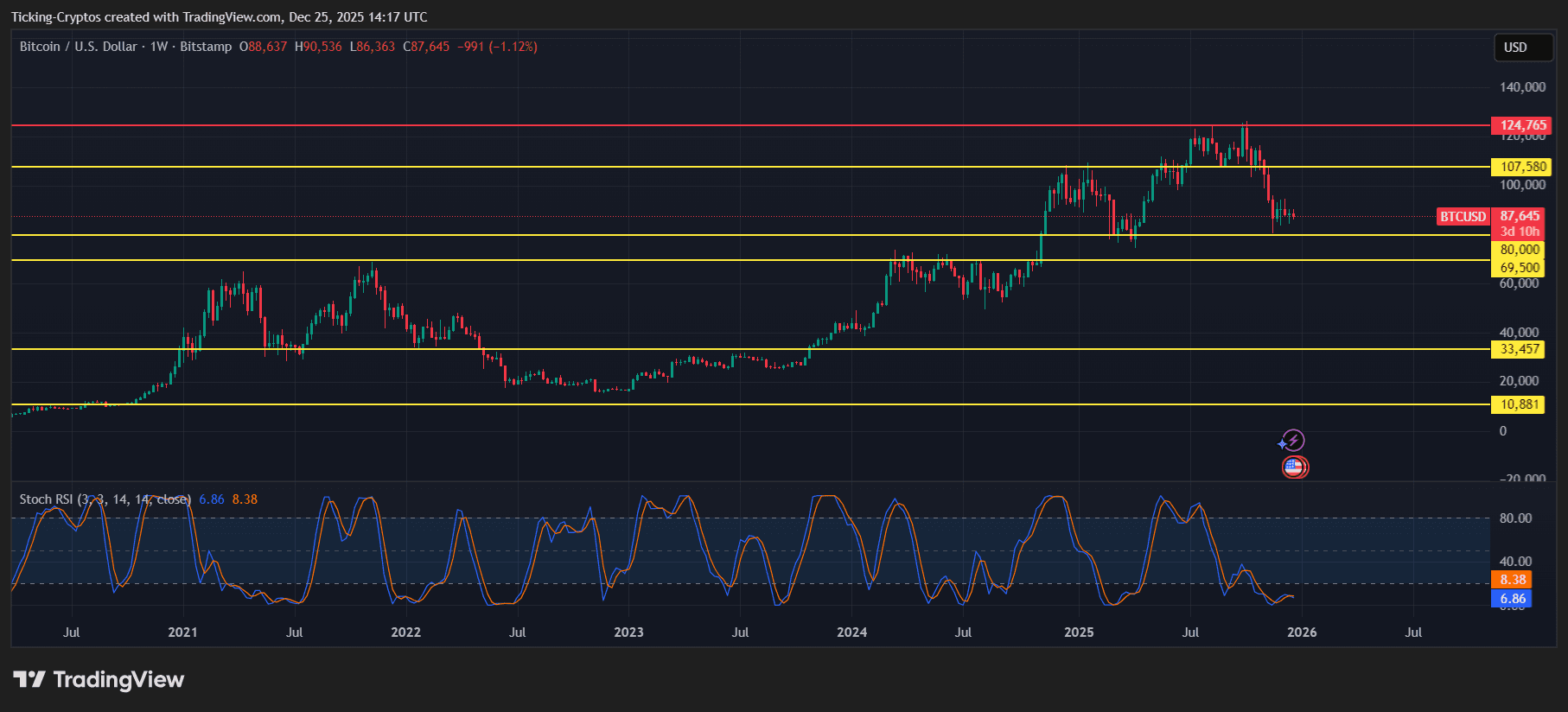
BTC/USD 1W - TradingView
Historically, BTC has followed a rhythm tied to liquidity, macro conditions, and halving events:
- Strong multi-year uptrends are followed by sharp corrections
- Extended consolidation phases often come before explosive rallies
- Major support zones tend to hold across multiple cycles
On the long-term chart, Bitcoin has respected key psychological levels for years. Once broken, these levels often flip from resistance into long-term support — a pattern that continues to shape expectations for 2026.
Monthly Returns Reveal a Clear Pattern
The Bitcoin monthly returns heatmap reinforces this cyclical nature.

Bitcoin Monthly Returns over the past years - coinglass
Over the past decade:
- Bull years show clusters of strong green months, often stacking double-digit gains
- Bear years are marked by extended red periods and sharp drawdowns
- Certain months, like October and November, have historically delivered outsized gains, while others tend to be more mixed
What stands out is that even in bullish years, Bitcoin experiences deep pullbacks, sometimes exceeding 20–30%. This is critical when thinking about 2026: volatility is not a bug in Bitcoin — it’s a feature.
Where Bitcoin Stands Heading Into 2026
From a technical perspective, Bitcoin is entering 2026 after a period of heavy consolidation following a major expansion phase. Price action suggests:
- Long-term buyers are still defending key support zones
- Momentum has cooled compared to peak rally conditions
- Volatility has compressed, which historically precedes large moves
This type of market structure has often appeared mid-cycle, rather than at absolute tops or bottoms.
Bitcoin Price Prediction for 2026: Bullish vs Bearish Scenarios
Bullish Scenario
If liquidity conditions improve and risk appetite returns:
- Bitcoin could reclaim higher resistance zones and push toward new cycle highs
- Long-term accumulation near major support levels may fuel another expansion phase
- A renewed macro tailwind could trigger a strong second leg of the bull cycle
In this case, 2026 could resemble previous continuation years rather than a full market top.
Bearish Scenario
If macro pressure persists and liquidity tightens:
- Bitcoin may remain range-bound or experience a deeper correction
- Previous cycle support zones would come back into focus
- Sideways price action could dominate large parts of the year
Historically, Bitcoin has also spent entire years consolidating before resuming its long-term uptrend.
What History Suggests About 2026
Looking purely at historical behavior:
- Bitcoin rarely peaks and collapses instantly
- Post-rally years often alternate between continuation and consolidation
- Long-term holders tend to accumulate during periods of uncertainty
This makes 2026 less about chasing parabolic moves and more about positioning, patience, and risk management.





