U.S. stocks sprint toward "never closing": Why is Nasdaq launching the "5×23 hours" trading experiment?
In the past, trading US stocks just meant sleepless nights—will it soon mean sleepless days too?
As the Crypto market has long been accustomed to a 7×24 never-sleeping rhythm, Nasdaq, the core hub of TradFi, finally couldn't sit still any longer.
On December 15, Nasdaq officially submitted documents to the US Securities and Exchange Commission (SEC), planning to extend trading hours from the current 5 days a week, 16 hours per day (pre-market / regular / after-hours), to 5 days a week, 23 hours per day (daytime / nighttime).
Once approved, US stocks will trade continuously from Sunday 21:00 to Friday 20:00, leaving only a 1-hour (20:00-21:00) daily market closure window, with the official reason being to "meet the growing demand from Asian and European investors, allowing them to trade during non-traditional hours."
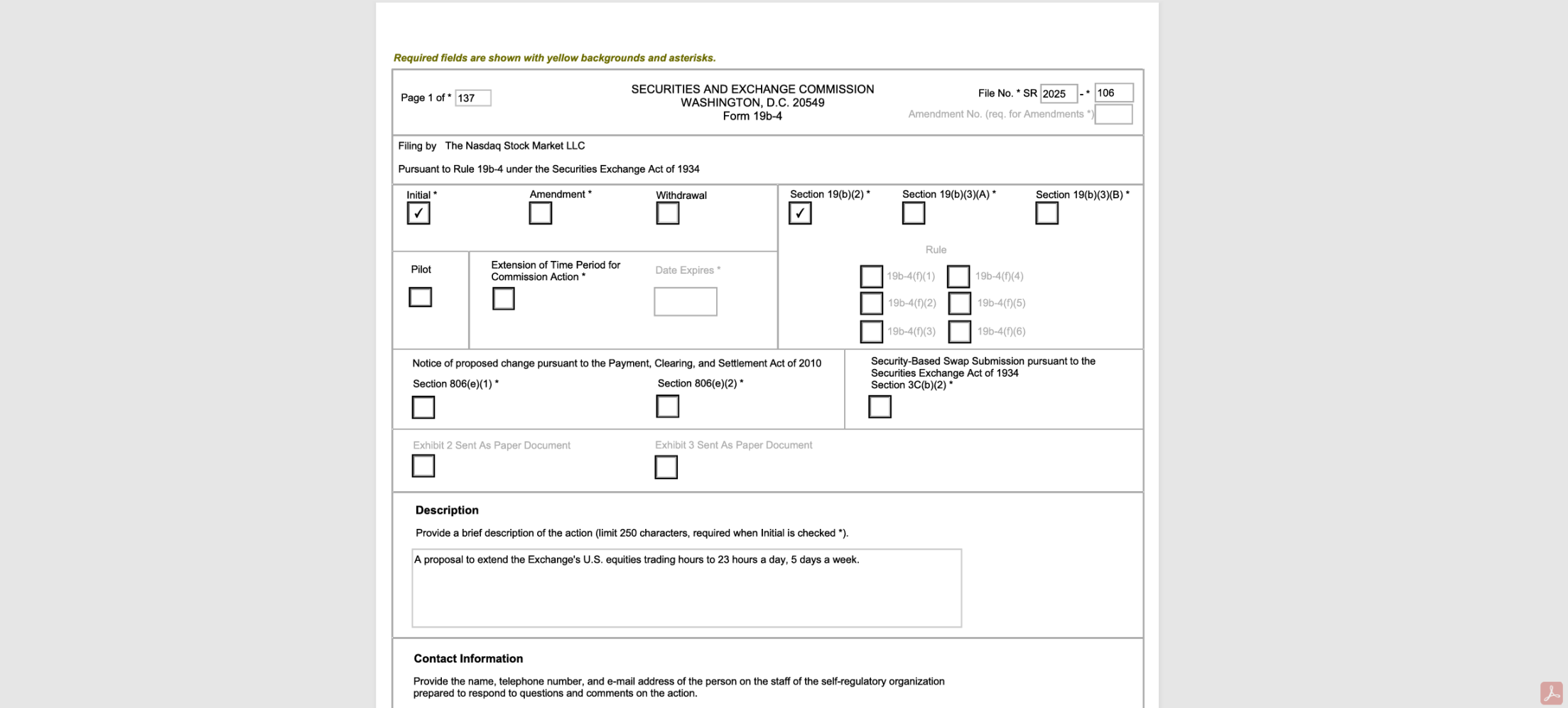
But if you peel back the layers, you'll find the logic goes much deeper—Nasdaq is clearly conducting an extreme stress test for the future tokenization of stocks. We've also pieced together a continuous timeline of developments:
Nasdaq and the US financial markets are preparing for a "never-closing financial system."
I. From 5×16 to 5×23: The "Last 1 Hour" Pushing TradFi to Its Limits
On the surface, this is just an extension of trading hours. But from the perspective of all TradFi participants, this move pushes the technical capacity and coordination of the existing financial infrastructure to its physical limits.
As is well known, stock trading in the TradFi system is a precisely interlocked set of gears. Besides Nasdaq, stakeholders include brokers, clearing institutions, regulators, and even listed companies themselves, meaning that to support 23-hour trading, all market participants must communicate fully and deeply overhaul all aspects such as clearing, settlement, and collaboration systems:
- Brokers and dealers must extend customer service, risk control, and trading maintenance systems to operate around the clock, causing a sharp rise in operational and labor costs;
- Clearing institutions (DTCC) must simultaneously upgrade trading coverage and clearing systems, extending service hours to 4 a.m. to match the new rule of "next-day settlement for nighttime trading" (21:00-24:00 trades count toward the next day);
- Listed companies must also recalibrate the timing of financial reports or major announcements, and investor relations and market participants must gradually adapt to the new reality where "major information is instantly priced by the market during non-traditional hours";
Of course, for those of us in the East 8 time zone, US stock trading previously concentrated in the late night or early morning. The future 5 days × 23 hours model means we can participate in real time without staying up late—a huge benefit. But it also raises a soul-searching question—since reform is already decided, why not go all the way to 7×24, instead of leaving that awkward 1 hour?
According to Nasdaq's public disclosures, the 1-hour gap is mainly for system maintenance, testing, and trade settlement. This precisely exposes the "Achilles' heel" of traditional financial architecture: under the current centralized clearing and settlement system (based on DTCC and broker/bank systems), a physical downtime is required for data batch processing, end-of-day reconciliation, and margin settlement.
Just like bank branches need to reconcile accounts after closing each day, this 1 hour is a "fault-tolerance window" in the real world. Although it requires huge labor shifts and system maintenance costs, it provides a necessary buffer for system upgrades, clearing and settlement synchronization, fault isolation, and risk management under the current financial infrastructure.
However, compared to before, the remaining 1 hour in the future will impose almost harsh demands on the cross-role coordination ability of the entire TradFi industry—it's nothing short of an extreme stress test.
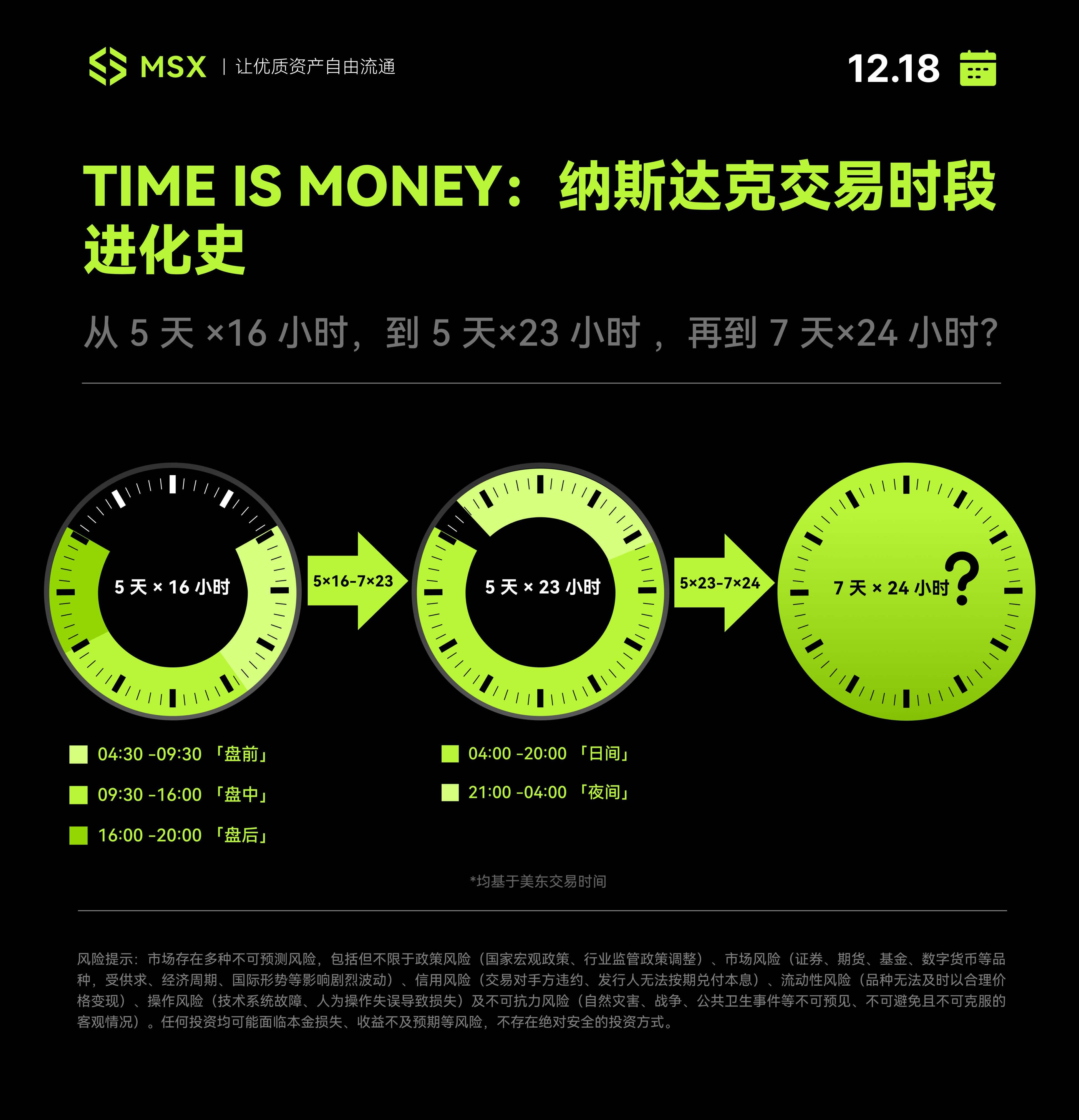
In contrast, Crypto and tokenized assets based on blockchain rely on distributed ledgers and atomic settlement via smart contracts, inherently supporting 7×24×365 trading with no closing, no market breaks, and no need to squeeze key processes into a fixed end-of-day window.
This also explains why Nasdaq is pushing the limits—not out of sudden "consideration" for Asian users, but out of necessity. As the boundaries between the 7×24 Crypto market and traditional financial markets blur, incremental trading demand for traditional exchanges increasingly comes from global capital across time zones and longer liquidity coverage periods.
It can be said that by 2025, tokenization is already inevitable, and players like Nasdaq have already been laying the groundwork behind the scenes (see also "Nasdaq Steps on the Gas: From 'Drinking Soup' to 'Eating Meat,' Is US Stock Tokenization Entering the Decisive Stage?"). From this perspective, the 23-hour trading system is not just an isolated rule change of "a few more trading hours," but rather an institutional transition, paving the way for stock tokenization, on-chain settlement, and a 7×24 global asset network:
Without overturning existing securities laws and the National Market System (NMS), the trading system, infrastructure, and participant behavior are being pushed toward an "on-chain-like" rhythm—testing and laying the groundwork for more radical goals (more continuous trading, shorter settlement cycles, and even on-chain settlement and tokenized delivery) in the future.
Imagine, once SEC approval is granted and the 23-hour trading system becomes the norm, the market's patience threshold and dependence on "anytime trading, instant pricing" will rise. How far away will the truly 7×24 endgame be?
At that point, with the official launch of tokenized US stocks, the global financial system will seamlessly transition to a truly "never-closing" future.
II. What Profound Impact Will This Have on the Market?
Objectively, the "5×23" model could trigger a structural shock across the global TradFi ecosystem.
In terms of time, it significantly expands the boundaries of trading hours, which is a substantial benefit for cross-time-zone investors, especially in Asia. But from a micro-market structure perspective, it introduces new uncertainties in liquidity distribution, risk transmission, and pricing power, making it easy to trigger a "sustainably overfished" global liquidity environment.
In fact, in recent years, the activity of US stocks during non-traditional trading hours (pre-market, after-hours) has exploded.
According to NYSE data, in Q2 2025, non-trading hour volumes exceeded 2 billion shares, with a turnover of $62 billion, accounting for 11.5% of US stock trading that quarter—a record high. Meanwhile, night trading platforms like Blue Ocean and OTC Moon have seen their volumes continue to climb. Night trading is no longer a fringe phenomenon but a new battleground mainstream capital cannot ignore.
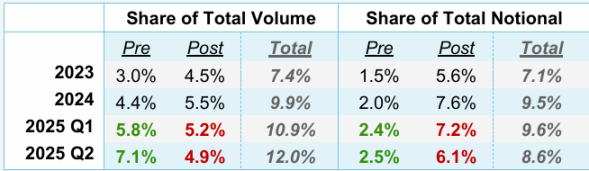
Source: NYSE
Behind this is essentially the concentrated release of real demand from global traders, especially Asian retail investors, to "trade US stocks in their own time zones." From this perspective, Nasdaq is not trying to create demand, but to bring the previously scattered, low-transparency night trading back into the centralized, regulated exchange system using its compliant status, reclaiming the pricing power lost in the shadows.
But the problem is, "5×23" trading does not necessarily lead to higher-quality price discovery. It is more likely to be a double-edged sword with some paradoxical effects:
- First is the risk of liquidity "fragmentation" and "dilution": Although extending trading hours theoretically attracts more cross-time-zone capital, in reality, it means limited trading demand is spread thinner over a longer time axis. Especially during the "night" period of the "5×23" model, US stock trading volumes are already lower than during regular hours, and further extension may lead to wider spreads, insufficient liquidity, higher trading costs and volatility, and even easier price manipulation during thinly traded periods;
- Second is the potential change in pricing power structure: As mentioned above, Nasdaq hopes to recapture scattered orders that have been diverted to platforms like Blue Ocean and OTC Moon through the "5×23" model. But for institutions, liquidity fragmentation doesn't disappear—it just shifts from "off-exchange dispersion" to "on-exchange time segmentation," raising higher demands for risk control and execution models. This fragmented liquidity environment also significantly increases the slippage cost of executing large orders;
- Finally, the possibility that black swan risks are amplified by "zero delay": Under the 23-hour trading framework, major unexpected events (whether earnings shocks, regulatory statements, or geopolitical conflicts) can be instantly translated into trading instructions. The market no longer has a "sleep on it and digest overnight" buffer. In the relatively thin night trading environment, such instant reactions are more likely to trigger gaps, violent volatility, or irrational chain liquidations, exponentially amplifying the destructive power of black swans when there are no counterparties;
This is why, as mentioned above, trading under the "5×23" model is far from simply "opening for a few more hours," nor is it just a matter of "more or less risk." It is a systemic extreme stress test for TradFi's price discovery mechanism, liquidity structure, and distribution of pricing power.
Everything is paving the way for that "never-closing" tokenized future.
III. Nasdaq's Grand Strategy: All Preparations Point to On-Chain
If we take a longer view and connect Nasdaq's recent intensive moves, it becomes even clearer that this is a carefully planned, step-by-step strategic puzzle, with the core goal of enabling stocks to eventually circulate, settle, and be priced like tokens.
To this end, Nasdaq has chosen a gentle, traditional finance-style path of incremental reform, with a very clear and layered roadmap.
The first step occurred in May 2024, when the US stock settlement system officially shortened from T+2 to T+1—a seemingly conservative but actually crucial infrastructure upgrade. Then, at the beginning of 2025, Nasdaq began signaling its intention for "around-the-clock trading," hinting at plans to launch uninterrupted five-day trading services in the second half of 2026.
Next, Nasdaq shifted its reform focus to the more hidden but critical back-end system—integrating blockchain technology into the Calypso system to achieve 7×24-hour automated margin and collateral management. This step brought little visible change for ordinary investors, but for institutions, it was a very clear signal.
By the second half of 2025, Nasdaq began to push forward on the institutional and regulatory fronts.
First, in September, it formally submitted an application to the SEC for stock "tokenization" trading. In November, it made tokenized US stocks its top strategic priority, vowing to "advance as quickly as possible."
Almost simultaneously, SEC Chairman Paul Atkins said in a Fox Business interview that tokenization is the future of capital markets, and that putting securities assets on-chain can achieve clearer ownership confirmation. He expects that "within about 2 years, all US markets will migrate on-chain and achieve on-chain settlement."
It was against this backdrop that Nasdaq submitted its application for the 5×23-hour trading system to the SEC in December 2025.
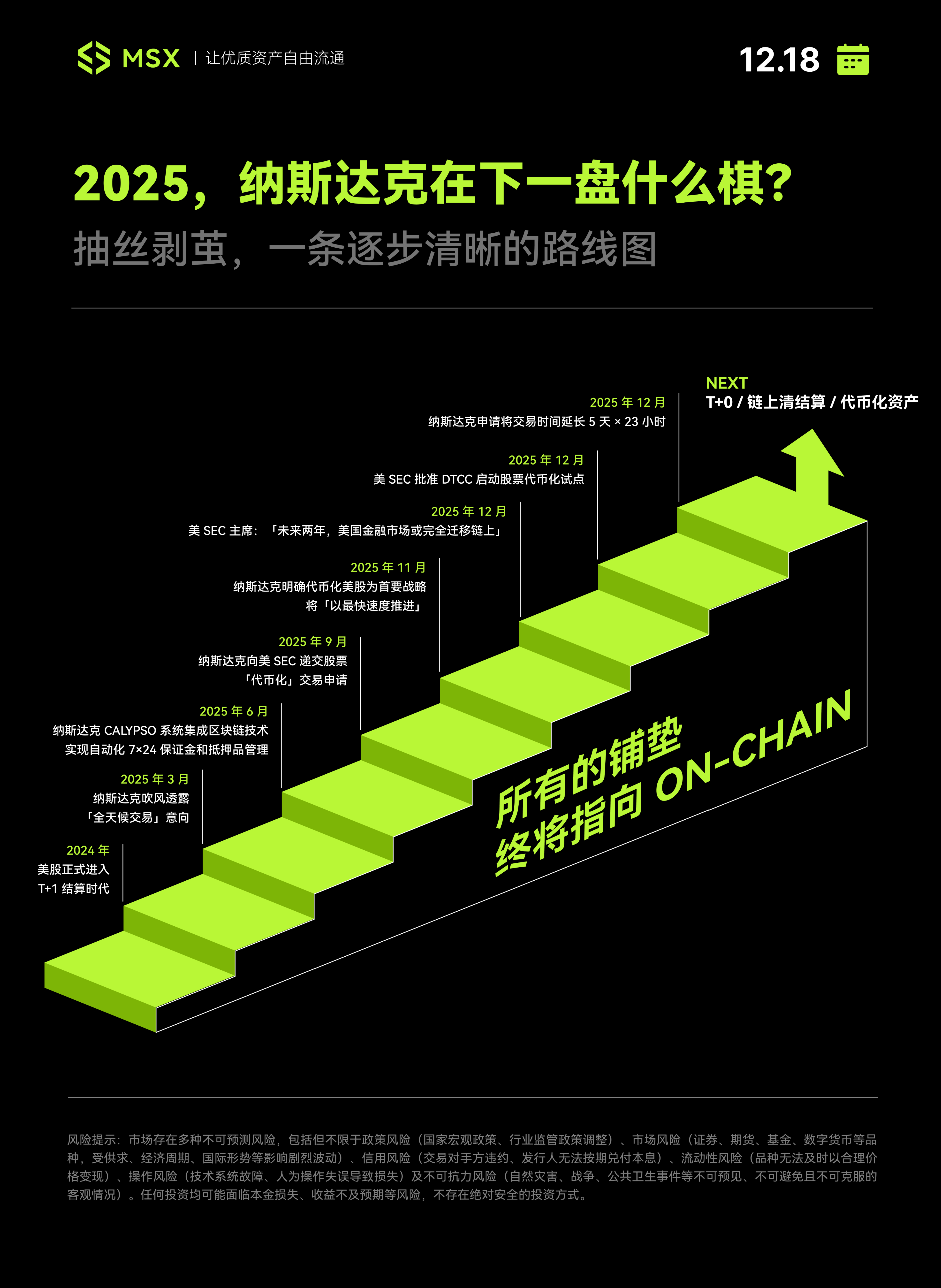
From this perspective, Nasdaq's extension of trading hours to a "23-hour trading system" is not a standalone reform, but a necessary step in its stock tokenization roadmap. Because tokenized assets in the future will inevitably pursue 7×24-hour liquidity, and the current 23 hours is the closest "transitional state" to an on-chain rhythm.
What's most intriguing is that in 2025, regulators (SEC), infrastructure (DTCC), and trading venues (Nasdaq) all showed a highly coordinated rhythm:
- SEC relaxes and sets the tone: On one hand, continuously loosening regulations; on the other, senior interviews consistently signal expectations for "full on-chain," injecting certainty into the market;
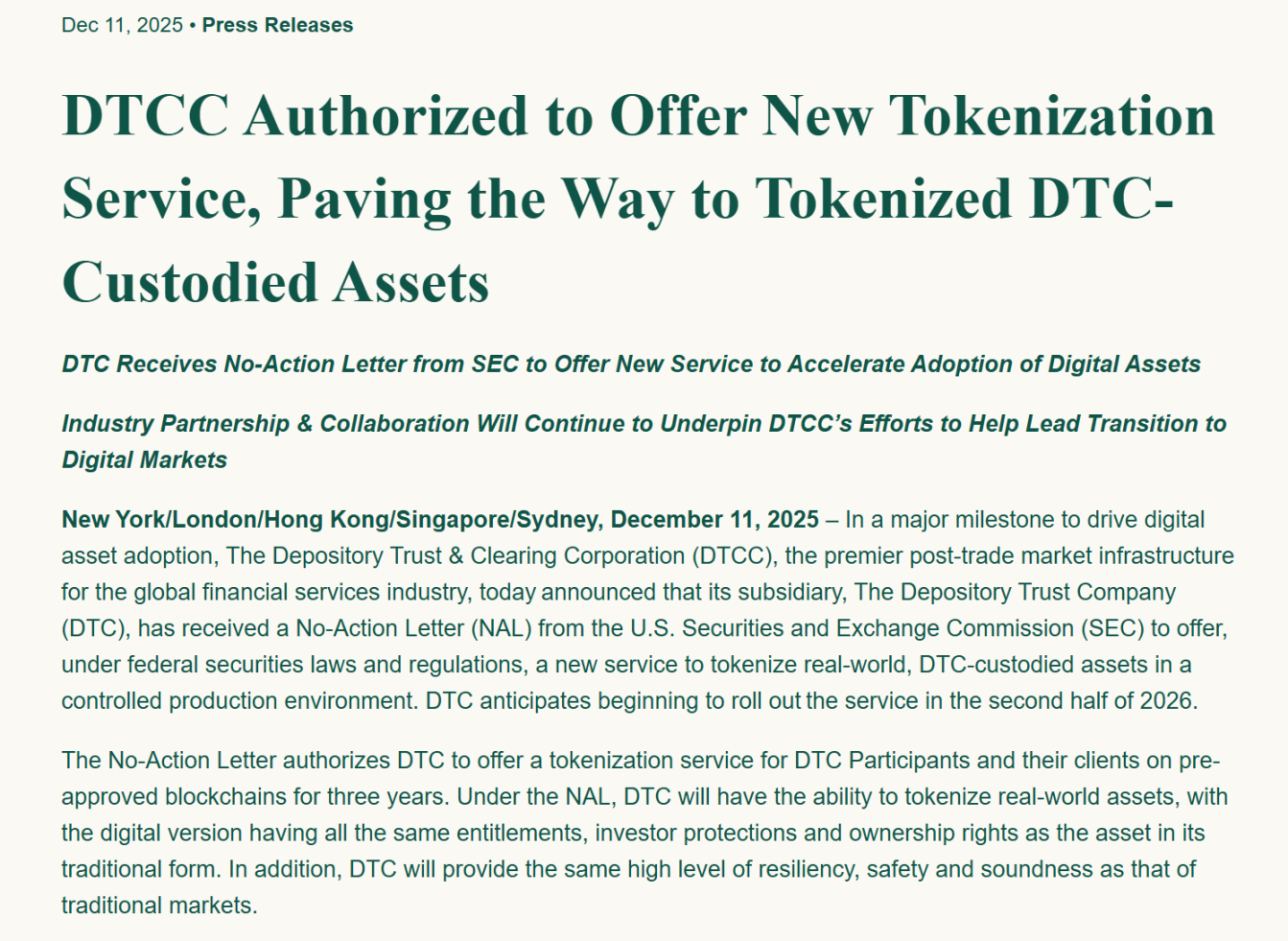
- DTCC lays the foundation: On December 12, DTCC subsidiary Depository Trust Company (DTC) received a no-action letter from the SEC, approving it to provide real-world asset tokenization services in a controlled production environment, with plans to officially launch in the second half of 2026, solving the core issues of clearing and custody compliance;
- Nasdaq charges ahead: Officially announces tokenized stock plans, raises the priority to the highest level, submits the 23-hour trading application, and attracts global liquidity;
Source: DTCC official website
When these three lines are placed on the same timeline, the tacit coordination is hard to ignore:
This is not a coincidence or a sudden whim of Nasdaq, but a highly coordinated, continuously advancing institutional project. Nasdaq and the US financial markets are making the final sprint toward a "never-closing financial system."
Final Words
Of course, once Pandora's box is opened, "5×23 hours" is only the first step.
After all, once human demand is unleashed, it cannot be reversed. So, since US stocks can be traded at midnight, users will inevitably ask: Why must I endure that 1-hour interruption? Why can't I trade on weekends? Why can't I settle instantly with U?
Once global investors' appetites are fully whetted by "5×23 hours," the incomplete architecture of TradFi will face its final reckoning. Only 7×24 native tokenized assets can fill that last hour's gap. This is why, besides Nasdaq, players like Coinbase, Ondo, Robinhood, and MSX are all racing madly—those who run slowly are destined to be swallowed by the on-chain tide.
The future is still far away, but time is running out for the "old clock."





