From an early internet technology pioneer to today’s world-renowned bitcoin evangelist, MicroStrategy co-founder Michael Saylor delivered a speech at Binance Blockchain Week in Dubai, outlining for a global audience a panoramic vision of the future of finance with bitcoin as its value foundation.
His argument goes beyond short-term price fluctuations, delving into the deep logic of institutional transformation, and firmly points out: bitcoin is undergoing a historic leap—from a controversial investment asset to a foundational capital supporting the development of the global digital economy.
And the digital credit system derived from this core will completely reconstruct the traditional credit market, which is as large as $300 trillion, triggering a true revolution in the financial order.

I. A Historical Turning Point
Saylor pointed out at the beginning that the past twelve months have been a key period for a “fundamental reversal” in the global attitude toward bitcoin. This shift did not come from within the tech community, but from the top-level design of traditional centers of power and capital, clearing the way for the full institutionalization of bitcoin.
1. Strategic Embrace from Political Leadership
● The core signal of this turning point comes from the highest political level in the United States. The U.S. President has publicly included support for bitcoin and crypto assets in the national strategic framework, making it clear that the country aims to compete for global leadership in the digital age.
● This is not empty campaign rhetoric; its real significance is reflected in the appointment of key positions in the new administration: the Secretary of the Treasury, the Chairman of the Securities and Exchange Commission (SEC), and even core officials in commerce and intelligence systems are all open supporters of digital assets.
● This means that recognition of bitcoin has risen from a marginal issue to a systemic policy consensus spanning administrative and regulatory fields, providing unprecedented political certainty for the industry’s long-term development.

2. Rapid Collapse of Traditional Financial Barriers
● If the political shift is the “starting gun,” then the follow-up by the traditional banking system is the decisive “sprint.” The global banking industry is known for its conservatism and risk aversion, but the pace of change over the past year has far exceeded expectations.
● The Office of the Comptroller of the Currency (OCC), the Federal Deposit Insurance Corporation (FDIC), and the Federal Reserve—core regulatory agencies—have jointly issued guidance, explicitly encouraging and allowing banks to provide crypto asset custody, accept bitcoin as collateral, and offer related credit services.
● Driven by this, top financial institutions including JPMorgan, Bank of America, and Citigroup have rapidly shifted from skepticism and avoidance to active exploration and business implementation. Wall Street’s full embrace marks bitcoin’s official integration into the arteries of modern finance, providing the strongest credit endorsement for its identity as “capital.”
II. Why Bitcoin Can Become the “Cornerstone”
Saylor emphasized that bitcoin’s ability to bear the responsibility of “digital foundational capital” does not stem from faith or hype, but because it has built a series of solid pillars over the past decade that no other asset can match.
1. Massive Political and User Base
● Behind bitcoin is a global community of shared interests. Hundreds of millions of users worldwide constitute a powerful social and political force. In the United States alone, the proportion of registered voters supporting crypto assets has reached about 30%, making them a voter group that no politician can ignore. This broad and deep grassroots foundation is the fundamental guarantee for bitcoin to resist policy risks and promote favorable legislation.
2. Trillion-Dollar Level of Real Capital Accumulation
● More than $1 trillion in real capital has been permanently injected into the bitcoin network. Taking MicroStrategy as an example, it has continuously invested about $4.8 billion, holding assets accounting for 3.1% of bitcoin’s total circulating supply. This large-scale, publicly listed institutional capital commitment is not short-term speculation, but a strategic choice to treat bitcoin as a core reserve asset, proving its maturity as a store of value.
3. The Most Powerful Distributed Computing Network in Human History
● The bitcoin network’s hash rate has exceeded 1,000 EH/s, a scale even greater than the combined computing power of all data centers owned by tech giants like Google and Microsoft. This decentralized computing network, composed of millions of mining machines worldwide, is an insurmountable barrier to ledger security. The level of security it provides is unattainable by any centralized system or traditional financial infrastructure.
4. An Energy Foundation Anchored in the Physical World
● The bitcoin network continuously consumes about 24 gigawatts of electricity, equivalent to the full output of 24 large nuclear power plants, with energy consumption exceeding the operational needs of the entire U.S. Navy. This large-scale, specialized use of real-world energy is the key process that firmly anchors the value of virtual digital assets in physical reality.
● It proves that bitcoin’s value is not a castle in the air, but is supported by tangible global energy conversion.
III. From Capital to Credit
Saylor did not stop at macro-level discussion, but used MicroStrategy as an example to explain in detail how to transform bitcoin as “raw capital” into “digital credit” that can serve broader economic needs, outlining the concrete practice of a “bitcoin treasury company.”
1. “Polarization” Capital Strategy: Restructuring Corporate Finance
● Traditional corporate finance faces a fundamental contradiction: the cost of corporate capital (such as an equity expected return of about 14%) is much higher than the yield on cash-like assets held (about 3%), which essentially erodes shareholder value over time.
● MicroStrategy’s strategy is to implement a “polarization” transformation: by issuing equity or bonds (at a cost of about 6%-14%), it raises funds to purchase bitcoin assets with a historical annualized return of about 47%. This operation creates huge value surplus, making the company’s capital structure stronger as it expands, achieving a fundamental shift from “value erosion” to “value creation.”
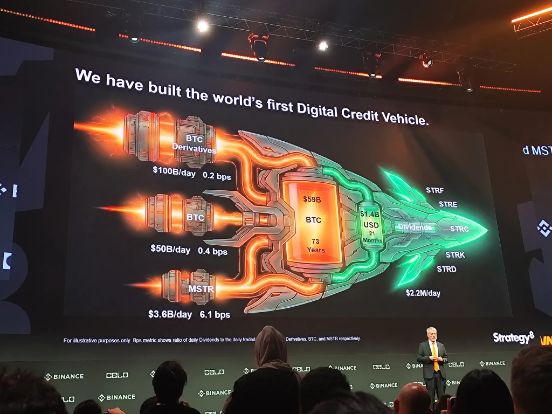
2. Building a “Digital Credit Product Factory”
The company’s ultimate goal is to transform highly volatile bitcoin capital into financial instruments that can generate stable and predictable cash flows. To this end, they have designed a product matrix for investors with different risk preferences:
● Flagship Product STRC: Positioned as a “high-yield bank account.” Its price remains stable around $100, with minimal volatility, but it offers an annualized yield of about 10.8% and pays dividends monthly. Its target is to meet the needs of investors seeking stable cash flow and averse to principal volatility.
● Tiered Risk Products: STRF (and the euro version Stream) are super-senior credit products with the highest security and a yield of about 9%; STRD is a long-duration high-yield instrument with a yield of up to 12.9%; STRK, as a structured product, allows investors to retain part of the bitcoin upside while receiving interest payments.
● Revolutionary Tax Efficiency: Saylor revealed one of the core advantages of their model—tax structure. By paying dividends to credit product holders in the form of “return of capital” rather than “taxable interest,” investors receive almost tax-free cash flow. This makes STRC, a product with a nominal yield of 10.8%, deliver a post-tax equivalent yield of about 17% for U.S. investors, forming an absolute “dimensionality reduction blow” compared to traditional bank savings or money market funds that are fully taxable.
IV. The Future Landscape
The vision Saylor depicts goes far beyond a single company’s product innovation; it is a systematic reshaping of the global credit system.
1. Repairing the Distorted Global Yield Curve
● In economies like Switzerland and Japan, which have long been in zero or even negative interest rate environments, the traditional financial system cannot provide real returns for savers.
● Digital credit tools can provide robust yields of over 10% in local currencies (such as Swiss francs or yen), effectively “rebuilding” a healthy yield curve for these economies, protecting the purchasing power of people’s savings, and solving the long-standing problem of financial repression in developed countries.
2. Comprehensive Upgrade of Traditional Credit Models
● Compared with traditional bank credit or corporate bonds, digital credit based on bitcoin collateral has natural advantages: high transparency (collateral ratios and risk models are updated publicly every 15 seconds), homogeneity (the underlying asset is single and clear), and extreme liquidity (the collateral is one of the most liquid assets globally, and the credit products themselves are actively traded).
● The issuance and matching efficiency is extremely high; hundreds of millions of dollars in credit lines can be created and allocated within a day, whereas traditional real estate or project financing cycles can last for years.
3. Fostering a Global “Bitcoin Treasury Company” Ecosystem
● The MicroStrategy model is replicable. In the future, localized “bitcoin treasury companies” are expected to emerge in Japan, South Korea, Europe, and other regions. They will use the same logic to provide efficient digital credit services for their domestic markets. This means that the digital capital and credit system based on bitcoin will no longer be limited to the U.S. or a few institutions, but will become a global, open, and competitive new financial ecosystem.
V. Embracing Volatility, Harnessing the Energy of the Digital Age
At the end of his speech, Saylor directly addressed the perennial doubts about bitcoin’s volatility. He offered a philosophical perspective: volatility is not a flaw, but an external manifestation of immense energy density. Just as nuclear reactions contain enormous energy, the volatility of bitcoin’s price precisely reflects the tremendous energy it gathers as a “capital engine” of the new era, capable of transforming the world.
For individuals and institutions, he provided a clear path of choices:
● If you seek long-term growth and can withstand volatility, you should directly hold “digital capital” like bitcoin.
● If you need stable cash flow or have a lower risk tolerance, you can participate in the growth dividends of the bitcoin network by investing in digital credit tools (such as STRC), while effectively managing volatility risk.
● If you are an enterprise or builder, you should consider how to integrate the “bitcoin capital + digital credit” model into your own balance sheet or business structure to achieve a leap in efficiency.
Saylor’s speech ultimately points to a grander proposition: the digitalization of the world is irreversible. From information to assets, and to the underlying rules of finance, everything is being digitally reconstructed. Bitcoin and the new financial system it has spawned are the most central “source of energy” in this reconstruction.
His closing remarks were profound: “Don’t instinctively run away from the flames, but learn how to move forward within them.” In this sweeping wave of digital civilization, bitcoin is no longer just an investment target, but the key cornerstone for understanding and participating in the future.





