Key Highlights to Watch at Solana Breakpoint 2025
Author: BlockBeats
Solana Breakpoint 2025 was held from December 11 to 13 in Abu Dhabi, UAE, bringing together over 6,000 developers and project teams from more than 100 countries, focusing on the latest progress and future development of the Solana ecosystem.
Industry leaders such as Real Vision co-founder and CEO Raoul Pal, Solana co-founder Anatoly Yakovenko, Solana Foundation Chair Lily Liu, and Galaxy founder and CEO Mike Novogratz attended and delivered speeches. BlockBeats will provide real-time updates and coverage from the conference site. The following is the latest content:

December 12
Figure has submitted an application to the US SEC for native stock issuance on Solana
On December 12, Figure Executive Chairman Mike Cagney stated at Solana Breakpoint, "About a week and a half ago, we released another development—essentially conducting a second IPO, where we are natively issuing a new version of Figure equity on a public blockchain.
This issuance will not go through DTCC, nor will it be traded on Nasdaq or NYSE, nor will it rely on introducing brokers like Robinhood, and certainly not on prime brokerage services from institutions like Goldman Sachs. This is a blockchain-native security, traded on Figure's own alternative trading system (ATS), which is essentially a decentralized trading platform: self-custody, self-execution, self-market.
Investors will be able to bind these securities to an ATS wallet, instead of a traditional introducing broker account; then they can use this equity for collateralized lending, borrowing, and other operations in DeFi."
Kamino Co-founder: Fixed-rate and fixed-term lending products coming soon, enabling true interest rate price discovery
On December 12, Kamino co-founder Marius stated at Solana Breakpoint, "We are about to launch fixed-rate, fixed-term lending products. Users will be able to choose the interest rate and term, and execute trades at that rate.
This mechanism allows institutions that need to determine financing costs to enter the market, while also enabling asset cycling strategies to achieve lockable stable spreads.
We are working with Fal X (one of the largest brokers in our market), and an important subcomponent is lending intent—it allows both borrowers and lenders to place orders at their desired rates, enabling true on-chain interest rate price discovery and forming an on-chain yield curve."
Drift Co-founder: Mobile App to launch in Q1 2026
On December 12, Drift co-founder Cindy stated at Solana Breakpoint, "We will launch a mobile App in the first quarter of next year.
This will be the first native application integrating multi-collateral accounts on mobile, and will also include: Launch App Store, native mobile experience, and upcoming native liquidity provision tools to bring deeper liquidity and faster execution efficiency."
Perp DEX aggregator Ranger: Token public sale to launch, aiming to raise $6 million
On December 12, Ranger Finance developer FA2 stated at Solana Breakpoint, "We are ready to issue the Ranger token. For Ranger, the most suitable launch platform is MetaDAO, with a minimum fundraising target of $6 million, which will also be the highest fundraising goal for the platform to date."
Metaplex announces official release of the first public version of Genesis SDK, anyone can build issuance platforms or access token data
On December 12, Metaplex Chief Design Lead Stephen stated at Solana Breakpoint, "The first public version of Genesis SDK is now officially live. Genesis SDK will empower various applications—for example, trading platforms wishing to build their own Launchpad, or aggregators wishing to monitor and alert traders.
When new tokens go live on-chain, any application can integrate and immediately use the smart contracts for fair issuance."
Bulk Co-founder: Solana is currently the best ecosystem to build on
On December 12, Bulk co-founder Jun stated at Solana Breakpoint, "As market makers, when we traded on different platforms, spot and perpetual markets, we quickly realized that Solana is currently the best ecosystem to build on—not only does it have the best teams, but also the highest net asset inflows, the most diverse community, and rich products. But it has always lacked a truly professional trading experience, and the problem ultimately boils down to a few key points: latency, a robust risk engine, and user experience. We came to Solana to solve this problem."
Backpack Founder: Solana is currently the only network capable of large-scale decentralized execution
On December 12, Backpack founder Armani Ferrante stated at Solana Breakpoint, "Solana is currently the only network capable of large-scale decentralized execution. Over the past few years, developers have explored a huge design space on how to solve scaling issues. Back in 2017 and 2018, there may have been hundreds of projects that raised hundreds of millions or even billions of dollars. But as far as I know, Solana seems to be the only project that can truly achieve this at scale."
HumidiFi Developer: Solana is completely reshaping retail finance, HumidiFi spreads "beat" Binance
On December 12, Ben, a core team member of the dark pool DEX HumidiFi, stated at Solana Breakpoint, "On the road to transforming the world, Solana can now settle tens of thousands of transactions per second at near-zero cost. Anyone globally can access it—through new seat licensing and membership tier systems, entering a fully open, permissionless, Wall Street-grade, programmable, global market.
We recently built a decentralized trading platform called 'HumidiFi', which offers tighter spreads than Binance, with average execution spreads of just a few basis points. But what I really want everyone to realize is: this system is completely reshaping retail finance. Retail investors can now get better spreads than any traditional brokerage platform, with average spreads narrowed to just a few basis points.
Currently, this system already accounts for 60% of all on-chain trading volume—and we're just getting started."
Solana Co-founder: Most startups with recent $100 million+ revenue are built on Solana, ecosystem expansion accelerates
On December 12, Solana co-founder Raj Gokal stated at Solana Breakpoint, "Among the 20 companies that recently reached $100 million in revenue, most are from the crypto industry, and the majority of those are built on Solana. This has always been our original goal.
I believe achieving this requires the 'entropy' brought by thousands of entrepreneurs—they constantly explore all possible value propositions using block space. And I think Solana now has this ecosystem momentum. Hackathons like 'Colosseum' are getting bigger, with over 1,700 teams participating each time.
When we talked about scaling in the past, a common metric was: what percentage of global financial business can be put on-chain. I believe Solana has a chance to accelerate its share in crypto over the next 10 years. And in reality, the crypto industry's development is much faster than we expected in 2017.
At that time, we couldn't imagine that the US would have such a clear regulatory environment today, nor that we would get support from major countries—they are starting to issue assets on-chain, and major banks are joining in. So I think Solana should raise its original on-chain target to 25%, and Solana can at least capture 10% of this market."
Solana Co-founder Toly: No longer has official GitHub commit rights, network moves towards true decentralization
On December 12, Solana co-founder Anatoly Yakovenko stated at Solana Breakpoint, "My favorite thing is: decentralization doesn't mean no leaders, but rather the emergence of many leaders. Over the past five years, so many people have stepped up—from the Foundation, Labs, and also community members, application and protocol builders who are not part of these initial organizations—they have truly taken on leadership roles for the entire network.
Now, I don't even have GitHub commit rights anymore, and my speech on stage only took two minutes. My goal is to sit in the audience—I think this means seeing the network truly mature and have a life of its own. I am very proud of this."
Anza VP: Reducing Solana block state costs, account creation rent to be reduced by 10x
On December 12, Anza VP of Core Engineering Brennan Watt stated at Solana Breakpoint that proposal SIMD-0389 could reduce Solana account creation rent by 10x, with potential scalability up to a 100x reduction.
Note: In the Solana network, Account Rent refers to a "storage fee" mechanism required to allow an account to permanently store data on-chain.
According to Anza's analysis of the security deceleration mechanism, this change was discussed at the recent SolanaConf and could unlock broader adoption by reclaiming hundreds of millions of dormant SOL, while maintaining network security.
Solana ecosystem MEV-based liquid staking rewards protocol Toby to launch token
On December 12, Solana ecosystem MEV-based liquid staking rewards protocol Toby announced at Breakpoint that it will launch the TOBY token, aiming to bring base yield to Solana through OpenMEV.
Reportedly, OpenMEV plans to serve the ecosystem's $10 billion real yield demand and will be integrated into multiple mainstream protocols such as Jupiter, Sanctum, Kamino, and Drift.
Jupiter stablecoin JupUSD expected to launch next week
On December 12, Jupiter announced at Solana Breakpoint that its stablecoin JupUSD is expected to launch next week.
BlockBeats previously reported that on October 8, Ethena and Jupiter partnered to launch the native Solana stablecoin JupUSD. The token is planned to go live in Q4. Jupiter plans to "gradually" convert about $750 million of USDC in its liquidity provider pool to JupUSD.
Solana Breakpoint 2026 Summit to be held in London, UK
On December 12, according to official news, the Solana Breakpoint 2026 Summit will be held for the first time at the Olympia Exhibition Centre in London, UK, from November 15–17, 2026.
December 11
Raoul Pal: Current bull market cycle should peak in 2026, crypto is actually a macro asset
On December 11, former Goldman Sachs executive, author of "Global Macro Investor," and Real Vision co-founder and CEO Raoul Pal stated at Solana Breakpoint:
"A declining labor participation rate means a shrinking workforce. Demographics are key to driving debt. Population growth will continue to decline, which means the debt-to-GDP ratio will keep rising, and that's the problem.
We have to face the global debt issue, and currency devaluation has always been a way to solve (or delay) this problem. We're already seeing signs that the Fed has to reconsider its balance sheet and start thinking about how to 'monetize' all this debt. Over the next 12 months, we are expected to need to print about $8 trillion in liquidity injections.
I know many people may think the crypto cycle is over, that 'the good days are gone.' But in fact, what drives all this is the cycle, not the bitcoin halving cycle, but the debt maturity cycle.
So, I think it's not a 4-year cycle, but a 5-year cycle. In a 5-year cycle, we've already passed the trough, the next step is the upward phase, and the cycle should peak at the end of 2026, not 2025. This is a breakthrough realization for us as global macro investors: understanding that crypto is actually a macro asset.
In addition, the altcoin/bitcoin cross rate is driven by the business cycle, and the business cycle looks like it's bottoming, not peaking."
Solana Co-founder: Stablecoins are the clear direction, Solana will capture as much market share as possible in the competition
On December 11, Solana co-founder Anatoly Yakovenko stated at Solana Breakpoint that the core of achieving growth is to continuously build products people need. He emphasized that stablecoins are the clear direction, and it is expected that $1 to $10 trillion in stablecoins will be put on-chain in the future, driving the gradual tokenization and on-chaining of about $500 trillion in global assets.
Toly said that the strong property rights protection and free-market capitalism brought by public chains and cryptography do not conflict with Wall Street logic, but rather complement each other by eliminating failures and risks through software, thus expanding Wall Street's financial scale at a faster pace. He emphasized that stablecoins are expanding rather than replacing the dollar, L1s, especially PoS networks, have clear value capture mechanisms, and Solana's goal is to capture as much market share as possible in this competition.
Lily Liu: SOL spot ETF saw nearly $1 billion net inflow in 6 weeks against the market, DAT companies will bridge Solana and public markets
On December 11, Solana Foundation Chair Lily Liu stated at Solana Breakpoint 2025:
"Solana is the first blockchain platform to establish a policy research institute. Today, it is imperative for every institution to develop a digital asset strategy. As these institutions enter the blockchain space, they are choosing Solana. Western Union, which processes over $60 billion in remittances annually, chose Solana. Pfizer, which processes $2 trillion in merchant payments annually, also chose Solana. Other institutions are following suit.
Of course, ETF is a major theme this year. We finally have physically-backed Solana staking ETFs—they landed in the Solana ecosystem about six weeks ago, and in just six weeks, assets under management have approached $1 billion. During a period of overall market weakness, we saw three consecutive weeks of net inflows. There are already six physically-backed Solana staking ETFs listed in the US market alone.
Another important theme this year, though somewhat controversial, is DAT (crypto treasury companies). Many see DAT as a short-term liquidity tool, but we hold the opposite view. Because Solana is one of the few platforms that allows enterprises to build at both the infrastructure and asset layers. We believe DAT will be long-term ecosystem companies, serving as bridges to connect Solana with public markets, building infrastructure, asset management systems, and integrating all these functions."
Coinbase Executive: Solana-based DEX trading feature now live on App
On December 11, Coinbase Solana Product Lead Andrew Allen stated at Solana Breakpoint that Coinbase has launched Solana-based DEX trading functionality in its App, allowing users to directly trade any Solana on-chain token in a familiar interface, and pay with USDC, USD cash, bank accounts, or debit cards, with slippage and routing handled automatically in the background.
Andrew stated that Coinbase is fully expanding native support for Solana, and in the future, users will be able to see Solana assets directly in the App, ensuring that millions of Coinbase users can access them without a token listing process as long as there is sufficient liquidity.
Bitwise Co-founder: Solana ecosystem applications truly utilize the last 1% of network performance
On December 11, Bitwise co-founder and CIO stated at Solana Breakpoint that compared to networks like Ethereum, applications on Solana truly utilize the last 1% of performance, providing users with the next marginal liquidity and scalability.
On many chains, running a node is just "downloading software and double-clicking to start," and then whoever stakes more or less, it makes little difference to the network or what applications users can build; but on Solana, the application landscape changes daily, the protocol layer, performance, and capacity are rapidly iterating, and node performance directly determines the ceiling.
Because of this, we are particularly concerned: as this product (referring to staking ETF/trust) locks more and more SOL, and its weight increases, the ecosystem, developers, users, and the entire community must feel that—its scale expansion will not "break" the market structure or ecosystem, but rather make the network more stable, reliable, and able to support the next round of innovation.
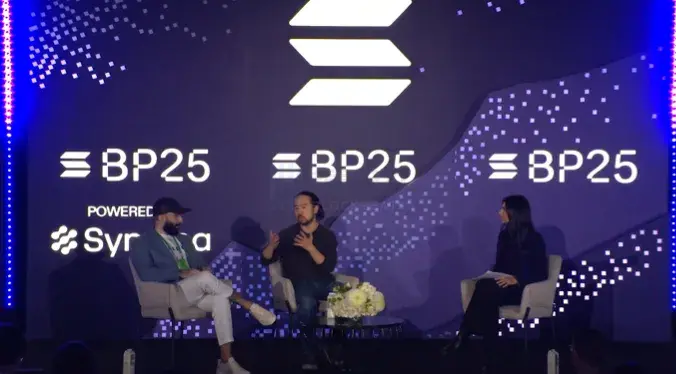
Paxos CEO: Has applied to the US SEC for clearing agency license to natively issue on-chain stocks and bonds
On December 11, Paxos co-founder and CEO Chad Cascarilla stated at Solana Breakpoint that Paxos has applied to the US SEC to become a clearing agency, and in the future will be able to directly custody and natively issue on-chain stocks and bonds, allowing users to hold real underlying assets rather than derivatives. He emphasized that this will lay a key foundation for large-scale on-chaining of traditional financial assets.
Cascarilla said Paxos aims to promote traditional assets entering the on-chain environment and to continue expanding in the stablecoin and asset tokenization fields, including the growth of USDG and gold tokenization products. He believes public chains will become a globally unified asset trading venue, significantly improving market accessibility and liquidity.
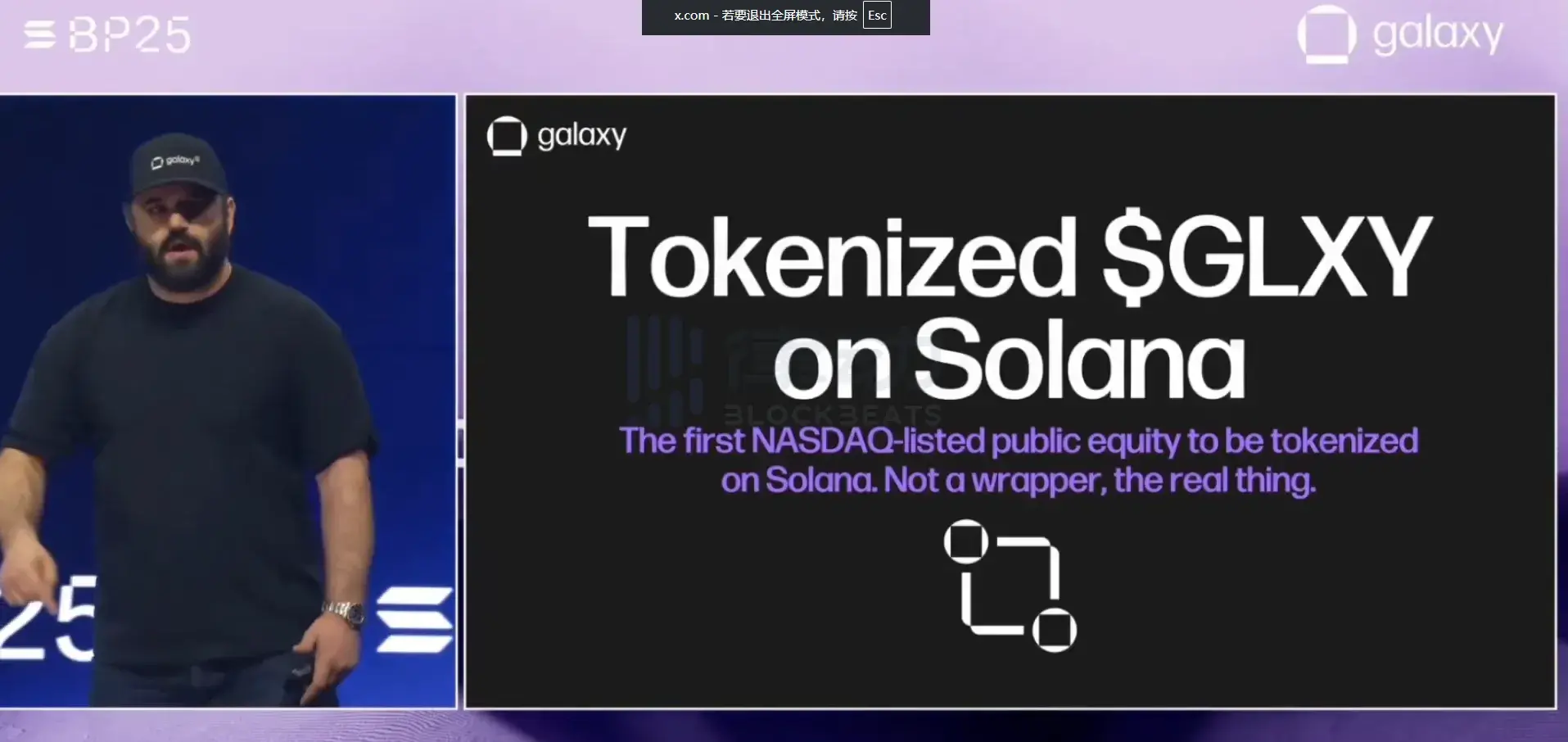
Galaxy DeFi Head: Solana is the only blockchain capable of supporting tokenized securities
On December 11, Galaxy DeFi Head Marcantonio stated at Solana Breakpoint: "Galaxy Digital is listed on Nasdaq and is a publicly traded stock. But we chose to tokenize our own stock on Solana, because in our view, Solana is the only blockchain with the required speed and efficiency to support tokenized securities.
We hope Solana can achieve absolute dominance, so that when you compare the price of the same asset on Solana and Nasdaq, you will choose to buy it on Solana. That is our ultimate goal."
Anza Chief Economist Max Resnick: SOL trading volume on Solana network is already three times that of Binance, competition is extremely fierce
On December 11, Anza Chief Economist Max Resnick stated at Solana Breakpoint, "In May, we reached 100,000 TPS. Not on testnet, not in a whitepaper, but on mainnet. The market structure is also evolving in real time: proprietary market makers are tightening spreads, and now SOL-USD trading volume is already three times that of Binance, competition is extremely fierce, and the order book is getting tighter and deeper every day."
Circle CEO: Circle Gateway to launch on Solana
On December 11, Circle co-founder and CEO Jeremy Allaire stated at Solana Breakpoint that Circle will soon launch Circle Gateway on Solana, enabling cross-chain instant access to unified USDC balances.
Sunrise CEO: Successfully launched MON, trading volume in first 24 hours surpassed Hyperliquid and many CEXs
On December 11, Sunrise CEO Saeed stated at Solana Breakpoint that Sunrise's first asset launch case on Solana was the MON token. We brought a non-native token, originally not issued on Solana, directly into the Solana ecosystem on the first day, first minute of launch. It not only competed with all other on-chain trading venues, but also faced off against many CEX competitors.
As a result, within 24 hours of listing, its trading volume surpassed well-known platforms such as Hyperliquid, KuCoin, Kraken, Coinbase, Bybit, Bitget, Gate—some of which have over a million users. Even more impressively, its spread was tighter and trading volume higher than these established CEXs, all supported solely by Solana's native ecosystem user base.
In addition, Saeed believes that if assets can be issued on Solana and can be as competitive as their centralized trading counterparts, then it's not just about listing crypto tokens, but also stocks, commodities, or any financial product.
Helius CEO: Recommends investors buy BSOL, helps developers build faster applications
On December 11, Helius CEO mert stated at Solana Breakpoint that investors can buy the BSOL stock token issued by Bitwise and managed by us (i.e., Bitwise's SOL spot ETF), but because you bought it, we use the proceeds to make the network run faster—so your transaction directly helps developers build applications faster.
Circle CEO: Solana's appeal is growing, more platforms are adopting USDC on Solana as their main infrastructure
On December 11, Circle CEO Jeremy Allaire stated at Solana Breakpoint that Solana's trading volume far exceeds all other chains. Solana's infrastructure is maturing, and its appeal is growing. More and more large consumer- and merchant-facing platforms are using USDC on Solana as their preferred infrastructure.
DoubleZero Co-founder: 15 core contributors are providing fiber optic cables for Solana to build a high-performance alternative Internet
On December 11, DoubleZero co-founder Austin Federa stated at Solana Breakpoint that DoubleZero has many independent contributors—now up to 15—who are contributing fiber capacity to the Double Zero network. These are real physical fiber cables, being connected to create a completely independent transmission path for Solana.
This "crowdsourced fiber" approach is unprecedented: all existing high-performance chain networks are operated by a single company holding a master private key; Double Zero has no such "single point," but rather 15 contributors each laying and controlling their own fiber lines.
Yat Siu: Animoca Brands has invested in over 628 portfolio companies, about 200 are gaming projects
On December 11, Animoca Brands co-founder and director Yat Siu stated at Solana Breakpoint that Animoca Brands has invested in over 628 portfolio companies, about 200 of which are gaming projects. He believes bitcoin is like digital gold, while altcoins are like the stock market and are the growth engine of the crypto space. Given that altcoins carry real use cases, their total market cap will eventually far surpass bitcoin.
OSL Group to issue stablecoin USDGO on Solana
On December 11, OSL Group Chief Business Officer Zhang Yinghua stated at Solana Breakpoint 2025 Summit that OSL Group will launch the USDGO stablecoin with the Solana network. OSL Group will serve as the brand and distributor of USDGO, while Anchorage Digital Bank will be the issuer.
Reportedly, USDGO is pegged 1:1 to the US dollar, is subject to US federal regulation, and is planned to officially launch in Q1 2026. Solana will be the first public chain to deploy USDGO, with plans to expand to more chains in the future. It is not just "another stablecoin," but a truly compliant stablecoin payment infrastructure for enterprises and institutions.
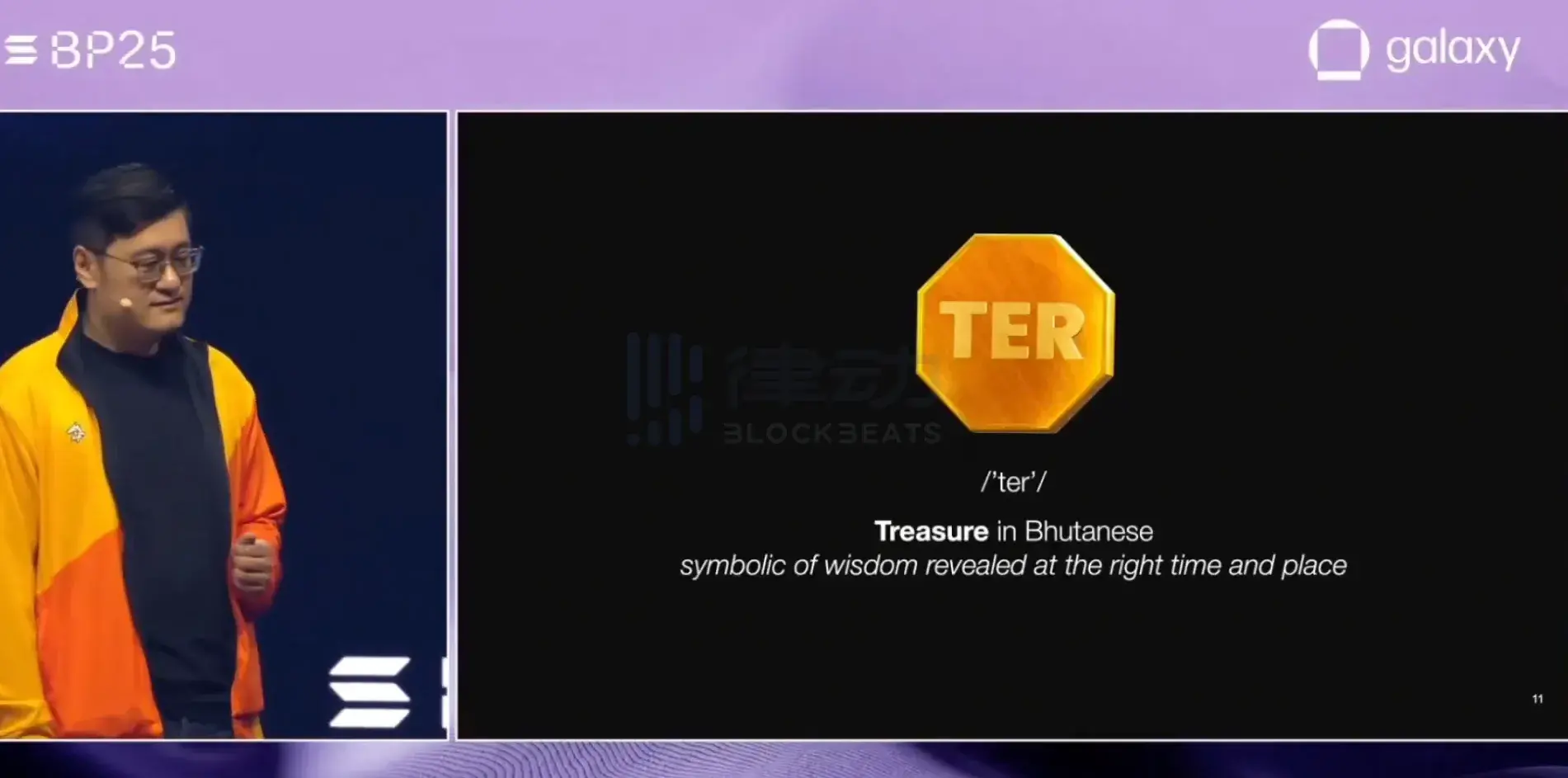
Bhutan announces launch of the world's first sovereign-backed gold token TER on Solana
On December 11, Bhutan government officials announced at Solana Breakpoint 2025 Summit another milestone cooperation with Solana, taking a key step towards making Bhutan a "crypto-friendly country":
On December 17, 2025—Bhutan National Day—the world's first sovereign-backed gold token will go live on the Solana chain. The token is called "TER," which means "treasure" in Dzongkha.
Reportedly, TER will be a 1:1 SPL token pegged to Bhutan's national treasury gold, with real-time auditability and second-level settlement, entering the on-chain world for the first time.
Solayer mainnet Alpha version officially launched, supports real-time financial applications
On December 11, Solayer officially released its InfiniSVM mainnet Alpha version. InfiniSVM is a hardware-accelerated blockchain capable of sustained throughput of 300,000 transactions per second and sub-second finality. The network enables developers to deploy existing Solana applications while achieving superior performance, unlocking use cases in high-frequency trading, real-world assets, and institutional finance.
Users can connect SOL via sBridge and immediately interact with deployed applications. Developers can access documentation and deployment tools to start building on InfiniSVM.
This release coincides with Solana Breakpoint in Abu Dhabi, marking Solayer's integration into the Solana ecosystem and its commitment to supporting it, while continuously expanding its capabilities in demanding application categories.
Galaxy Founder: Solana is still seen as a blockchain network "born for capital markets"
On December 11, Galaxy founder and CEO Mike Novogratz stated at Solana Breakpoint:
"As regulation becomes clearer, the industry has entered a stage where we must truly build products that users will use. The value of crypto assets is driven by both community and real growth, and the narrative must be supported by real usage and innovation. Solana has high-speed performance and is seen as a chain 'born for capital markets.' Galaxy's cooperation with Jump is also based on its capabilities in high-frequency infrastructure.
The crypto market has been volatile this year, but I personally remain optimistic. Just this year, a Galaxy client completed a $9 billion bitcoin sell-off, with early investors cashing out some profits to diversify their portfolios. Meanwhile, a steady stream of new entrants continues to buy bitcoin. I've been attending conferences in Abu Dhabi for the past few days, which has further strengthened my optimistic outlook. Abu Dhabi Finance Week brings together top investors from around the world, including capital giants. After communicating with these industry leaders, I'm even more convinced: the global wave of embracing blockchain and digital assets is accelerating, not slowing down."
Kyle Samani explains Solana ACE: Will allow developers to specify custom sorting rules
On December 11, Multicoin co-founder and Forward Industries (FORD) Board Chair Kyle Samani stated at Solana Breakpoint: ACE (Application-Controlled Execution) will allow developers to specify custom sorting rules, while still operating on a single global system with a global liquidity pool.
As part of Solana's "Internet Capital Markets" roadmap for July 2025, ACE grants smart contracts millisecond-level control over transaction ordering, combining traditional financial microstructure with blockchain scalability to reduce fragmentation in DeFi.
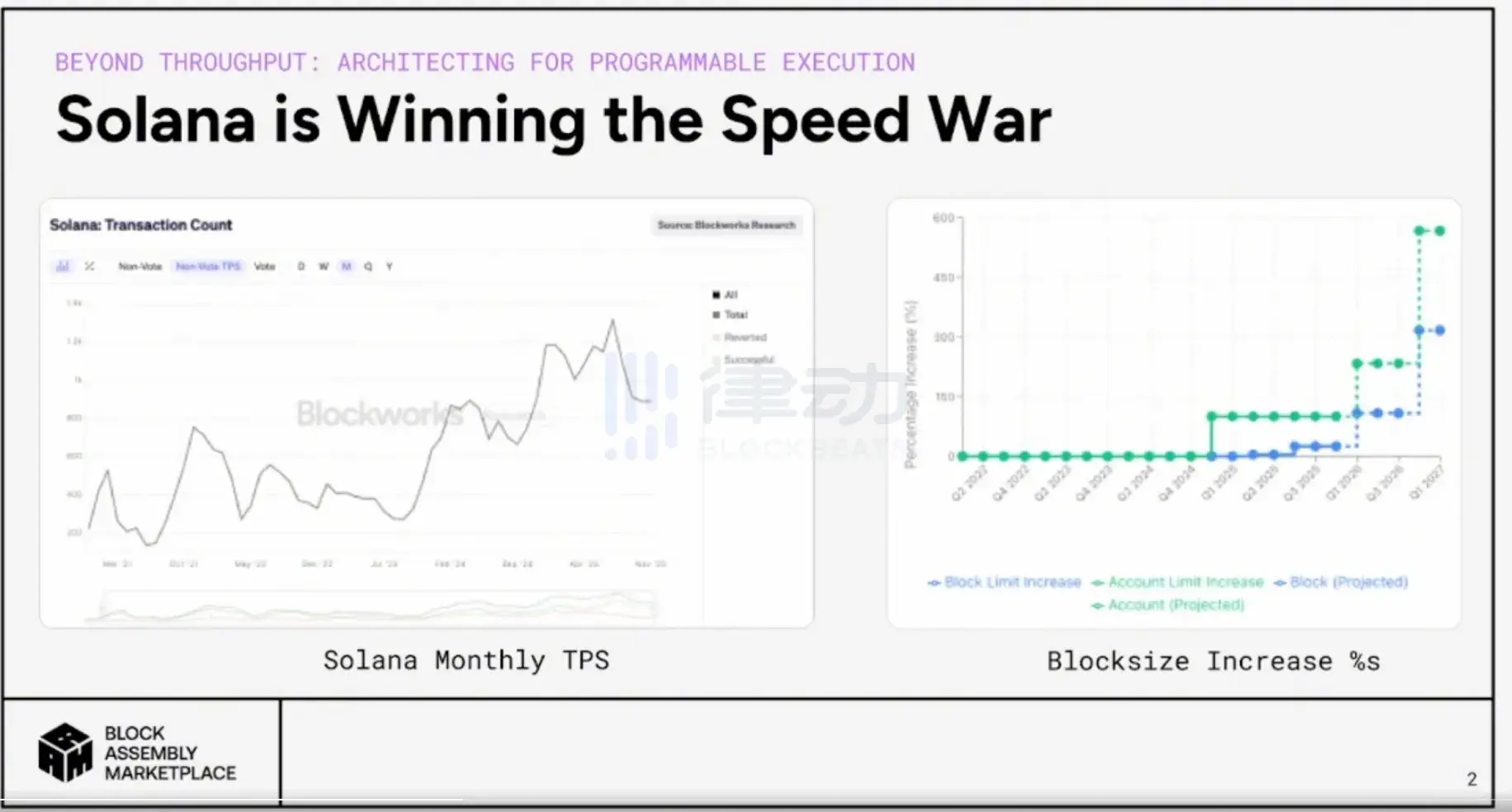
Jito Co-founder: Solana is winning the speed war, network block compute limit to jump to 100 million compute units early next year
On December 11, Jito co-founder and CEO buffalu stated at Solana Breakpoint that Solana is winning the speed war, and this is already very clear. "Over the past few years, we've seen a 6x increase in transactions per second, thanks to the joint efforts of all Solana ecosystem engineers and excellent application developers.
In the chart on the right, you can see the continuous growth of block space over the past few years. At the beginning of this year, Solana's per-block compute limit was about 48 million compute units, then increased to 50 million, 60 million compute units. It is expected to jump to 100 million compute units early next year and continue to grow exponentially."