
Bitcoin: Strategy Falls, but Cantor Still Believes

In the midst of crypto turmoil, Cantor Fitzgerald surprises. The investment bank has drastically lowered its price target for Strategy, while stating that fears of forced liquidation are exaggerated. A decision that raises questions, since Strategy bets everything on bitcoin. What lies behind this downward revision, and what are the real risks for investors?

In brief
- Cantor Fitzgerald reduces its price target for Strategy (MSTR) by 60%, from $560 to $229.
- Strategy has $1.44 billion in cash, enough to cover its dividends for 21 months, limiting the risks of forced sales of its 650,000 bitcoins.
- Bitcoin remains decisive: its price movement will determine MSTR’s valuation and the outcome of risks related to exclusion from MSCI indices.
Cantor Fitzgerald halves its target for Strategy
Cantor Fitzgerald has shaken the markets by lowering its price target for Strategy from $560 to $229, a drop of 60%. A rare decision, even in as volatile a sector as crypto. This revision comes as Strategy’s (MSTR) stock has lost 35% since the beginning of the year and 27% in the last month. With a market cap of $53 billion, the company holds over 650,000 bitcoins, valued at about $55.7 billion at the current price.
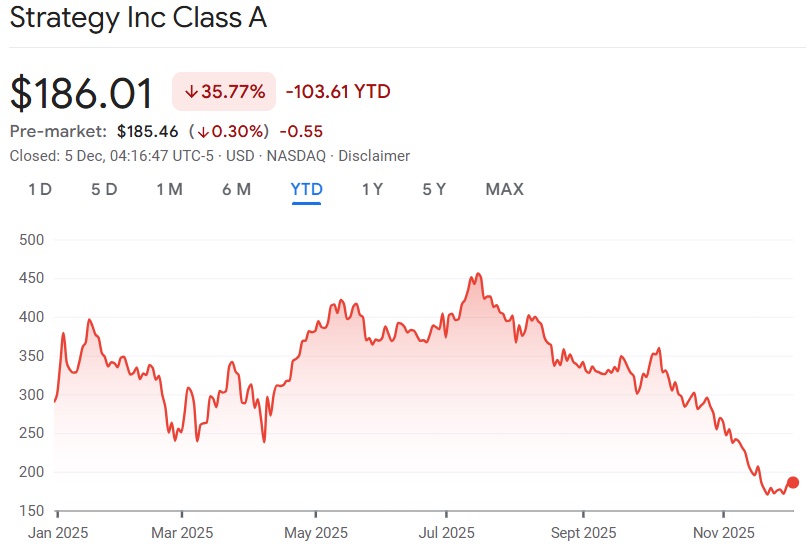 Strategy (MSTR) stock plunges.
This 60% cut by Cantor Fitzgerald on MSTR is partly explained by bitcoin’s price falling from $126,000 in October to about $86,000 in early December 2025. Worse yet, Strategy faces a major regulatory risk. MSCI is considering excluding companies with more than 50% of assets in crypto. This decision could trigger forced sales of MSTR worth $2.8 billion.
Strategy: why Cantor remains optimistic despite everything
Despite the drastic revision of its price target, Cantor Fitzgerald maintains an optimistic view on Strategy. The bank highlights several key strengths of the company, notably:
- The $1.44 billion cash reserve, raised in fiat currency and not in bitcoin;
- The ability to issue new shares to fund itself, reducing the risk of forced sales of its BTC holdings;
- The “leveraged bitcoin beta” of Strategy, a stock whose valuation almost entirely depends on bitcoin’s price.
Furthermore, Cantor Fitzgerald notes that liquidation fears would only be justified in an extreme bitcoin crash, with a 90% drop! A scenario analysts at the bank consider unlikely. Moreover, the bank views the recent correction as a healthy consolidation phase, necessary before a sustainable recovery.
Bitcoin: how its price dictates market decisions
Bitcoin’s price plays a central role in stock valuations, and Strategy is a perfect example. The correlation between BTC and MSTR prices is striking: when bitcoin falls, MSTR collapses. In November 2025, record outflows of $3.6 billion from bitcoin ETFs accelerated the decline of MSTR and the entire crypto sector. This dynamic shows how much bitcoin influences investors’ and analysts’ decisions.
Additionally, analysts’ decisions and indices like MSCI are directly influenced by bitcoin’s volatility. Therefore, a price recovery above $100,000 could revive MSTR and ease regulatory fears. Conversely, another decline would worsen pressure on Strategy and speed up its exclusion from indices.
Cantor Fitzgerald sent a clear message: Michael Saylor’s company is not in immediate danger, but its future remains closely tied to bitcoin’s. Between strong liquidity and regulatory risks, the company embodies the challenges and opportunities of a maturing crypto market. And you, would you be ready to bet on Strategy despite the uncertainties?
Disclaimer: The content of this article solely reflects the author's opinion and does not represent the platform in any capacity. This article is not intended to serve as a reference for making investment decisions.
You may also like
The Growing Buzz Around Momentum (MMT) Token: Could This Be the Next Major Opportunity in Crypto Investments?
- Momentum (MMT) token surged 4,000% post-2025 TGE, driven by exchange listings and speculative demand, despite a 70% correction. - Institutional adoption accelerated by $10M HashKey funding and regulatory frameworks like MiCAR, while Momentum X targets RWA tokenization. - Retail investors face volatility risks from leveraged trading and token unlocks, contrasting institutions' focus on compliance and stable exposure. - Technical indicators show mixed outlook, with RSI suggesting potential bullishness but

Tech Learning as a Driver of Progress in 2025
- Global demand for AI, cybersecurity, and data science education drives enrollment surges, with U.S. AI bachelor's programs rising 114.4% in 2025. - Institutions innovate through interdisciplinary STEM programs and digital ecosystems, addressing workforce gaps with AI ethics and immersive tech integration. - Education-tech stocks gain traction as hybrid learning models and AI-driven platforms align with $4.9 trillion digital economy growth and rising cybersecurity job demand. - Federal funding challenges

TWT's Tokenomics Revamp for 2025: Supply Structure Adjustment and Lasting Value Impact
Aster DEX: Connecting Traditional Finance and DeFi by Streamlining Onboarding and Encouraging Institutional Participation
- Aster DEX bridges TradFi and DeFi via a hybrid AMM-CEX model, multi-chain interoperability, and institutional-grade features. - By Q3 2025, it achieved $137B in perpetual trading volume and $1.399B TVL, driven by yield-bearing collateral and confidential trading tools. - Institutional adoption surged through compliance with MiCAR/CLARITY Act, decentralized dark pools, and partnerships with APX Finance and CZ. - Upcoming Aster Chain (Q1 2026) and fiat on-ramps aim to enhance privacy and accessibility, pos

Trending news
MoreCrypto prices
More





