
Vanguard ‘Degen Effect’ Fuels 10% Surge for Bitcoin in Explosive Rebound

Bitcoin (BTC) price surged more than 6% on Wednesday, pushing toward the $94,000 threshold during the early hours of the Asian session. It comes just hours after Vanguard lifted its long-standing ban on trading Bitcoin ETFs. The sudden rally triggered one of the strongest intraday moves of the quarter, raising new questions about how much
Bitcoin (BTC) price surged more than 6% on Wednesday, pushing toward the $94,000 threshold during the early hours of the Asian session. It comes just hours after Vanguard lifted its long-standing ban on trading Bitcoin ETFs.
The sudden rally triggered one of the strongest intraday moves of the quarter, raising new questions about how much conservative capital may now flow into crypto markets.
A Sudden Bitcoin Price Spike as Vanguard Flips Its Crypto Stance
The Bitcoin price surged above $93,000 on Wednesday, adding over $200 billion to its market capitalization in 36 hours.
The surge began during the US opening on Tuesday. It put Bitcoin on track for its biggest daily gain since May 2021, as the pioneer crypto approached $91,000, with levered short liquidations surging.
According to ETF analyst Eric Balchunas, this surge is attributed to the “Vanguard Effect,” which occurred on the first day after the firm lifted its ETF ban.
THE VANGUARD EFFECT: Bitcoin jumps 6% right around US open on first day after bitcoin ETF ban lifted. Coincidence? I think not. Also $1b in IBIT volume in first 30min of trading. I knew those Vanguardians had a little degen in them, even some of the most conservative investors…
— Eric Balchunas (@EricBalchunas) December 2, 2025
As BeInCrypto first reported on December 1, Vanguard has ended its years-long crypto ban. Now, it allows trading of Bitcoin, Ether, XRP, Solana, and other regulated crypto ETFs and mutual funds.
This marks a dramatic departure from its previous position. For years, Vanguard executives have argued that crypto lacks intrinsic value, produces no cash flows, and does not fit long-term retirement strategies.
The firm rejected Bitcoin ETFs after their January 2024 debut and even restricted customer purchases of competing funds. However, from as early as January 2024, analysts predicted the firm would soften its stance.
“Vanguard’s anti-bitcoin ETF stance is totally on brand and would’ve made Bogle proud. That said, I think they will soften in the coming years as they build their advisory business; they’ll need to have access to alternative asset classes,” Balchunas said in a January 13, 2024, post.
Notably, its restrictive stance had compelled many Vanguard customers to redirect their funds to alternative firms. The backlash from clients was swift and decisive, with Vanessa Harris, a former Vanguard client, sharing her experience.
“Just fully transferred my retirement account from Vanguard to Fidelity because Vanguard won’t support Bitcoin ETFs, and appears to be manipulating the price of Bitcoin by only allowing people to sell GBTC, not buy,” Harris said.
The post has since been taken down.
Nonetheless, sustained customer demand, combined with Bitcoin ETFs becoming one of the fastest-growing product categories in US fund history, has forced a strategic reassessment.
Vanguard now says Bitcoin and crypto ETFs have been “tested and performed as designed through multiple periods of volatility.”
While the firm still refuses to launch its own crypto products or support meme coin-linked funds, opening access alone represents one of the most significant institutional shifts of 2025.
Institutional Momentum Surges Through IBIT and Vanguard
Balchunas highlighted that BlackRock’s IBIT ETF reached $1 billion in trading volume within the first 30 minutes, with Vanguard saving Bitcoin just before the Christmas holiday, when trading momentum typically begins.
Vanguard saving bitcoin was not on my 2025 bingo card I can tell you that
— Eric Balchunas (@EricBalchunas) December 2, 2025
The wave of inflows was not limited to Balchunas’ observations. Analyst Crypto Rover said the price action was no mystery.
“This is why bitcoin pumped… Vanguard just lifted its Bitcoin ETF ban reversal, and a wave of new institutional investors rushed in through BlackRock’s $IBIT ETF. BlackRock’s $IBIT alone hit over $1.8 billion in trading volume within the first two hours,” he wrote.
Separately, market watcher Vivek Sen reported that Bitcoin ETF volume on Vanguard surpassed $1 billion within the first 30 minutes, describing the surge as “wild.”
These rapid inflows suggest that a portion of previously blocked demand, comprising conservative, retirement-oriented investors who could not access Bitcoin ETFs, may have entered the market as soon as the restriction disappeared.
One-Off Burst or the Start of a Larger Trend?
Despite the excitement, analysts remain divided on whether Vanguard’s reversal marks a structural shift. When asked whether this is a short-term effect after the ban is lifted, or if it is the beginning of a systemic flow of conservative capital into Bitcoin ETFs, Balchunas urged caution.
“I doubt it. I think there’s a small % of ppl who were pent up. And it’s good to be on the platform and available. You never know when others may allocate. That said, you can’t rely on ETF Boomers for everything,” he warned.
The remark highlights a key tension, that while institutional-grade access is expanding, the long-term behavior of traditional investors remains uncertain.
Bitcoin, Ethereum, XRP, and Solana, among cryptocurrencies featured in Vanguard’s new pivot, are rallying. BTC was trading for $93,562 as of this writing, up by nearly 10% in the last 24 hours.
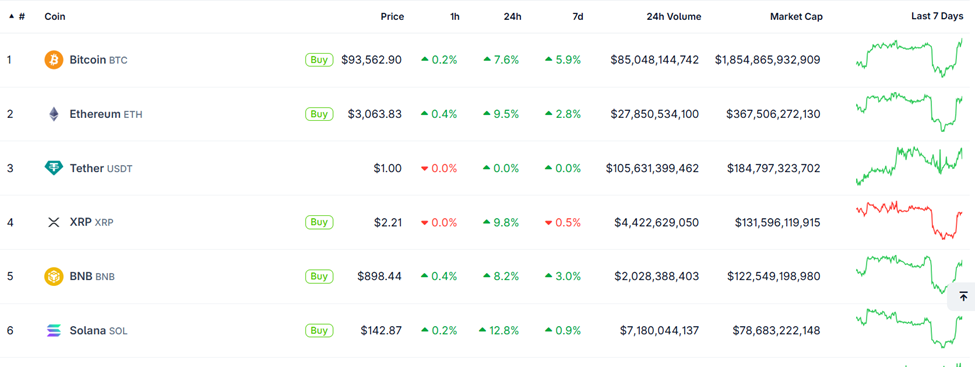 Bitcoin and altcoins’ price performances. Source:
If conservative capital continues to flow into IBIT and other spot ETFs, the market could enter a new phase of liquidity expansion. However, if this spike was merely the release of pent-up demand, momentum may cool quickly.
Either way, Vanguard’s reversal ensures that the wall between traditional finance and crypto just got much thinner, and investors are reacting fast.
Disclaimer: The content of this article solely reflects the author's opinion and does not represent the platform in any capacity. This article is not intended to serve as a reference for making investment decisions.
You may also like
Investing in Educational Technology as Demand for AI and STEM Expertise Grows
- Global EdTech market valued at $277.2B in 2025 is projected to surge to $907.7B by 2034, driven by AI integration in personalized learning and VR/AR tools. - Investors prioritize platforms aligning academic programs with AI/STEM workforce needs, achieving 20-75% higher ROI through systemic AI adoption across institutions. - Case studies like MIT's $350M AI college and OpenClassrooms' 43,000 career-advancing learners demonstrate scalable ROI from workforce-aligned education models. - Despite uneven AI int

Zcash’s Unpredictable Rise: Immediate Drivers and Future Outlook for Privacy
- Zcash (ZEC) rebounded 20% after a 55% drop, testing $375 as liquidity events and technical indicators fueled short-term optimism. - RSI/MACD signals suggest potential $475 breakout if bulls reclaim $375, though ZEC remains 57% below its 2025 peak. - Institutional adoption grows with Grayscale Zcash Trust assets surging 228%, driven by optional privacy tech attracting both retail and institutional users. - Regulatory scrutiny under MiCA and FinCen rules, plus Zcash's hybrid privacy model vs. Monero/Dash,

Zcash Halving and Its Impact on the Cryptocurrency Market
- Zcash’s 2028 halving will reduce block rewards by 50%, mirroring Bitcoin’s scarcity-driven model. - Historical data shows pre-halving price surges, fueled by FOMO and social media-driven hype cycles. - Behavioral economics highlight crypto markets’ reliance on narratives over fundamentals, with sentiment driving 30% of short-term price swings. - Zcash faces adoption challenges despite robust privacy tech, as regulatory uncertainty and competition limit its market share growth. - The 2028 event tests whet

Algo Slips 0.22% as Market Volatility and Investor Lawsuits Intensify
- ALGO fell 0.22% on Dec 7, 2025, marking a 60.15% annual decline amid broader market turbulence. - Investor lawsuits against Alvotech (ALVO) and agilon health (AGL) triggered 34-51.5% stock drops over alleged misrepresentations. - Rising litigation in healthcare/biotech sectors highlights investor demands for corporate transparency and regulatory compliance. - ALGO's decline reflects sector-wide risk aversion rather than direct legal ties, with analysts predicting prolonged caution until regulatory clarit

Trending news
MoreCrypto prices
More





