
Crypto on-chain activity surges as active users hit 70M, a16zcrypto reveals

A16zcrypto says active crypto users are now around 70 million, up 10 million from last year, showing more people are actually using crypto. And adoption is picking up everywhere, with wallets booming in emerging markets more than anywhere else.
- Andreessen Horowitz’s crypto arm estimates that active crypto users have grown to 40-70 million, up 10 million from last year, signaling a shift from passive ownership to regular on-chain activity.
- Adoption is rising globally, with mobile wallets booming in emerging markets and trading activity leading in developed nations, while Bitcoin, Ethereum, and Solana see renewed engagement from users and developers.
- Institutional adoption and stablecoins are transforming finance, with billions flowing through exchange-traded products and over $150 billion in U.S. Treasuries held on-chain, highlighting crypto’s expanding role in global money flows.
Andreessen Horowitz ‘s crypto-focused investment arm, a16zcrypto, says the crypto market is quietly carving out more room at the global finance table than many outside the industry might expect.
In a recent “State of Crypto 2025” report , the firm estimated there’re roughly 40-70 million active crypto users, representing an increase of about 10 million over the past year, based on an updated methodology.
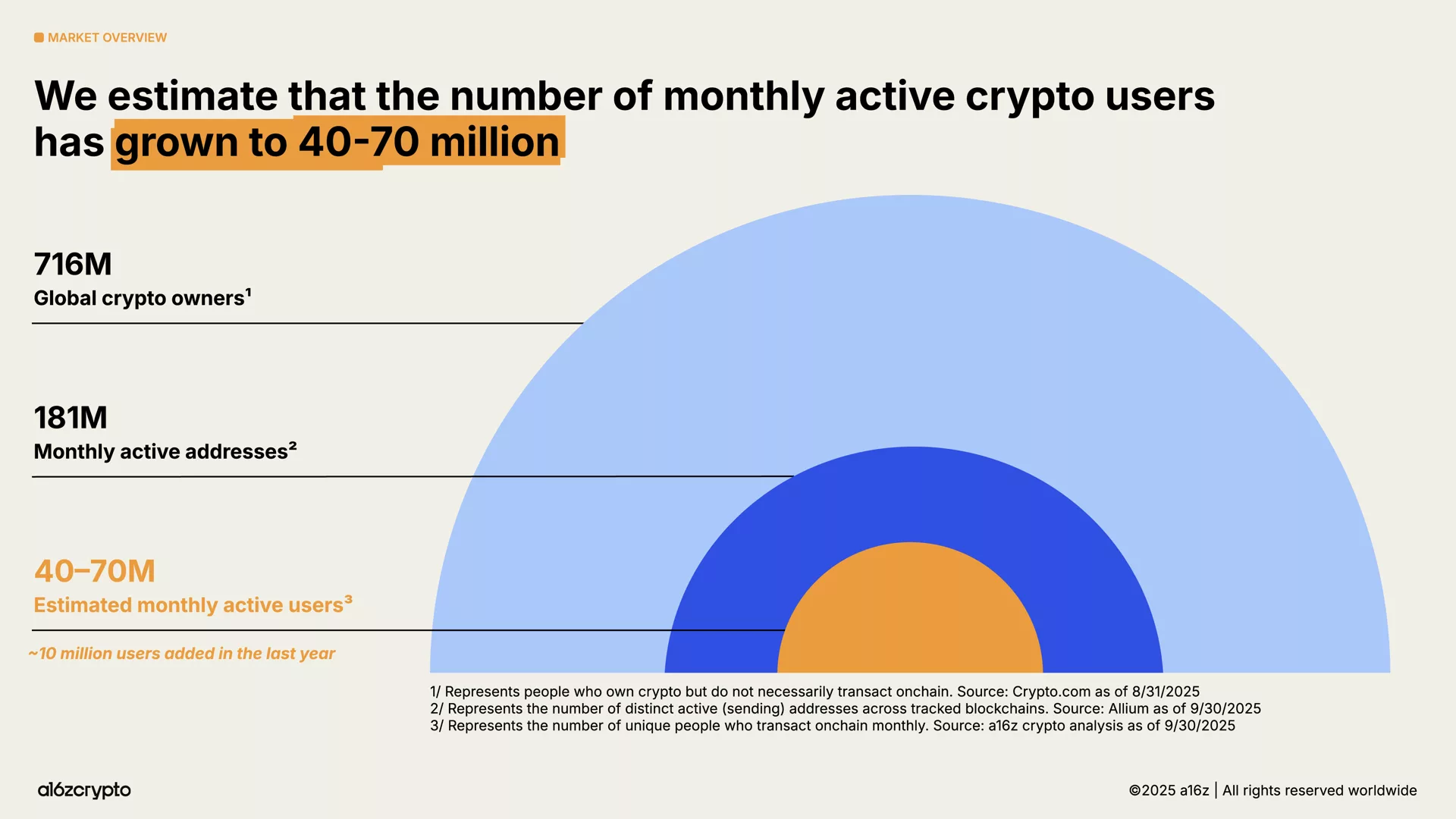 The number of monthly crypto users | Source: a16zcrypto
While this remains a small fraction of the 716 million people who own crypto, the crypto-focused arm suggested it signals the market is moving beyond passive ownership into more regular, on-the-ground activity.
“Crypto is global, but different parts of the world appear to use it in different ways. Mobile wallet usage, an indicator of onchain activity, is growing fastest in emerging markets like Argentina, Colombia, India, and Nigeria.”
Meanwhile, token-related web traffic points to a different type of user in developed nations. Australia and South Korea show heavy engagement with trading and speculation rather than pure transactional activity, the data reveals.
 The number of monthly crypto users | Source: a16zcrypto
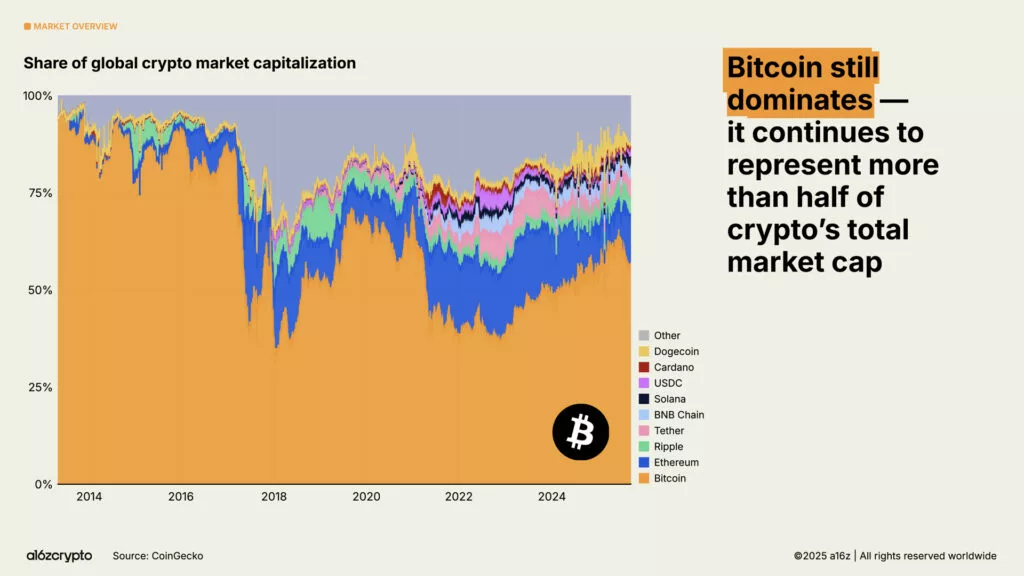
This growing user activity is mirrored in the market itself. Bitcoin ( BTC ) remains dominant, crossing $126,000 and capturing more than half of crypto’s market cap. Ethereum ( ETH ) and Solana ( SOL ) are clawing back from their post-2022 slumps.
“Hyperliquid and Solana account for 53% of revenue-generating economic activity today, a significant departure from the dominance of Bitcoin and Ethereum in previous years.”
a16zcrypto
Developers and institutions
On the developer side, a16zcrypto said Ethereum and its Layer-2 networks remain the top destination for new builders, while Solana has seen builder interest rise 78% over the past two years.
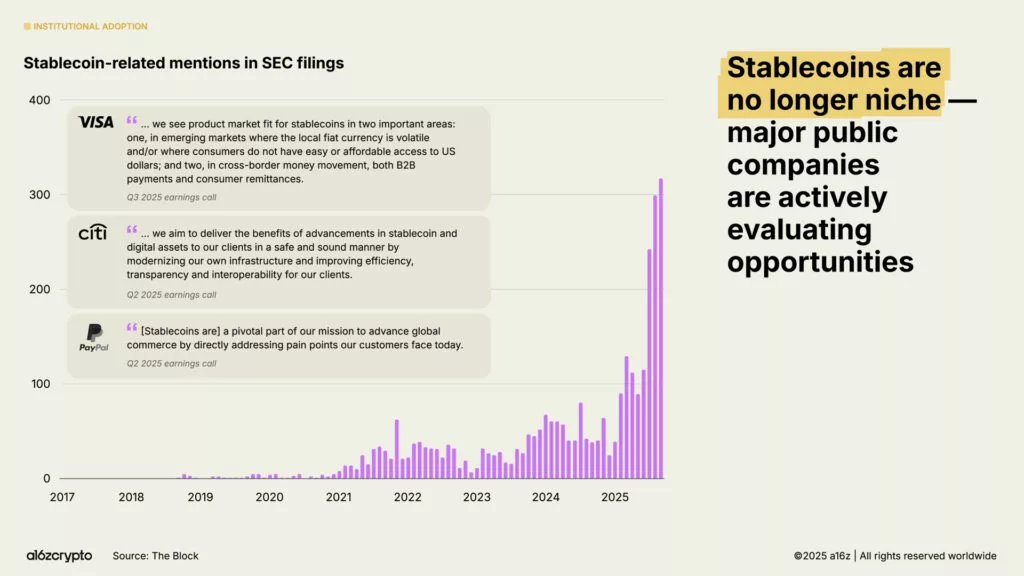
Institutional adoption, the firm added, is no longer a matter of speculation as major banks and fintechs are rolling out crypto products, from Circle’s billion-dollar IPO to JPMorgan and Visa integrating digital assets alongside equities and ETFs.
“Mentions of stablecoins in SEC filings have grown 64%, and a flurry of announcements have continued to follow from major financial institutions.”
a16zcrypto
Exchange-traded products are unlocking billions of institutional dollars, while publicly traded “digital asset treasury” companies now collectively hold around 10% of both Bitcoin’s and Ethereum’s token supplies.
Stablecoins are now here
Stablecoins , a16zcrypto said, have become the backbone of the on-chain economy. The report indicated that stablecoins have done $46 trillion in total transaction volume in the last year, up 106% from the previous year.
Adjusted for organic activity, that amounts to $9 trillion, more than five times PayPal’s throughput and over half of Visa’s. Monthly adjusted stablecoin transaction volume reached $1.25 trillion in September alone, a figure largely uncorrelated with trading volume, underscoring real-world use beyond speculation.
 Stablecoin adoption over the years | Source: a16zcrypto
The rise of stablecoins is reshaping dollar dynamics. They now hold more than $150 billion in U.S. Treasuries, more than many sovereign nations. Per the data, over 99% of stablecoins are denominated in U.S. dollars, and they are projected to grow 10x to more than $3 trillion by 2030, offering a new, on-chain source of demand for U.S. debt even as foreign central bank holdings falter.
So, in other words, crypto’s footprint is expanding. From the wallets in Argentina to Wall Street boardrooms, it’s starting to matter where it counts: in the flow of money itself.
Disclaimer: The content of this article solely reflects the author's opinion and does not represent the platform in any capacity. This article is not intended to serve as a reference for making investment decisions.
You may also like
Zcash Halving and Its Impact on Cryptocurrency Market Trends
- Zcash's 2028 halving will cut block rewards to 0.78125 ZEC, continuing its deflationary supply model to reduce annual inflation to 2%. - Historical data shows halvings trigger extreme volatility, with ZEC surging 1,172% in 2025 but collapsing 96% within 16 days. - Institutional adoption grows via $137M Grayscale Zcash Trust, yet EU's MiCA regulations challenge privacy coins' compliance with transparency rules. - Future success depends on balancing privacy features with regulatory adaptability as Zcash's

Emerging Prospects for Industrial Real Estate in Webster, NY
- Webster , NY, is transforming its industrial real estate through the $9.8M FAST NY Grant, upgrading infrastructure on a 300-acre Xerox brownfield into a high-tech hub. - The initiative aims for a 2% industrial vacancy rate by 2025, boosting residential property values by 10.1% and attracting projects like the $650M fairlife® dairy facility. - Xerox campus reconfiguration and 600 Ridge Road redevelopment, supported by state programs, create shovel-ready spaces with modern infrastructure for advanced manuf

Why Solana's Latest Plunge Highlights Underlying Weaknesses in the Crypto Market
- Solana's 57% price crash in Nov 2025 exposed systemic crypto vulnerabilities, including psychological biases, excessive leverage, and fragile infrastructure. - Token unlocks from Alameda/FTX estates and $30M selling pressure triggered the downturn, yet $101.7M in institutional inflows highlighted market paradoxes. - Fed rate cuts drove $417M into Solana ETFs, but uncertainty caused 14% price drops, revealing crypto's growing integration with traditional finance. - $19B in liquidations during the Oct 11 "

The Growing Impact of Security Systems Technology on the Future Development of Higher Education Infrastructure
- 21st-century higher education infrastructure increasingly relies on advanced security systems to address cyberattacks and campus safety threats. - AI and zero-trust architectures enable proactive threat detection, with 80% of institutions adopting zero-trust strategies by 2025. - Integrated security investments boost enrollment, research credibility, and institutional reputation, though skill gaps and outdated infrastructure hinder full implementation. - ROI extends beyond cost savings, with 60% of stude

Trending news
MoreCrypto prices
More





