
News
Stay up to date on the latest crypto trends with our expert, in-depth coverage.

OracleX is a decentralized prediction platform based on the POC protocol. It addresses pain points in the prediction market through a dual-token model and a contribution reward mechanism, aiming to build a collective intelligence decision-making ecosystem. Summary generated by Mars AI The content of this summary is produced by the Mars AI model, and its accuracy and completeness are still being iteratively improved.

The article refutes the argument that bitcoin will be replaced, highlighting bitcoin's unique value as a protocol layer, including its network effects, immutability, and potential as a global settlement layer. It also explores new opportunities for bitcoin in the AI era. Summary generated by Mars AI. This summary was produced by the Mars AI model, and the accuracy and completeness of its content are still being iteratively improved.
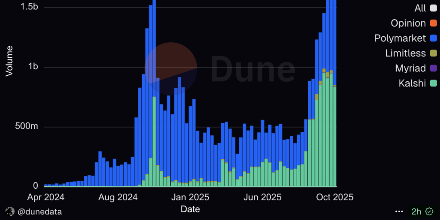
Quick Take Kalshi has tapped Solana to move its prediction markets onchain and enable permissionless monetization of its “global liquidity pool.” The move comes on the heels of Polymarket’s reentry into the U.S. and after a banner month for both platforms.

Quick Take Forward Industries has hired former ParaFi Capital Managing Director Ryan Navi to help lead strategy amid Solana’s price declining over 40% since treasury was formed. ParaFi Capital has invested in multiple Solana DATs including Forward, Sharps Technology, and Sol Strategies.

Quick Take BitMine has accumulated nearly 100,000 ETH in the past week, stepping up weekly buying by 39%. ETH’s 30% monthly decline has pushed BitMine’s treasury value down from nearly $14 billion in October to about $9.7 billion. The company will hold its annual shareholder meeting on Jan. 15, 2026, at the Wynn Las Vegas.

Quick Take South Korea’s ruling Democratic Party is pushing the government to submit its stablecoin bill by Dec. 10. The party aims to pass the bill into law by January, according to a local media report.

- 02:09US OCC Chief: No reason to treat banks and crypto institutions differentlyJinse Finance reported that Jonathan Gould, the head of the US Office of the Comptroller of the Currency (OCC), stated that crypto companies applying for federal banking licenses should receive “equal treatment” as traditional institutions, with no reason for artificial regulatory distinctions. He noted that digital asset custody and secure storage are not new concepts, and that electronic business in this area “has continued for decades.” Gould emphasized that the banking system is capable of evolving “from the telegraph era to the blockchain era” and should not be confined to outdated technological and business frameworks. He revealed that the OCC has received 14 new bank applications this year, including new business entities involving digital assets, which is nearly equal to the total number of similar applications over the past four years, indicating a significant rise in demand. Gould believes that allowing institutions engaged in crypto and innovative technologies to obtain federal regulation is a necessary path to ensure the financial system continues to keep pace with the modern economy. He also responded to concerns from some banks about crypto companies obtaining licenses, stating that the regulatory framework is fully capable of supervising them.
- 01:58Cardano founder says the quantum threat to cryptocurrencies is overhypedOn December 9, according to beincrypto, Cardano founder Charles Hoskinson stated that the threat of quantum computing to blockchain is exaggerated and not urgent at present. He pointed out that the industry already knows how to build quantum-resistant systems, but quantum-safe protocols run 10 times slower and cost 10 times more, and no network is willing to sacrifice throughput. Hoskinson said that before the National Institute of Standards and Technology (NIST) establishes post-quantum cryptography standards (FIPS203-206), the industry cannot rashly adopt algorithms that may be deprecated. He cited the US Defense Advanced Research Projects Agency (DARPA) Quantum Blockchain Initiative (QBI), saying that the project is evaluating whether large-scale practical quantum computers can be realized before 2033, and that real quantum pressure is expected to emerge in the 2030s.
- 01:48PayPal stablecoin market cap to reach $4 billion, driven by DeFi protocolsAccording to ChainCatcher, citing DL News, the circulating supply of PayPal's stablecoin PYUSD has surged by 224% since September, surpassing $3.8 billion and becoming the sixth largest stablecoin. The DeFi protocol Ethena has become the largest holder of PYUSD, holding $1.2 billion through the custodian Copper. PayPal, in cooperation with liquidity management company Sentora, provides incentives on the decentralized exchange Curve Finance and subsidizes yields for DeFi protocol users. The Solana lending protocol Kamino currently offers nearly 6% annualized yield for lending PYUSD, with part of the yield subsidized by PayPal. Over the past three months, the scale of PYUSD on Solana has increased from $250 million to over $1 billion. U.S. Treasury Secretary Scott Besant expects the stablecoin market to reach $3 trillion by 2030.