Dogecoin ETF Launch Disappoints Investors
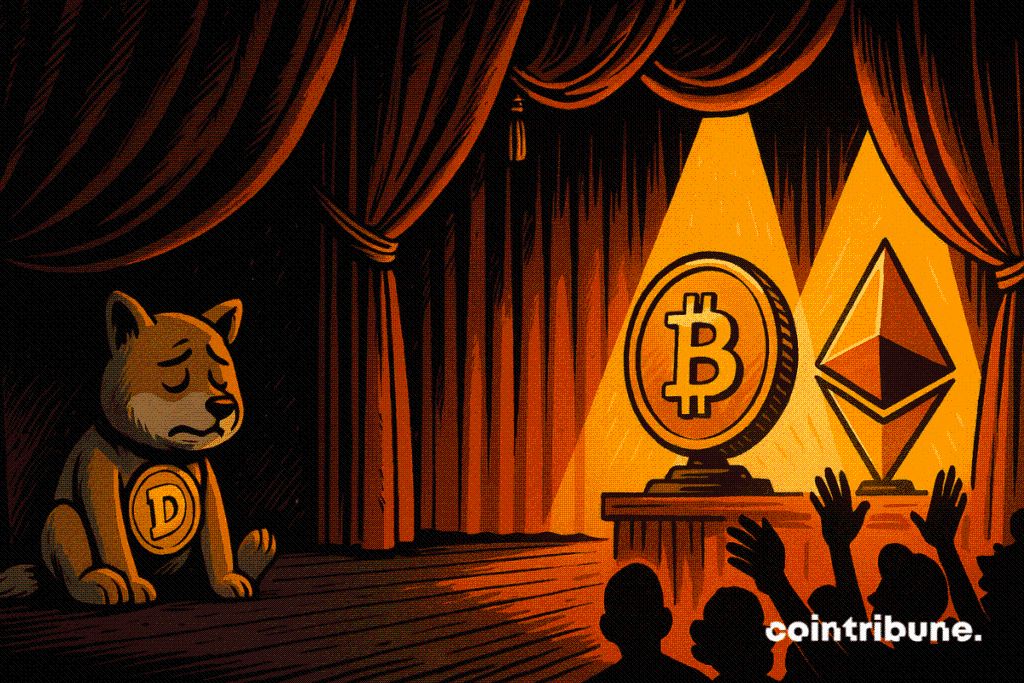
Dogecoin struggles to convince institutional investors. Despite a strong capitalization and a media-covered launch, crypto-backed ETFs show volumes in free fall. In a sector where Bitcoin and Ethereum concentrate the bulk of flows, the disinterest in DOGE illustrates the limits of assets perceived as too speculative.
In brief
- The launch of Dogecoin ETFs raised high expectations, but investor interest quickly declined.
- The total volume traded fell to $142,000, far from the $3.23 million reached at the end of November.
- Despite strong activity on the spot market, DOGE does not attract in its ETF version.
- Meanwhile, Bitcoin and Ethereum capture the bulk of ETF flows, with $3.1B and $1.3B traded respectively.
Promising start, lightning fall
On December 8, Dogecoin-backed ETFs recorded their lowest liquidity level since launch.
The total volume traded (TVT) collapsed to $142,000, a figure marking a sharp decline compared to late November days when TVT had nearly reached $3.23 million. This rapid decline comes after a promising launch.
At the market launch of the Grayscale Dogecoin Trust in November, ETF analyst Eric Balchunas expected $12 million volume on the first day. However, only $1.4 million was traded at open.
Indeed, this drop in interest contrasts with strong Dogecoin activity on spot markets. Far from being a slowing asset, DOGE recorded a 24-hour trading volume of $1.1 billion over the same period.
Market capitalization also remains solid at $22.6 billion. These data highlight a clear gap between DOGE’s popularity and the weak adoption of its ETFs. Here are possible explanations :
- Investors continue to favor direct exchanges via centralized platforms rather than regulated financial products like ETFs ;
- The speculative and community profile of DOGE may be a mismatch with asset managers’ or institutional investors’ expectations ;
- Disappointing launch volumes may have hurt operators’ confidence in the product’s viability.
This phenomenon illustrates a frequent paradox in the crypto world: an asset can be heavily traded and appreciated by the general public without succeeding in transitioning to institutional formats like ETFs.
Institutional capital converges towards major assets
While Dogecoin ETFs struggle to maintain investor attention, Bitcoin and Ethereum continue to capture the majority of flows, consolidating their status as dominant assets in the regulated ecosystem.
On December 8, Bitcoin ETFs recorded a volume of $3.1 billion, followed by Ether ETFs with $1.3 billion. Such a concentration of capital strongly contrasts with the modest performance of altcoins, still well represented as listed financial products: Solana recorded $22 million traded, XRP $21 million, Chainlink $3.1 million, and Litecoin barely $526,000.
Beyond volumes, some trends emerge. The XRP ETF continues to show positive daily net inflows since its launch, while Solana, after a $32 million outflow last Wednesday, began a new three-day inflow streak. Moreover, these elements show that despite emerging diversified offerings, demand remains focused on historical assets perceived as more stable, better understood, and easier to integrate into institutional portfolios.
This centralization of flows on Bitcoin and Ethereum underlines the importance of maturity perceived by traditional finance players. While memecoins like Dogecoin attract retail investors in unregulated markets, they still struggle to establish themselves as credible instruments in institutional financial products. In the short term, this reality could slow similar initiatives around other altcoins or memecoins, refocusing ETF issuers’ strategies on assets that are both liquid, established, and better aligned with risk management standards.





