Behind the $20 million financing, does Ostium aim to become the TradeFi king of traditional assets?

Ostium enables retail investors to use self-custody wallets to directly trade leveraged positions on traditional assets such as gold, crude oil, S&P 500, Nasdaq, Tesla, and Apple.
Ostium enables retail investors to directly trade leveraged positions on traditional assets such as gold, crude oil, S&P 500, Nasdaq, Tesla, and Apple using self-custody wallets.
Written by: 1912212.eth, Foresight News
On December 3, decentralized derivatives trading platform Ostium Labs officially announced the completion of a $20 million Series A funding round, co-led by General Catalyst and Jump Crypto, with participation from Wintermute Ventures, Coinbase Ventures, Crucible Capital, and several well-known angel investors. With this round, Ostium's total funding has reached $27.5 million, with a valuation of $250 million.
This is one of the most significant financings in the DeFi sector for 2025. Ostium’s core positioning is to “bring the world’s most liquid markets on-chain,” allowing retail investors to directly trade leveraged positions on traditional assets such as gold, crude oil, S&P 500, Nasdaq, EUR/USD, Tesla, and Apple using self-custody wallets, completely freeing them from offshore CFD brokers’ account freezes, withdrawal restrictions, and opaque pricing.
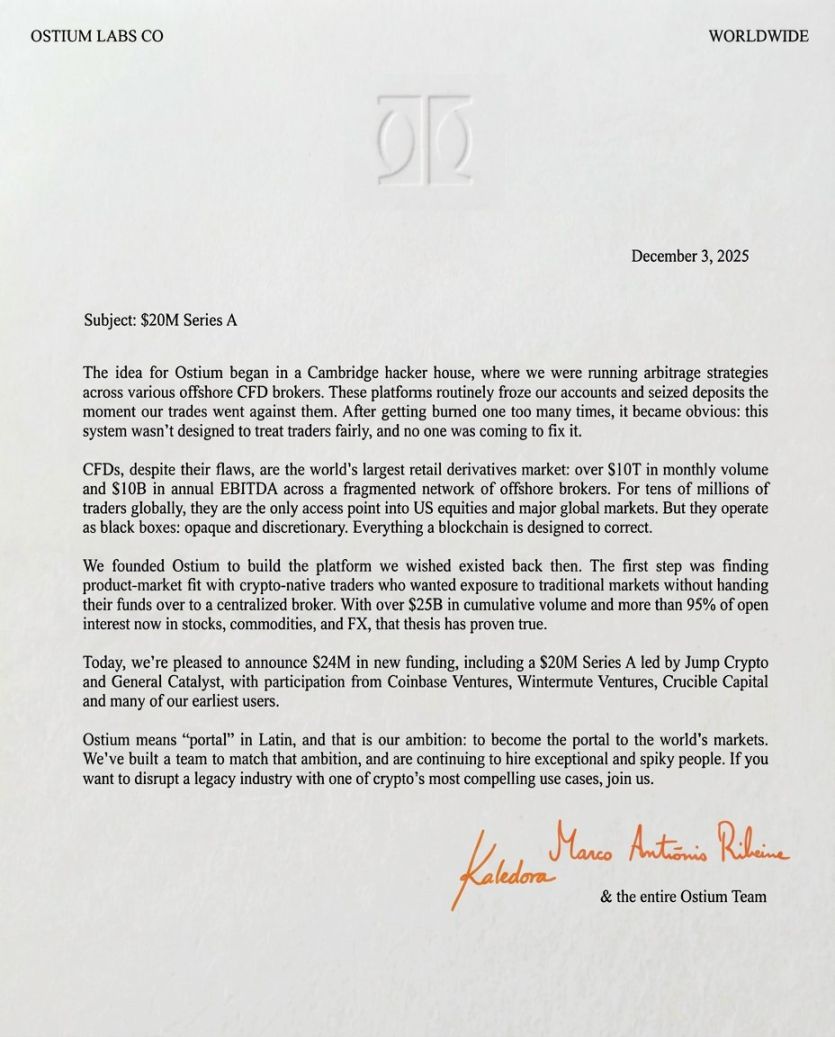
Founder Kaledora stated bluntly in the announcement: “We decided to build a transparent, self-custody, and fairly priced alternative because our accounts were repeatedly frozen and our margin was confiscated by offshore CFD platforms. Today’s funding is to build a truly global infrastructure.”
ALL IN on Traditional Assets
The Ostium protocol is an open-source, decentralized exchange on Arbitrum that enables transparent and non-custodial perpetual contract trading of real-world assets. More specifically, Ostium is building decentralized trading infrastructure that allows you to trade any asset as if you were trading perpetual contracts—all on-chain. Users can trade perpetual contracts on forex, commodities, indices, stocks, and blue-chip crypto assets.
The biggest difference between Ostium and mainstream perpetual DEXs like GMX and Hyperliquid is that Ostium has been all-in on RWA (real-world assets) from day one, completely abandoning the vAMM (virtual automated market maker) model in favor of a single-quote RFQ (Request for Quote) plus professional hedging flow hybrid architecture.
Simply put: the quotes users see come directly from professional liquidity providers (currently one hedging partner is integrated), and real market prices are anchored via a dedicated oracle, resulting in extremely tight spreads and minimal slippage. Secondly, all orders are executed, cleared, and settled entirely on-chain, with funds never leaving the user’s wallet, achieving true self-custody. Currently, over 95% of the platform’s OI is concentrated in traditional assets (gold, silver, crude oil, S&P, Nasdaq, EUR/USD, JPY/USD, Tesla, Apple, Coinbase, etc.), which is a unique phenomenon in the entire DeFi perpetual sector.
The protocol’s CTO Marco stated in the announcement that the platform’s cumulative trading volume has exceeded $25 billion, with stocks, commodities, and forex accounting for over 95% of open interest.
Main features overview:
- Up to 50x leverage (100x for some assets), supports overnight positions with no funding fee or liquidation risk (as real hedging flow takes the other side)
- Instant settlement upon closing positions, no withdrawal review required, funds return to wallet in seconds
- Cross-margin mode, allowing users to use a single USDC collateral to hold multiple positions simultaneously
- Upcoming multi-quote competition mechanism (makers will directly compete for large orders at the protocol level, with economic interests bound via native staking and slashing mechanisms)
- Newly launched ostiscan.xyz, allowing real-time viewing of protocol’s residual hedging exposure (OLP net positions) for ultimate transparency
Ostium protocol CEO Kaledora stated that the name is derived from the ancient Roman port city Ostia, and the goal is not to compete with traditional securities exchange trading protocols, but rather with global online brokers like Robinhood, eToro, and IG.
Harvard + Bridgewater + Royal Ballet Combo
The two co-founders of Ostium are arguably the most “unconventional” yet complementary entrepreneurial partners of 2025.

CEO Kaledora Fontana Kiernan-Linn was previously a quantitative researcher at Bridgewater Associates and a professional ballet dancer at the Royal Danish Ballet. She is a typical “polymath,” able to write models at a macro hedge fund and perform Swan Lake on stage. In her teens, she was admitted to the Royal Danish Ballet, where she danced for four years before attending Harvard University. At Harvard, she met co-founder Marco Antonio Ribeiro, who had competed in international Olympiads in physics, biology, and chemistry.
Co-founder and CTO Marco Antonio Ribeiro, in the early days, arbitraged CFD brokers with Kaledora at a hacker house near Harvard. A tech geek, he led the development of all Ostium smart contracts and the RFQ engine architecture. He previously served as a core developer for several DeFi protocols.
Other team members come from Bridgewater, BlackRock, Jane Street, Citadel, Two Sigma, as well as Uniswap and dYdX, with an average of over 8 years of industry experience. They are well-versed in both deep hedging in traditional markets and on-chain mechanism design. The team currently has only 15 members.
Token Launch Planned
According to the official documentation, Ostium has not yet officially launched its governance mechanism, but states that community participation is crucial to the protocol’s success and is working towards a gradual transition to increasingly community-driven governance. This governance will play a key role in Ostium protocol’s long-term development and success.
In plain terms, a token will be launched. Therefore, depositing and trading via wallet connection may come with airdrop expectations.
According to its official tweet on December 1, Ostium has distributed 500,000 points for week 35 to 1,320 traders and 3,430 liquidity providers. The week 36 points campaign is about to begin.
Disclaimer: The content of this article solely reflects the author's opinion and does not represent the platform in any capacity. This article is not intended to serve as a reference for making investment decisions.
You may also like
Last Cycle’s Signal King Murad: 116 Reasons Why the 2026 Bull Market Will Come
I do not agree with the view that the market cycle is only four years; I believe this cycle may extend to four and a half or even five years, and could last until 2026.
Ethereum completes Fusaka upgrade, team claims it can unlock up to 8x data throughput
Major upgrades, which used to take place once a year, are now happening every six months, demonstrating that the foundation still maintains strong execution capabilities despite recent personnel changes.
Glassnode: Is Bitcoin Showing Signs of a 2022 Crash Again? Beware of a Key Range
The current bitcoin market structure is highly similar to Q1 2022, with over 25% of on-chain supply in a loss, ETF capital flows and spot momentum weakening, and the price relying on key cost basis areas.

Crypto Giants Clash: Faith, Utility, and Macro